

Clearing Your Water: Understanding Planktonic and Filamentous Algae Lifecycles in Your Pond
 |

Summary:
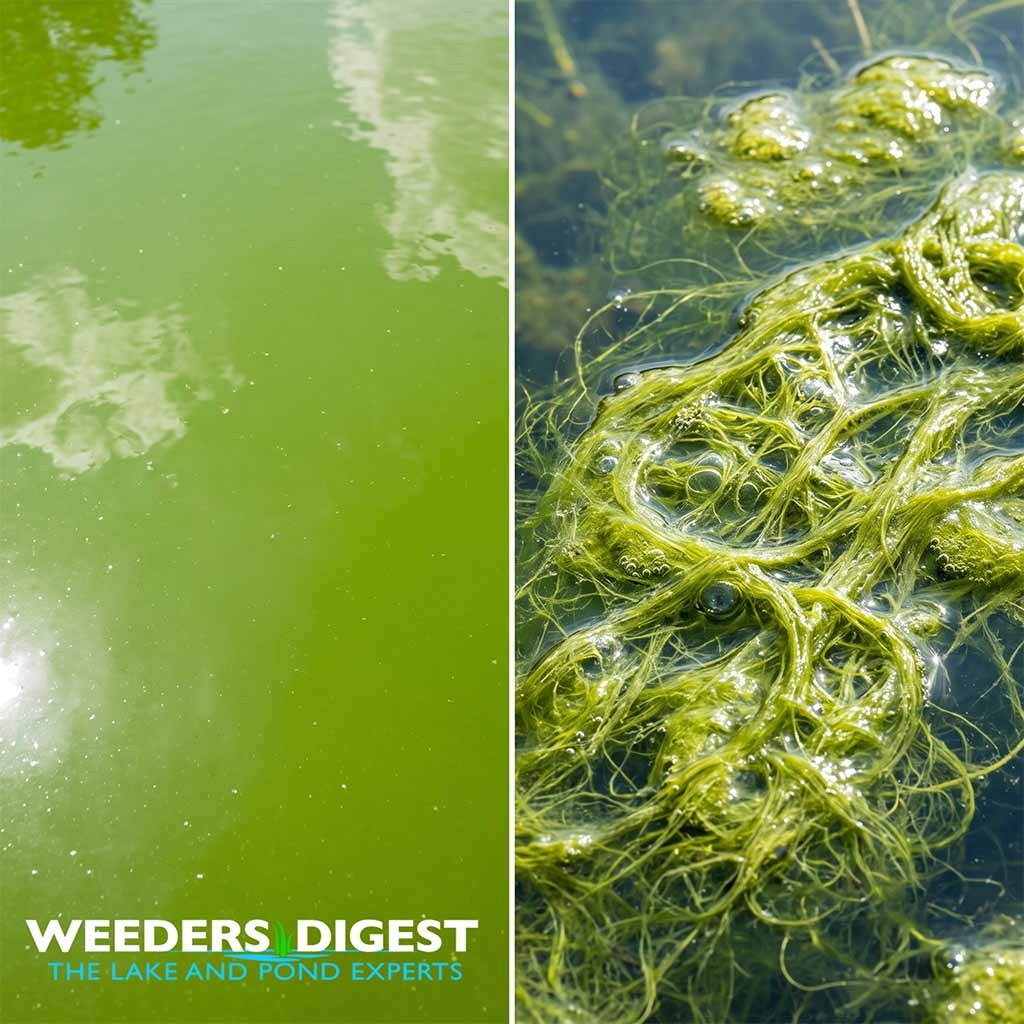
Planktonic algae are microscopic, free-floating organisms that reproduce rapidly to tint your pond water green, whereas filamentous algae are multicellular organisms that start growing on the pond floor before rising to the surface as dense, stringy mats. Understanding the difference between these two types of algae is the first and most crucial step in reclaiming the health and beauty of your waterbody. Because they live and grow in entirely different ways, treating them as if they are the exact same issue will often lead to wasted time and recurring pond problems.
As a Certified Lake Manager, I regularly visit properties where homeowners believe their pond has been completely overtaken by aggressive aquatic weeds. However, the moment I drag a rake through the water and pull up heavy, stringy clumps resembling wet green hair, I know we are dealing with filamentous algae rather than rooted plants. This field observation is common, and it drastically shifts the management strategy from weed control to targeted algae mitigation. Filamentous algae mats are tough, structurally woven, and require physical removal or specialized treatments that can penetrate their thick exterior.
Planktonic algae, on the other hand, act more like a dye in the water. These single-celled organisms thrive suspended in the water column and rely heavily on available sunlight and free-floating nutrients like phosphorus and nitrogen. When a pond gets a sudden influx of nutrients from lawn fertilizer runoff or heavy rain, planktonic algae can multiply exponentially, creating what is known as an algae bloom. Managing planktonic algae usually involves reducing these nutrient sources, increasing subsurface aeration, or applying liquid treatments that mix directly into the water column.
By contrast, the lifecycle of filamentous algae demands a different control approach. Because they sprout from tiny spores attached to rocks or debris on the pond bottom, simply treating the surface of the water often leaves the root of the problem untouched. Controlling filamentous algae usually involves mechanically skimming the mats off the surface, utilizing bottom-diffused aeration to disrupt their benthic habitat, or using granular sinking treatments that attack the algae where it originates. By properly identifying which lifecycle is dominating your pond, you can apply the exact method needed to restore water clarity.
The Science Behind It:
Planktonic algae, scientifically classified as phytoplankton, are single-celled or colonial photosynthetic organisms suspended entirely within the pelagic, or open-water, zone of aquatic ecosystems. Their lifecycle primarily revolves around rapid asexual reproduction via cellular division. Under optimal environmental conditions—specifically high solar irradiance, warm water temperatures, and elevated concentrations of nitrogen and phosphorus—planktonic algae can experience exponential growth rates. This rapid cellular division results in dense algal blooms that significantly increase water turbidity, restrict light penetration, and fundamentally alter the optical properties of the water column. Because they are unattached and free-floating, phytoplankton populations are highly sensitive to water column dynamics, hydraulic flushing, and the immediate availability of dissolved nutrients.
In contrast, filamentous algae belong to the periphyton or benthic communities and exhibit a vastly different morphological structure and reproductive lifecycle. Genera such as Spirogyra, Cladophora, and Pithophora begin their development as individual spores attached to benthic substrates, which include rocks, submerged woody debris, and nutrient-rich sediment. Through localized cellular division, these cells elongate into long, interconnected filamentous chains. As this biological mass photosynthesizes, it respires dissolved oxygen. Due to the densely woven cellular structure of the filaments, these oxygen bubbles become trapped within the algal matrix. The resulting buoyancy physically lifts these heavy mats from the benthic zone to the surface, creating thick, floating canopies that block light penetration to deeper aquatic zones and suppress submerged macrophyte growth.
Understanding these morphological and developmental differences is critical for implementing effective limnological control methods. Planktonic algae can often be managed proactively through nutrient mitigation strategies, such as watershed management, establishing vegetative buffer strips, or applying phosphorus-binding agents directly to the water column. When chemical control is necessary, liquid algaecides are typically broadcast evenly across the surface. However, treating a severe planktonic bloom carries a high risk of sudden dissolved oxygen depletion; as the massive volume of single-celled algae dies and begins to decay simultaneously, aerobic bacteria consume the available oxygen in the water, which can precipitate severe, secondary fish kills.
Filamentous algae, due to their structural density and benthic origins, present a more complex management challenge that often requires a multifaceted approach. Mechanical harvesting—physically removing the mats from the aquatic system—is highly effective for extracting organic biomass and permanently sequestering the nutrients bound within the algae. For chemical interventions, contact algaecides or copper-based treatments are heavily utilized. According to research from Oklahoma State University and Virginia Tech Extension programs, achieving a standard treatment concentration of 1 part per million (ppm) requires applying exactly 2.72 pounds of copper sulfate active ingredient per acre-foot of water, factoring in that an acre-foot of water weighs approximately 2.7 million pounds. Furthermore, data from Penn State Extension indicates that standard algaecide applications typically cost between $50 and $200 per acre of pond area, depending heavily on the severity of the infestation and the specific chemical formulations required.
For maximum efficacy, limnological treatments targeting filamentous algae must penetrate the thick cellular walls and reach the benthic layers where the initial growth originates. Aquatic biologists often recommend utilizing granular formulations that rapidly sink to the pond bottom, or injecting chelated liquid copper below the surface using weighted trailing hoses. This targeted delivery methodology ensures the active chemical ingredients interact directly with the basal cells before the mats naturally detach and float to the surface, thereby effectively interrupting the filamentous lifecycle at its earliest developmental stage.