

My Field Guide to Understanding Sediment Resuspension in Your Shallow Lake
 |
Summary:
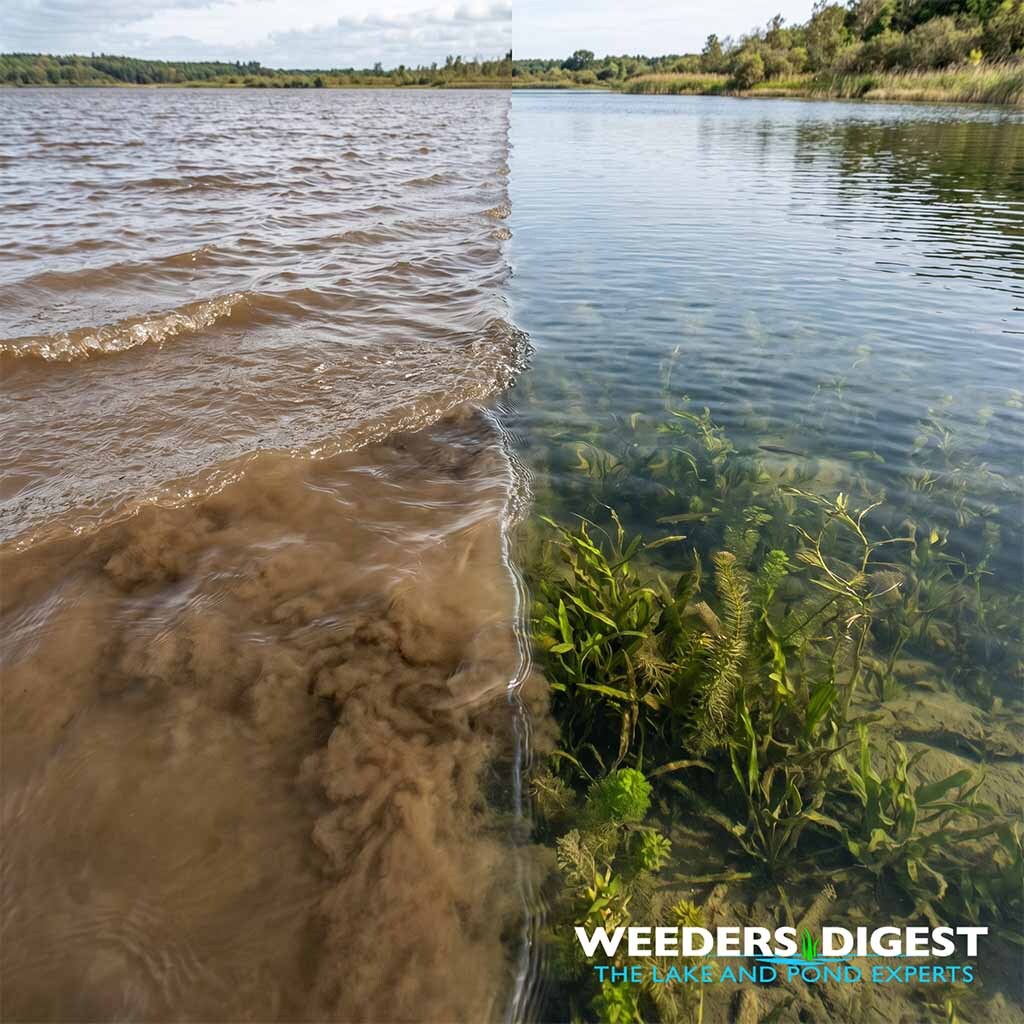
Sediment resuspension occurs when the muck, mud, and particles resting at the bottom of a shallow lake are forcefully stirred up and mixed back into the water column. In shallow waterbodies, this process is primarily driven by wind-induced waves, bottom-feeding fish, or heavy recreational boating that churn up the lakebed, creating persistently cloudy or turbid water. When these bottom sediments are disturbed, they don't just muddy the water; they also release trapped nutrients like phosphorus into the lake, which acts as a powerful fertilizer for unwanted algae blooms.
As a Certified Lake Manager, one of the most common complaints I hear from waterfront homeowners after a heavy summer storm or a busy holiday weekend of boating is that their crystal-clear lake suddenly looks like chocolate milk. I always have to explain that we aren't just looking at suspended dirt; we are witnessing decades of settled nutrients being rapidly reintroduced into the ecosystem, essentially setting the dinner table for a massive algae outbreak in the coming days.
Once the sediment is suspended, it physically blocks sunlight from reaching beneficial underwater plants. Without enough light, these native plants die off, which only makes the problem worse because their root systems are no longer there to hold the bottom sediment in place. This creates a vicious cycle where muddy water kills the plants, and the subsequent lack of plants leads to even muddier water. Over time, this shifts a healthy, clear lake into a continuously turbid, algae-dominated pond that is incredibly difficult to manage.
The Science Behind It:
The mechanics of sediment resuspension in shallow aquatic ecosystems revolve around hydrodynamics and benthic-pelagic coupling, which is the continuous exchange of energy, mass, and nutrients between the bottom substrate (benthic zone) and the main body of water (pelagic zone). When shear stress from wind waves or biological bioturbation exceeds the critical cohesive threshold of the sediment bed, particles are lifted into the overlying water. This process dramatically increases turbidity and attenuates photosynthetically active radiation (PAR), the specific wavelengths of light required for aquatic macrophytes to conduct photosynthesis. The exponential decline of irradiance with depth severely limits the growth of submerged vegetation, locking the lake into an alternative stable state dominated by phytoplankton rather than clear water and complex flora.
A primary consequence of this physical disturbance is the acceleration of internal nutrient loading. Benthic sediments in eutrophic lakes act as massive sinks for phosphorus and nitrogen, which accumulate over decades from watershed runoff. When the sediment is resuspended, dissolved reactive phosphorus is desorbed from particulate matter and released directly into the water column. This internal loading can be a staggering driver of water quality degradation, often outpacing external pollution inputs. For example, in a study analyzing the sources of phosphorus in a shallow lake ecosystem, researchers determined that internal loading from the sediments accounted for 55% to 65% of the total phosphorus entering the water column on an annual basis (Steinman et al., 2006).
Mitigating sediment resuspension requires breaking the feedback loop between turbidity, nutrient release, and the absence of stabilizing vegetation. Biological restoration often focuses on re-establishing submerged aquatic macrophytes, whose physical structures attenuate wave energy and whose roots consolidate the benthic substrate. The impact of these plants on hydrodynamic energy is highly significant. Field research in shallow lake environments has demonstrated that the presence of established macrophyte beds provides strong abatement against wave action, reducing the sediment resuspension rate by up to 29-fold compared to un-vegetated zones (Zhu et al., 2015).
Chemical mitigation strategies are also frequently evaluated alongside biological efforts to manage the nutrient-release aspect of resuspension. Aluminum sulfate, commonly known as alum, can be applied to the water column to form a flocculent layer that settles on the sediment. This layer binds with inorganic phosphorus, preventing it from dissolving back into the water even if the sediment is temporarily disturbed. Studies have shown that an application of 24 milligrams of aluminum per liter effectively inactivates phosphorus release from sediments, interrupting the nutrient spikes typically associated with resuspension events (Steinman et al., 2006). Ultimately, combining sediment stabilization with targeted nutrient binding offers the most comprehensive approach to restoring hydrodynamic balance in shallow lakes.
Sources / References:
- Steinman, A. D., Nemeth, L., Nemeth, E., & Rediske, R. (2006). Factors influencing internal P loading in a western Michigan, drowned river-mouth lake. Journal of the North American Benthological Society - URL:https://scholarworks.gvsu.edu/cgi/viewcontent.cgi?article=1002&context=peerscipub
- Zhu, M., Zhu, G., Nurminen, L., Wu, T., Deng, J., Zhang, Y., Qin, B., & Ventelä, A.-M. (2015).
- The Influence of Macrophytes on Sediment Resuspension and the Effect of Associated Nutrients in a Shallow and Large Lake (Lake Taihu, China). PLOS ONE, 10(6), e0127915.https://doi.org/10.1371/journal.pone.0127915 (Cited by: 125) - URL:https://pmc.ncbi.nlm.nih.gov/articles/PMC4452177/