

Does My Lake's Depth Really Affect Its Water Clarity?
Does My Lake's Depth Really Affect Its Water Clarity?
Summary:
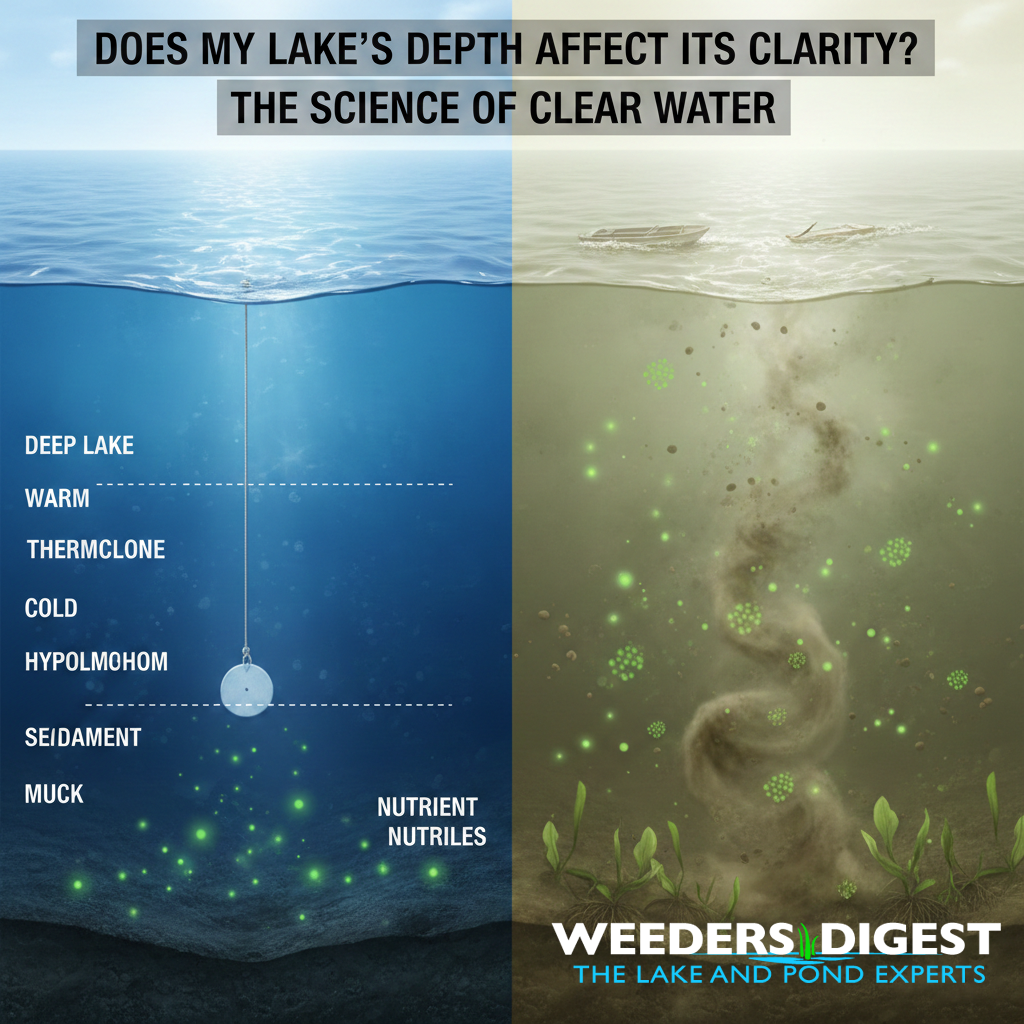
Many homeowners assume that a deep lake is naturally "cleaner" than a shallow one, and while that isn't always true, depth is one of the most powerful factors in determining how clear your water stays throughout the year. In a deep lake, there is a massive "buffer" of cold water that keeps nutrients and muck trapped at the bottom, far away from the sunlight. In a shallow lake, every boat wake or gust of wind can stir the bottom back up to the surface. Understanding the relationship between your lake's depth and its clarity helps explain why some waters stay crystal clear all summer while others turn cloudy as soon as the temperature rises.
The Science Behind It:
The primary reason depth influences clarity is through a process called thermal stratification. In a deep lake, the water separates into distinct layers: the warm, sunlit epilimnion at the top and the cold, dark hypolimnion at the bottom. These layers are separated by a "thermocline" that acts as a physical barrier. According to research from the Global Lake Ecological Observatory Network (GLEON), this barrier prevents nutrients like phosphorus, which settle into the deep muck, from rising back into the light. In deep lakes, once a particle sinks, it is often "out of the system" for the season, leading to higher transparency and deeper Secchi disk readings.
Conversely, shallow lakes often exist in what scientists call a polymictic state, meaning they mix from top to bottom frequently throughout the summer. Because there is no deep, cold layer to act as a trap, wind energy and boat traffic can easily cause sediment resuspension. When the bottom muck is stirred up, it releases "interstitial" nutrients directly into the sunlit water column. Research published in Freshwater Biology indicates that this constant recycling of nutrients fuels continuous algae growth, making it much harder for a shallow lake to maintain high clarity compared to a deep-water system.
The "photic zone"—the depth to which sunlight can reach—also plays a critical role. In a shallow lake, sunlight may reach the entire bottom. This allows rooted aquatic plants to grow across the whole lake bed, which can actually be a benefit, as these plants "anchor" the sediment and prevent it from clouding the water. However, if these plants are removed or die off, the lake can flip into a "turbid stable state," where the water remains permanently murky because there is nothing left to hold the bottom in place. Scientific studies show that deep lakes are less susceptible to this "flip" because a large portion of their basin is too deep for plants to grow, leaving the clarity to be dictated by the volume of water rather than the stability of the bottom.
Finally, the volume-to-surface-area ratio affects how a lake processes "external loading." A deep lake has a much larger volume of water to dilute the nutrients that wash in from the shoreline. If ten pounds of phosphorus wash into a deep lake, the impact on clarity is minimal because the nutrient is diluted across millions of gallons of water. In a shallow lake, that same ten pounds of phosphorus is concentrated in a much smaller space, leading to a much more dramatic and visible algae bloom. This "dilution capacity" is why deep lakes are often more resilient to environmental changes and tend to maintain their clarity even as development increases around the shoreline.
Sources / References: