

Are My Lake Weeds Actually Good for the Lake?
 |
Summary:
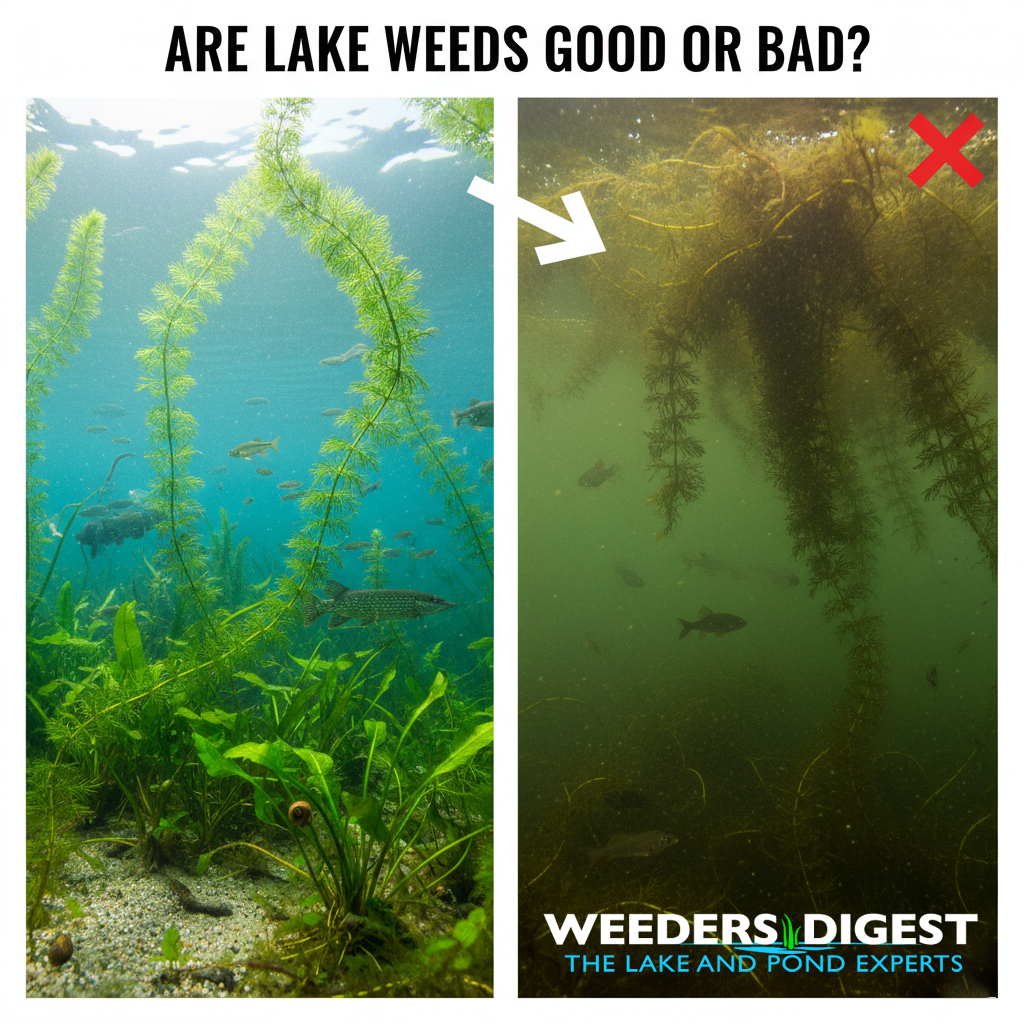
It is common to view aquatic plants as a nuisance that ruins a swimming area or tangles a boat propeller, but from an ecological standpoint, they are the "lungs" and "filter" of the ecosystem. Native lake weeds play a vital role in maintaining water clarity and supporting a healthy fish population. They act as a biological anchor for the lake bottom, preventing the muck from being stirred up, and they compete with algae for the nutrients that would otherwise turn the water green. While an overgrown shoreline can be frustrating, a lake without any plants would quickly become a cloudy, unstable environment where fish struggle to survive.
The Science Behind It:
The primary ecological benefit of aquatic vegetation is its role in maintaining an alternative stable state. In limnology, lakes generally exist in one of two conditions: a "clear-water state" dominated by rooted plants (macrophytes) or a "turbid state" dominated by algae (phytoplankton). Rooted plants are essential for the clear-water state because they engage in nutrient sequestration. By pulling phosphorus and nitrogen out of the water column and the sediment, they "starve" the algae, preventing the massive blooms that decrease water transparency. Research published in Freshwater Biology shows that when aquatic plants are removed entirely, the sudden surplus of nutrients almost always leads to a permanent shift toward murky, algae-filled water.
Beyond nutrient control, these plants provide essential structural complexity for the lake's food web. Submerged vegetation acts as a nursery for "young-of-the-year" game fish and a habitat for the macroinvertebrates (insects and snails) that fish eat. According to the American Fisheries Society, a lake with a moderate density of native plants (typically 20-40% coverage) produces larger and healthier predator fish, such as Bass and Northern Pike, compared to lakes with no vegetation. The plants provide "edge habitat" where predators can hunt and prey can hide, creating a balanced and resilient fish community.
The physical presence of weeds also protects the shoreline through sediment stabilization. The root systems of aquatic plants bind the lakebed together, much like grass prevents soil erosion on land. In shallow areas, the foliage of the plants dampens wave energy from wind and boat wakes. Without this "buffer," the constant movement of water would resuspend fine silts and organic muck, keeping the water perpetually cloudy. Scientific studies in Aquatic Botany highlight that rooted plants are the most effective natural defense against turbidity, as they prevent the bottom from being stirred back into the water column.
However, the distinction between "good" and "bad" weeds often comes down to whether the species is native or invasive. Native plants, like Coontail or American Pondweed, typically grow in a diverse "mosaic" that allows for water movement and fish travel. Invasive species, such as Eurasian Watermilfoil or Curly-leaf Pondweed, grow in aggressive, dense monocultures that can "choke" a lake. These invasives can grow so thick that they actually decrease dissolved oxygen levels and hinder fish movement, effectively negating the benefits that native plants provide. Thus, while "weeds" are biologically necessary, maintaining a balance of native species is the key to a healthy, clear, and functional lake.