

Are Your Retaining Walls Killing Your Lakefront Dreams?
 |

Summary:
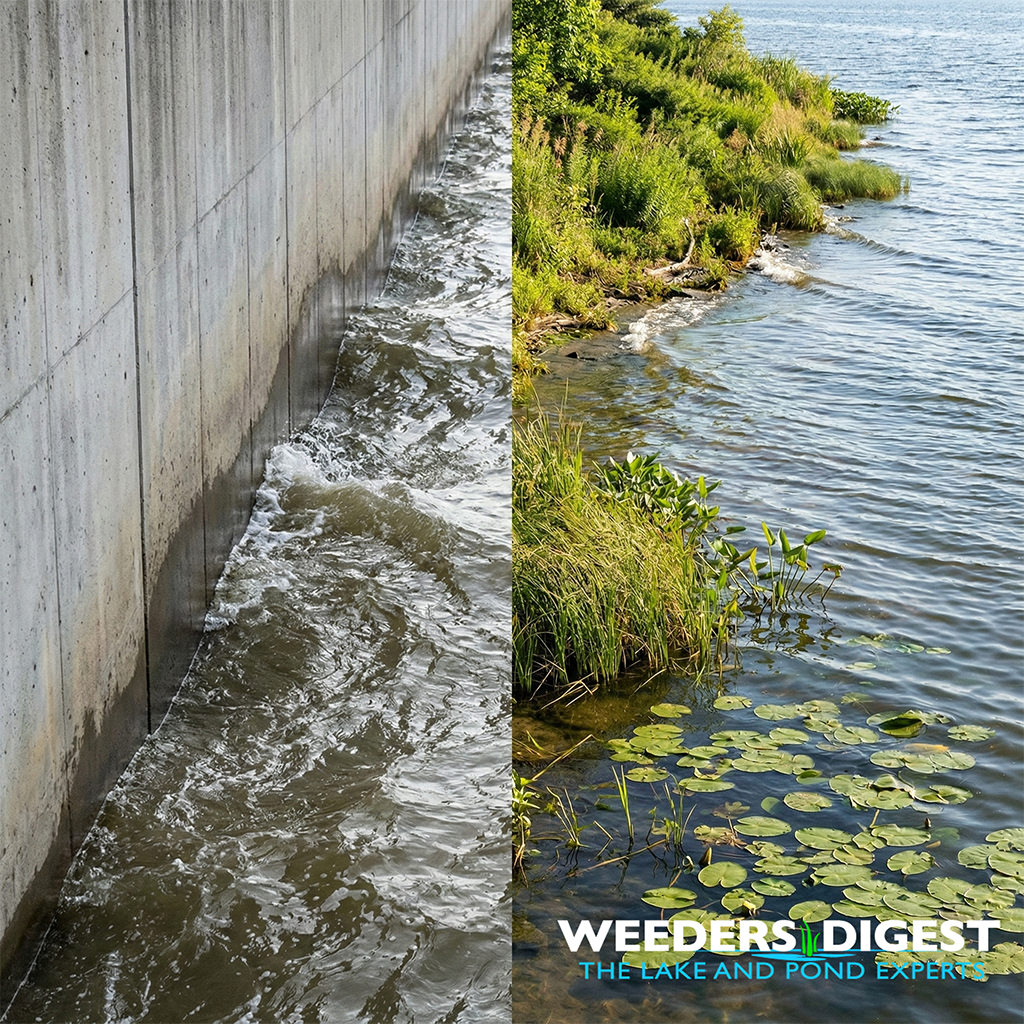
When you look at your shoreline, a crisp, stone or timber retaining wall might look like the perfect solution to keep your lawn from sliding into the water. It provides a clean edge for your property and creates a stable platform for your Adirondack chairs. However, what looks like a structural victory is often an ecological disaster for the lake you love. These vertical barriers create a harsh "dead zone" where land meets water, cutting off the natural transition that fish and wildlife depend on for survival.
We often see homeowners install these walls to fight erosion, only to find that the water becomes cloudier and the waves more aggressive over time. This happens because the wall doesn't actually absorb energy; it fights it. Instead of the water gently washing onto a sloped shore, it slams into the wall and bounces back, scouring away the lakebed and destroying the habitat of the very creatures that make lake life special.
While a wall might protect your physical yard in the short term, it often degrades the overall health and clarity of the waterbody. Over time, this can lead to deeper water at your shoreline and a loss of the sandy bottom you might have once enjoyed. Understanding how these structures interact with the liquid environment is the first step in deciding if a hard wall is truly the best choice for your piece of paradise.
The Science Behind It:
The installation of vertical retaining walls, or bulkheads, significantly alters the hydromorphology and ecological connectivity of the littoral zone. From a physical perspective, these structures induce a phenomenon known as wave reflection. Unlike natural, sloped shorelines that dissipate kinetic energy through friction and infiltration, vertical walls reflect wave energy back into the water column. This reflected energy interacts with incoming waves to create turbulence, leading to the suspension of benthic sediments and the accelerated scouring of the lakebed at the base of the wall. Research published in North American Lake Management Society journals indicates that this process, termed "toe erosion," often leads to the eventual structural failure of the wall itself while simultaneously increasing water turbidity.
Ecologically, retaining walls represent a total loss of the "riparian-ecotone" transition. This area is critical for nutrient cycling and provides essential habitat for various taxa. According to studies on shoreline hardening, the removal of the natural slope eliminates the shallow-water refuge required by juvenile fish and amphibians. Without the presence of emergent and submergent macrophytes—which cannot take root in the high-energy, scoured environment created by a wall—the primary production and dissolved oxygen levels in the immediate vicinity are frequently compromised. This results in a "biological desert" where biodiversity is significantly lower compared to natural or bioengineered shorelines.
Furthermore, the lack of a natural gradient prevents the filtration of terrestrial runoff. In a natural system, shoreline vegetation acts as a biological buffer, sequestering nitrogen and phosphorus before they enter the water. A vertical wall creates a direct conduit for nutrient-rich runoff to enter the lake, often bypassing any potential for vegetative uptake. This nutrient loading, combined with the loss of habitat, can shift the local ecosystem toward algal dominance. The scientific consensus among limnologists suggests that while these structures provide immediate soil stabilization, they facilitate long-term degradation of the aquatic environment's structural and functional integrity.
Strategic alternatives, such as "living shorelines" or "rip-rap" with interstitial plantings, are increasingly recommended by aquatic biologists. These methods utilize the principles of ecological engineering to provide stabilization while maintaining the necessary physical-chemical exchange between the terrestrial and aquatic biomes. By mimicking the natural dissipation of energy, these alternative methods preserve the substrate stability and promote a more resilient, biodiverse littoral community.
Sources / References:
- Maryland Department of Natural Resources: Shoreline Management and Erosion Control
- University of Minnesota Extension: Shoreline stabilization - retaining walls