


Natives vs. Invasive Aquatic Weeds | What’s the difference between Native Plants and Invasive Plants in my Lake
Natives vs. Invasive Aquatic Weeds | What’s the difference between Native Plants and Invasive Plants in my Lake?
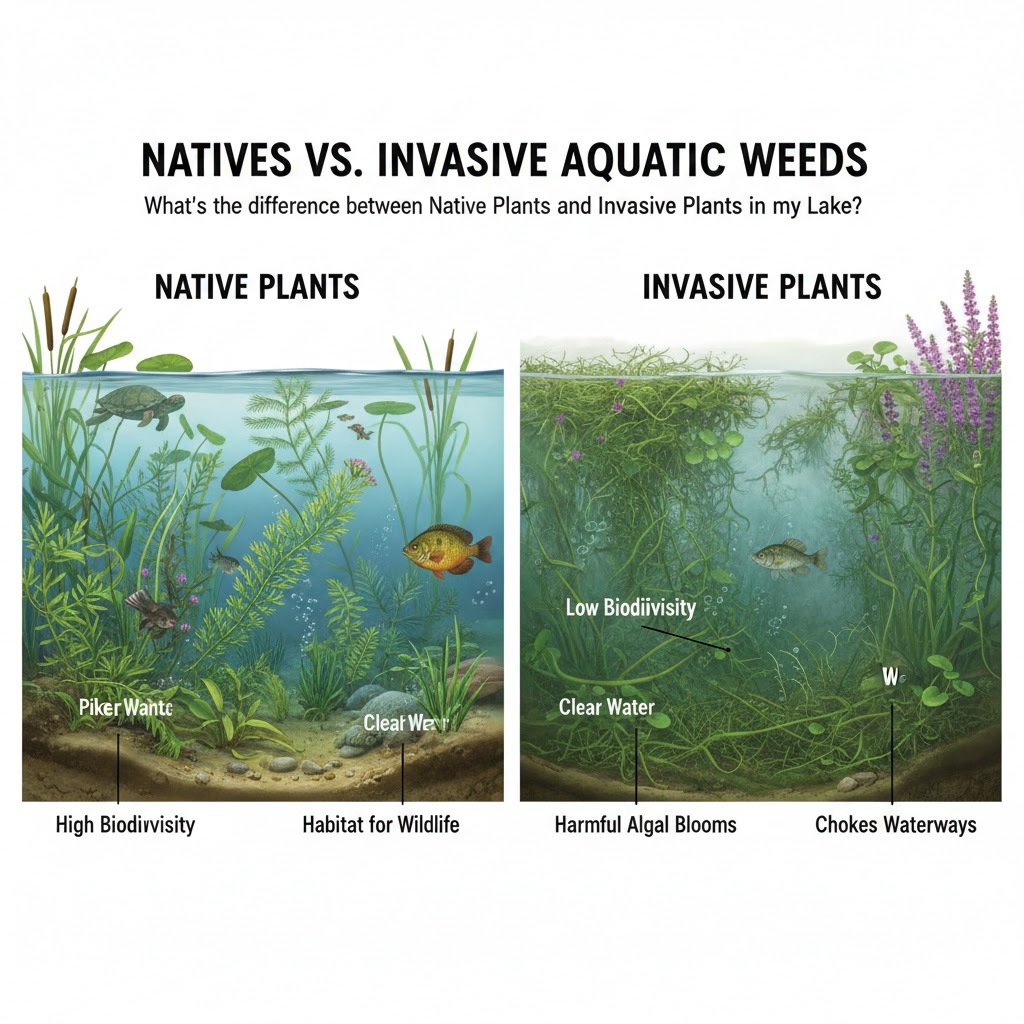
Summary: When you look out over your shoreline, it is easy to assume that any green plant growing in the water is a "weed" that needs to be removed. However, there is a massive difference between the plants that belong in your lake and the ones that are trying to take it over. Native plants are the "good neighbors" of the underwater world; they have lived in your local area for thousands of years, evolving alongside the fish, turtles, and birds that call your lake home. They grow in a balanced way, providing essential nursery space for baby fish and acting as a natural filter to keep your water clear and healthy.
Invasive weeds, on the other hand, are like uninvited houseguests that refuse to leave and eventually try to own the property. These species were brought here from other parts of the world—often by accident on boat trailers or from escaped water gardens. Because they didn't grow up in our local ecosystem, they don't have any natural "enemies" like specific insects or diseases to keep them in check. This lack of biological control allows them to grow at an explosive rate, quickly turning a diverse underwater garden into a tangled, matted mess that can make swimming and boating nearly impossible.
The easiest way to think about it is through the lens of harmony versus dominance. Native plants work with the lake, sharing space and resources to support a thriving environment. Invasive weeds work against the lake, aggressively crowding out everything else until they are the only thing left. Recognizing this difference is vital because while we want to protect and encourage our native species, we must be proactive in managing the invasives before they permanently alter the character of your waterfront.
If you are seeing a sudden explosion of growth that seems to be choking out the areas where you used to see a variety of different plants, you are likely dealing with an invasion. My goal is to help you identify these shifts early so we can maintain the ecological integrity and the recreational value of your water for years to come.
The Science Behind It: The distinction between native and invasive aquatic macrophytes is defined by their evolutionary history and their subsequent ecological integration. Native species are those that have developed and adapted within a specific geographic range without anthropogenic intervention, establishing complex symbiotic relationships with local fauna and microbial communities (Purdue University, 2021). These plants typically occupy specific ecological niches, and their growth is regulated by a network of "checks and balances," including co-evolved herbivores, pathogens, and interspecific competition. This results in a high level of biodiversity where multiple species coexist, supporting stable nutrient cycling and providing structural complexity for aquatic life.
In contrast, invasive species are non-indigenous organisms that, when introduced to a new environment, exhibit aggressive growth patterns that cause environmental or economic harm. Research indicates that approximately only 1% of introduced species become truly invasive, but those that do often possess "r-selected" life history traits: rapid growth rates, high reproductive output via both seeds and vegetative fragmentation, and broad physiological tolerances (NC State Extension, 2024). A defining characteristic of invasive aquatic weeds, such as Hydrilla verticillata or Myriophyllum spicatum (Eurasian Watermilfoil), is their ability to form dense canopy-like mats that intercept nearly all incoming solar radiation, effectively "shading out" native submersed vegetation.
The ecological impact of this dominance is profound. Scientific studies show that invasive monocultures significantly alter the physical and chemical properties of the water column. As these dense stands limit water mixing and air-water exchange, dissolved oxygen levels can plummet, particularly during nocturnal respiration or following a large-scale plant die-off. Furthermore, the loss of native plant diversity leads to a simplified habitat that is less suitable for native fish populations. While native plants provide a "mosaic" of cover, invasive mats are often too dense for larger predatory fish to navigate, leading to stunted populations of prey fish and a breakdown in the traditional food web (Lilly Center for Lakes & Streams, 2021)
From a limnological perspective, the management of these species requires an understanding of "Invasibility"—the susceptibility of a lake to colonization. Factors such as high alkalinity, nutrient loading (eutrophication), and frequent physical disturbance (boating or shoreline development) can create an environment where invasive species thrive over natives (Capers et al., 2009). Because invasive weeds often lack the natural predators found in their home ranges, they gain a competitive advantage that allows them to divert more energy into biomass production rather than defense mechanisms. This "Enemy Release Hypothesis" explains why a species that is well-behaved in its native Europe or Asia can become a catastrophic nuisance in North American waters.
Sources / References:
- https://lakes.grace.edu/native-non-native-invasive-species/
- https://ag.purdue.edu/btny/purdueweedscience/wp-content/uploads/2021/03/Identifying-and-Managing-Aquatic-Vegetation.pdf
Recent Posts
-

Natives vs. Invasive Aquatic Weeds | What’s the difference between Native Plants and Invasive Plants in my Lake
Natives vs. Invasive Aquatic Weeds | What’s the difference between Native Plants and Invasive Plants …6th Feb 2026 -

The "Spring Clear-Water Phase": Why Your Pristine Lake Turns Cloudy Every Summer
The "Spring Clear-Water Phase": Why Your Pristine Lake Turns Cloudy Every Summer Summary:Many lake o …6th Feb 2026 -
Creating a Thriving Ecosystem: Attracting Wildlife to Your Lake Property
The Vision of a Living Shoreline Lakefront living offers a unique opportunity to connect with nature …4th Feb 2026