

Can I Actually "Reset" My Lake or Pond? What You Need to Know
 |
Summary:
As a lake or pond owner, it is incredibly easy to feel like you are losing the battle against murky water, invasive weeds, and that thick layer of muck on the bottom. You might find yourself wondering if there is a "factory reset" button for your ecosystem—a way to wipe the slate clean and start over. While it sounds like a dream, the reality of a lake or pond reset is a bit more complex than just draining the water and starting over. The trick isn't one silver bullet; it’s understanding the specific factors driving your problem—whether it's nutrients, oxygen, circulation, or biology—and fixing the right thing.
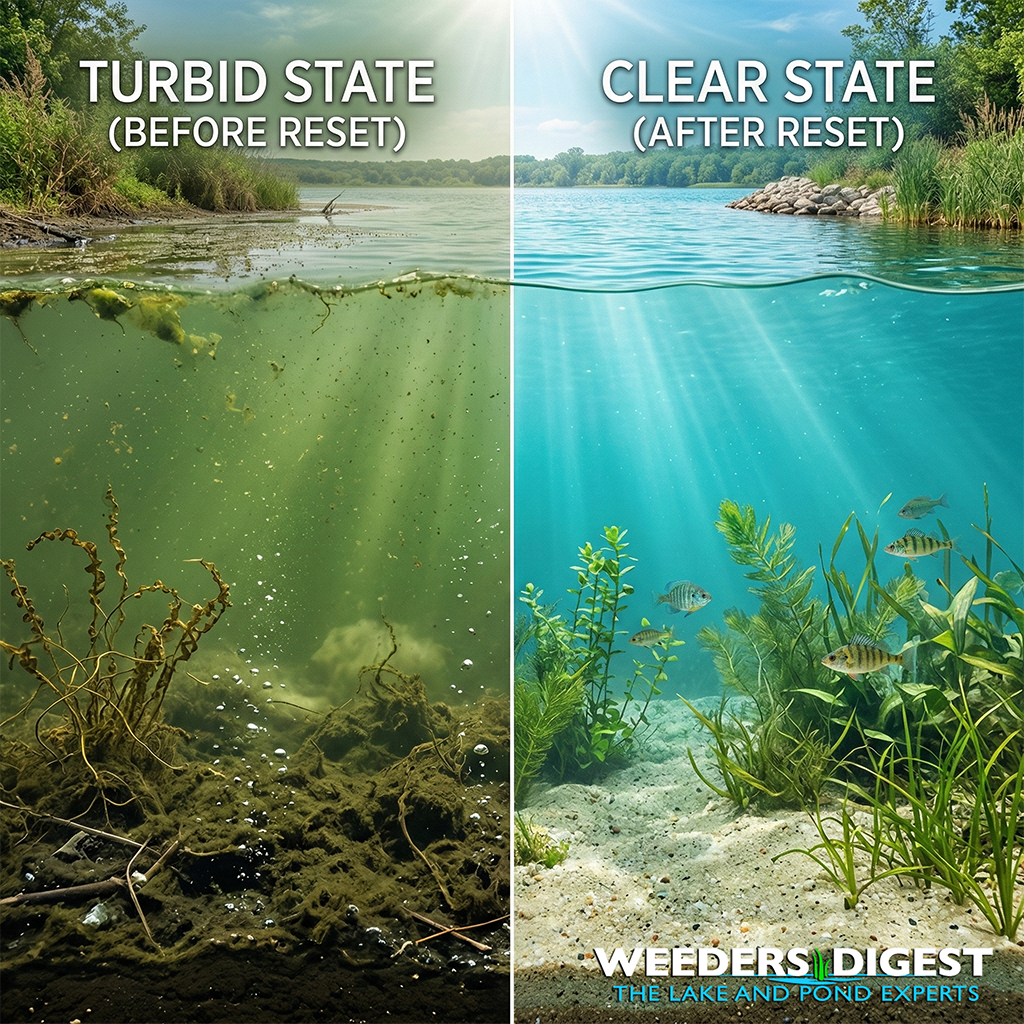
In the world of lake and pond management, a "reset" usually refers to a major intervention designed to shift the water from a "turbid state" (dominated by algae and high nutrients) back to a "clear state" (dominated by healthy plants and balanced chemistry). This isn't a simple weekend project; it's a strategic overhaul of the biological and chemical makeup. While we can’t literally turn back time, we can use science to force a dramatic recovery.
The process of resetting often involves tackling the "internal loading" of nutrients built up over decades. Imagine your lake or pond as a bank account; even if you stop "depositing" nutrients via external runoff, there is still a massive balance of phosphorus sitting in the mud. To get a true reset, we have to address that "savings account" through methods like mechanical dredging. Dredging is the "nuclear option" because it physically removes muck, nutrients, and the weed seed banks. While this can be done effectively as a DIY project using specialized sediment pumps to reclaim your shoreline, you should always check with your local governing authority (such as the DNR or local watershed district) to ensure you have any necessary permits before beginning.
Ultimately, a successful reset requires patience and a shift in how you view your waterfront. It isn't just about killing weeds; it’s about restoring the natural checks and balances—like managing oxygen dynamics—that allow the lake or pond to clean itself. While you can’t reset a lake or pond as easily as a computer, you can absolutely push it in the right direction. By understanding whether the issue is driven by nutrients, oxygen, circulation, or biology, you can stop searching for a "silver bullet" and start fixing the right thing—resulting in a reclaimed ecosystem that feels brand new for generations to come.
The Science Behind It:
The concept of a lake or pond "reset" is grounded in the theory of alternative stable states in shallow lake or pond ecology. Research by Scheffer et al. (1993) demonstrates that shallow lakes and ponds typically exist in one of two equilibria: a clear-water state dominated by submerged macrophytes or a turbid-state dominated by phytoplankton (algae). Once a lake or pond crosses a critical nutrient threshold—specifically phosphorus loading—it "switches" states. Because of a phenomenon known as hysteresis, simply reducing external nutrient inputs is often insufficient to trigger a return to the clear state because the ecosystem has developed feedback loops that maintain the turbid condition.
To achieve a physiological reset, managers must address the internal phosphorus cycle. According to Søndergaard et al. (2003), phosphorus accumulated in lake and pond sediments can be released back into the water column under various conditions, such as anoxia at the sediment-water interface or physical disturbance. This internal loading sustains high algal biomass even after external point sources are mitigated. A "reset" often involves the application of lanthanum-modified clay or aluminum sulfate (alum) to chemically bind phosphorus in the sediments, effectively "locking" it away and making it unavailable for algal uptake, thereby mimicking a low-nutrient, oligotrophic environment.
Biological "resets" also utilize biomanipulation, a technique involving the top-down control of the food web. As detailed in research published in Freshwater Biology, removing benthivorous fish like common carp (Cyprinus carpio) can significantly reduce turbidity. Carp increase suspended solids and phosphorus through "bioturbation"—the physical stirring of bottom sediments during feeding. By removing these "ecosystem engineers" and restablashing piscivorous fish populations, managers can reduce the pressure on zooplankton, which in turn graze more heavily on algae, clearing the water column.
Complete mechanical resets, such as sediment dredging, represent the most aggressive form of restoration. This process physically removes the nutrient-rich organic "muck" layer that has accumulated over decades. This not only increases the mean depth of the water body—reducing the area where sunlight can reach the bottom to fuel invasive weed growth—but also removes the seed bank of nuisance species and the primary source of internal nutrient loading. However, this must be followed by the re-establishment of native vegetation to stabilize the new equilibrium and prevent the system from rebounding into a degraded state.
Sources / References:
- Alternative aquatic ecosystem states and their use in lake restoration (University of Florida / IFAS)
- Restoration of Shallow Lakes by Nutrient Control and Biomanipulation (ResearchGate / Journal of Aquatic Plant Management)