

Can I Finally Reclaim My Sandy Beach from This Muck and Mime?
Summary:
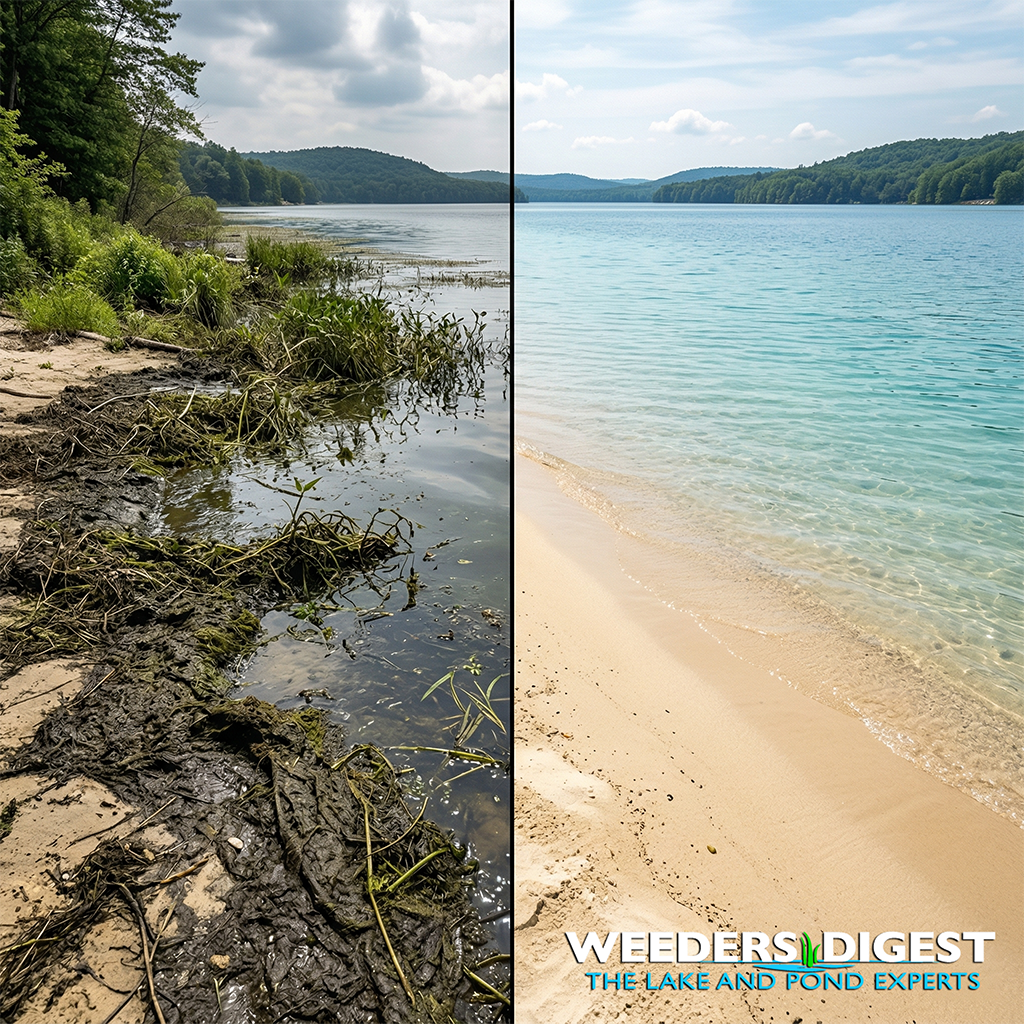
Finding your once-pristine sandy beach buried under layers of black muck and tangled weeds is a frustrating experience for any waterfront homeowner. You likely remember a time when the lake bottom was firm under your toes, but now it feels like walking through a swamp. The short answer is that while you can certainly restore the beauty and functionality of your beach, the word "permanently" comes with a significant asterisk. Lake ecosystems are dynamic, living systems that naturally move toward a state of filling in—a process called lake aging or succession.
To get your beach back, you have to fight against the constant inflow of organic matter. When leaves, grass clippings, and runoff enter the water, they settle and decompose, creating that soft, smelly muck. This muck acts as a nutrient-rich potting soil for aquatic weeds, which then trap even more sediment, creating a cycle that buries your sand deeper every year. Reclaiming your beach requires removing the existing organic buildup and then implementing a consistent maintenance strategy to prevent the cycle from starting all over again.
Think of your beach like a garden. You can weed it and mulch it to make it look perfect today, but if you walk away and never touch it again, the weeds will inevitably return. Reclaiming a sandy beach is entirely possible through physical removal or biological acceleration, but staying "reclaimed" requires you to be an active steward of your shoreline. Without ongoing intervention, the natural forces of the lake will always try to turn your sandy oasis back into a wetland.
The Science Behind It:
The transition of a sandy littoral zone into a muck-dominated environment is driven by the process of cultural eutrophication and organic sedimentation. In a balanced oligotrophic or mesotrophic system, wave action and aerobic decomposition keep the near-shore substrate relatively clean. However, as nutrient loading (specifically phosphorus and nitrogen) increases from anthropogenic sources, primary productivity accelerates. This leads to an overabundance of macrophytes and phytoplankton. As these organisms complete their life cycles, their detritus settles into the benthic zone, forming a layer of flocculent organic matter commonly referred to as muck.
The accumulation of this organic matter triggers a feedback loop. Research published in Hydrobiologia highlights that dense beds of submerged aquatic vegetation (SAV) significantly reduce water velocity and turbulence near the lake bed. This reduction in kinetic energy allows finer particles and organic silts to settle out of the water column rather than being flushed away by longshore currents. Furthermore, the interstitial spaces between the sand grains become clogged with fine organic particulates, creating an anaerobic environment. In these hypoxic conditions, the rate of decomposition slows dramatically because anaerobic bacteria are less efficient than aerobic microbes, leading to the "permanent" accumulation of muck over the original mineral substrate.
Citing studies from University Extension programs, such as those conducted by Michigan State University, it is evident that reclaiming these areas requires disrupting this sediment-nutrient legacy. Mechanical harvesting or manual removal of macrophytes provides temporary relief, but the underlying issue remains the benthic "internal loading." When muck is present, it acts as a continuous source of internal phosphorus. Even if external nutrient inputs are curtailed, the sediment continues to fuel weed growth. Restoration often involves physical sediment removal (dredging) or the application of high-density aerobic bacterial inoculants and calcium carbonate catalysts to "digest" the organic component of the muck, thereby exposing the original sandy substrate.
The permanence of such restoration is governed by the principles of limnological equilibrium. A study in the Journal of Aquatic Plant Management suggests that unless the physical characteristics of the shoreline—such as wave energy or slope—are modified, or unless a maintenance protocol is established, the site will return to its successional trajectory. The re-establishment of a sandy beach is effectively a reversal of natural hydrosere succession. Maintaining this state requires the ongoing management of the "sediment budget" and the regular removal of newly deposited organic matter before it can integrate into the benthic profile and trigger a return to an anaerobic, weed-dominant state.
Sources / References:
- Michigan State University Extension: Understanding Lake Aging and Eutrophication
- Journal of Aquatic Plant Management: Effects of Sediment Nutrient Content on Macrophyte Growth