

How My Favorite Lakes Master the Art of Self-Correction
 |
Summary:
Have you ever wondered how a local pond stays crystal clear for years without a single person lifting a finger to clean it? It often feels like magic, but what you are actually witnessing is a complex, living system performing a high-stakes balancing act. Nature has built-in "checks and balances" that manage everything from the oxygen levels fish breathe to the amount of nutrients fueling plant growth. When a lake is healthy, it functions like a self-regulating machine, using microscopic organisms, underwater forests, and even the change of seasons to keep itself in peak condition.
Think of your lake as a living organism with its own immune system. Just as your body fights off a cold, a lake uses its biological and chemical tools to process "waste" like fallen leaves or runoff. This natural equilibrium ensures that no single element, such as algae or a specific fish species, takes over and ruins the neighborhood. Understanding this balance is the first step toward appreciating the hidden work happening beneath the surface of the water every single day.
However, this balance is a delicate dance. While a lake is incredibly resilient, it relies on a specific rhythm of temperature changes and a diverse community of residents—from the tiniest bacteria to the largest bass—to maintain its status quo. My goal is to help you see that "still" water is never actually still; it is constantly working, adjusting, and breathing to sustain life and clarity.
The Science Behind It:
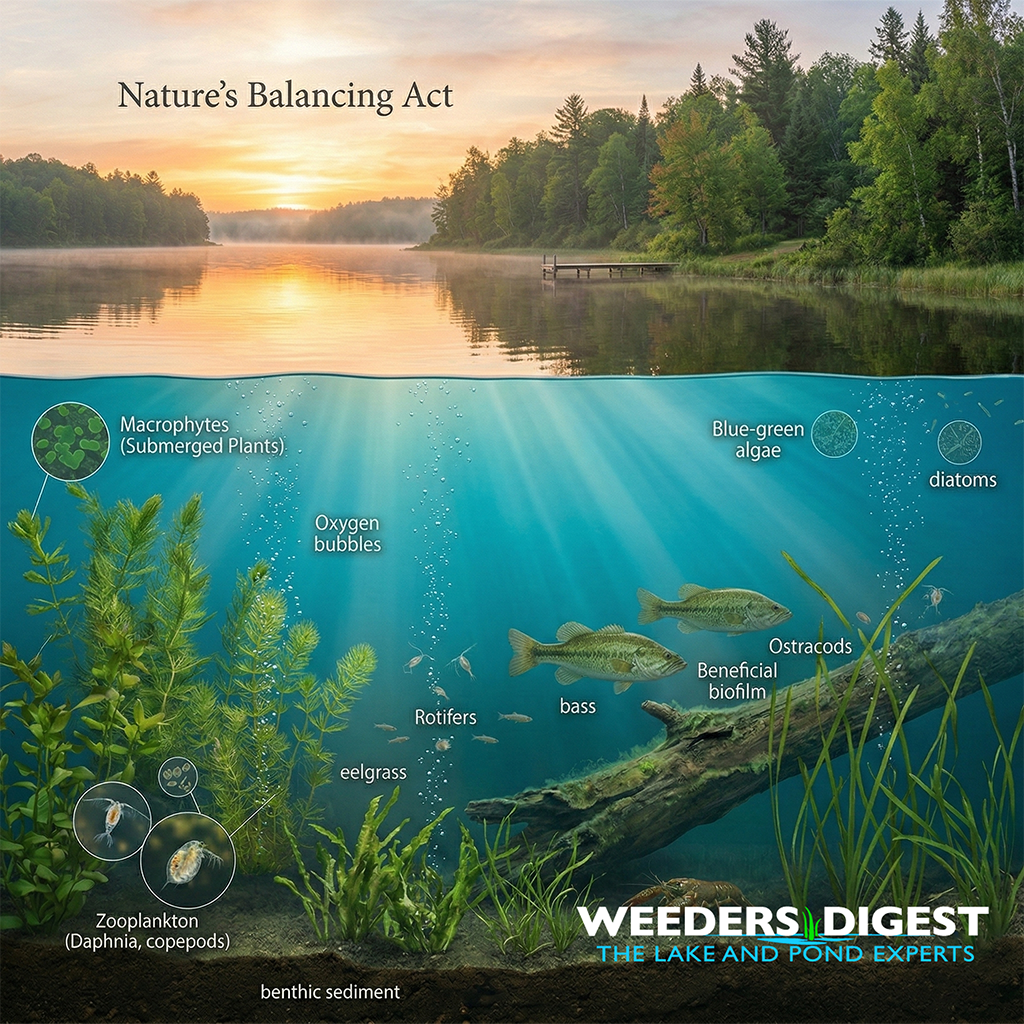
The natural regulation of lacustrine environments is primarily governed by the principles of trophic dynamics and biogeochemical cycling. At the core of this balance is the "bottom-up" and "top-down" control mechanism. Bottom-up control refers to the limitation of primary productivity by the availability of essential nutrients, specifically phosphorus and nitrogen. In a balanced oligotrophic or mesotrophic state, nutrient levels remain low enough to prevent runaway phytoplankton blooms. Conversely, top-down control involves the predation of zooplankton by planktivorous fish, which in turn regulates the population of algae. According to research published in Freshwater Biology, this "trophic cascade" is essential for maintaining water clarity, as a healthy population of piscivorous fish ensures that zooplankton remain abundant enough to graze down algal biomass.
Chemical equilibrium is further maintained through the process of thermal stratification and seasonal turnover. In temperate climates, lakes undergo a physical restructuring twice a year. During spring and fall turnovers, the vertical mixing of the water column redistributes dissolved oxygen to the benthic (bottom) zones and brings sequestered nutrients to the surface. This prevents the onset of anoxia at the sediment-water interface. As noted in studies by the University of Wisconsin-Madison’s Center for Limnology, maintaining an aerobic state at the lake bottom is critical because it allows iron-bound phosphorus to remain trapped in the sediment. If the lake becomes anaerobic, a chemical reaction occurs that releases this "internal load" of phosphorus back into the water, triggering rapid eutrophication.
Biotic diversity acts as a stabilizer against environmental stressors, a concept known as the "Insurance Hypothesis" in aquatic ecology. A diverse community of macrophytes (aquatic plants) provides multiple functions: they compete with algae for nutrients, stabilize bottom sediments with their root systems to prevent turbidity, and offer refugia for beneficial microorganisms. These plants also play a vital role in the carbon cycle, sequestering carbon and producing oxygen through photosynthesis. The presence of a varied littoral zone ensures that the lake can absorb pulses of nutrient runoff without shifting into a turbid, algae-dominated state.
Microbial processing is the final, invisible pillar of natural lake balance. The nitrogen cycle within a lake relies on specialized bacteria to perform nitrification and denitrification, converting organic waste into harmless nitrogen gas that escapes into the atmosphere. This microbial loop ensures that organic matter, such as decaying leaf litter and fish waste, is efficiently decomposed and recycled rather than accumulating and choking the ecosystem. When these biological, chemical, and physical pathways function in unison, the lake achieves a state of dynamic equilibrium, resisting sudden shifts in water quality and biological composition.
Sources / References:
- University of Wisconsin-Madison: Center for Limnology - Lake Research
- Journal of Freshwater Biology: Trophic Cascades in Aquatic Ecosystems