

Is Your Boat Secretly Fertilizing the Lake? The Surprising Truth About Prop Wash
 |
Summary:
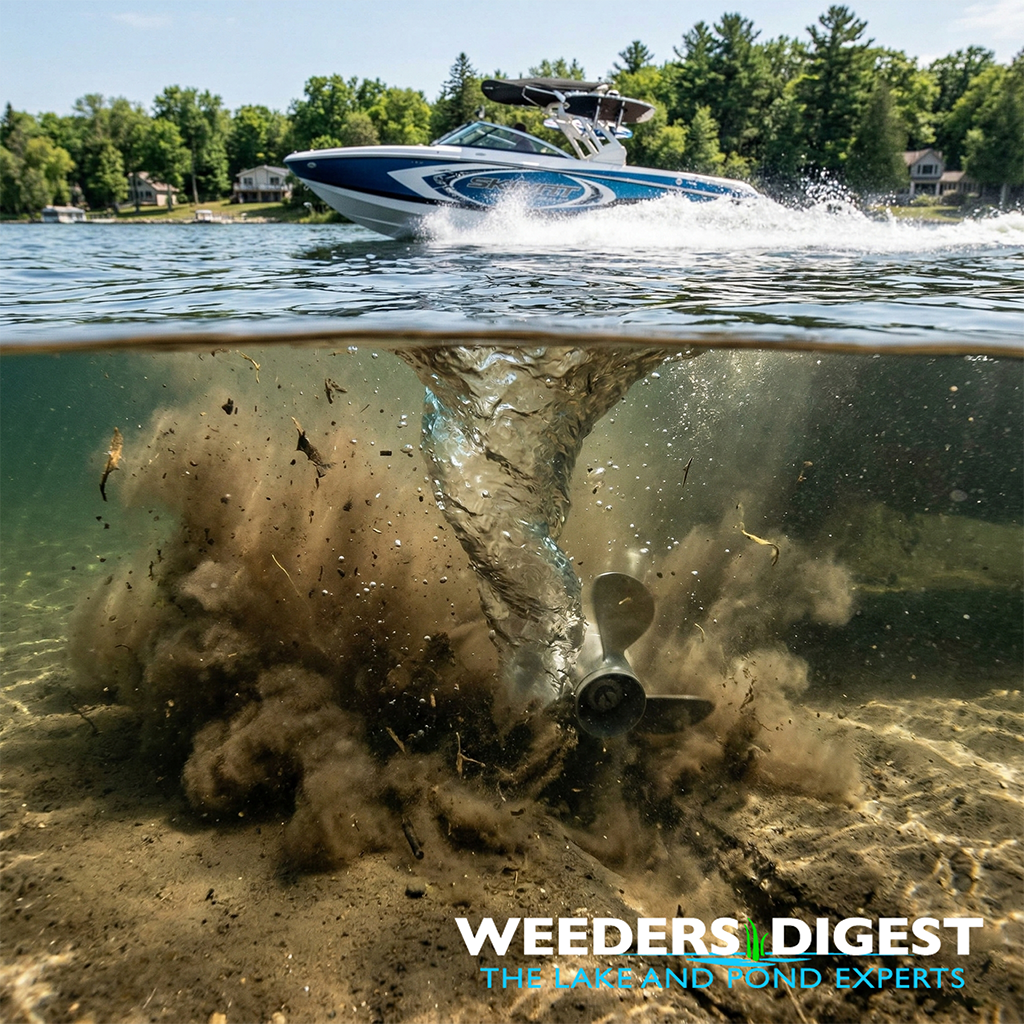
If you have ever noticed the water behind your boat turning a murky brown or seen a sudden surge in green algae after a busy holiday weekend, you are likely seeing the direct effects of nutrient resuspension. While it might seem like your boat is just moving through the water, the powerful force of a propeller—especially in shallower areas—acts like a massive underwater blender. This agitation stirs up the soft "muck" or sediment at the bottom of your lake, which acts as a massive storage bank for decades of accumulated nutrients.
When these sediments are disturbed, they release phosphorus and nitrogen directly into the water column. For a homeowner, this is important because those nutrients act as a high-powered fertilizer for weeds and algae. Instead of staying buried safely under the sand, these "fuel" sources are brought up to the sunlit surface where they can trigger unsightly blooms and decrease the overall clarity of your shoreline. In short, your boating habits can unintentionally feed the very weeds you are trying to manage.
The impact depends heavily on how deep the water is and how much power you are using. In shallow areas, even a small engine can reach the bottom, while larger wake-enhancing boats can disturb the lakebed even in much deeper water. Understanding this connection is the first step in keeping your water clear and your lakefront healthy for years to come.
The Science Behind It:
The mechanical energy generated by motorized watercraft, specifically through propeller wash and hull-generated wakes, represents a significant source of "internal loading" in freshwater ecosystems. Internal loading refers to the recycling of nutrients already present within the lake system, as opposed to "external loading" from runoff or septic systems. Scientific investigations have confirmed that the turbulence from propellers can penetrate significant depths; for instance, research cited by the New Hampshire Department of Environmental Services indicates that a 50-HP motor can effectively mix the water column and disturb sediments up to 15 feet below the surface.
When this physical disturbance occurs, it triggers the resuspension of fine-grained benthic sediments. These sediments are often rich in soluble reactive phosphorus (SRP) and particulate phosphorus. According to a study by Larratt et al. (2025) on Lake Windermere, a measurable 25% increase in water column phosphorus was recorded after just two passes by a wake boat. This rapid spike occurs because the mechanical agitation breaks the thin oxic microzone at the sediment-water interface, which normally acts as a chemical barrier preventing phosphorus from leaching into the overlying water.
The limnological implications are profound, particularly in "polymictic" or shallow lakes that do not stay stratified throughout the summer. As noted in research published in Lake and Reservoir Management, the energy from boat wakes can be 6 to 9 times more powerful than natural wind waves. This artificial energy not only increases turbidity—which limits light penetration for beneficial native plants—but also provides a pulsed delivery of nutrients to phytoplankton in the euphotic zone. This often leads to a "regime shift" where a lake moves from a clear-water, plant-dominated state to a turbid, algae-dominated state.
Furthermore, the chemical composition of the resuspended material can alter the lake's trophic status. Scientific data from the Waukesha Terra Vigilis Group suggests that wake-surfing activities can generate "significant bottom effects" even at depths exceeding 20 feet. By bringing phosphorus-rich interstitial pore water into the aerobic upper layers of the lake, boating activity essentially "fertilizes" the water column. This process accelerates eutrophication, leading to more frequent cyanobacteria blooms and a decrease in dissolved oxygen as the organic matter eventually decomposes.
Sources / References:
- https://www.lakeambassadors.ca/lwawp/wp-content/uploads/2025/04/APPENDIX-OF-QUESTIONS-Mar-31-2025.pdf
- https://www.tandfonline.com/doi/abs/10.1080/10402381.2024.2388540
- https://pmc.ncbi.nlm.nih.gov/articles/PMC11166673/