

Are Those Black Spots in Your Shallow Water Algae or Something Else?
 |

Summary:
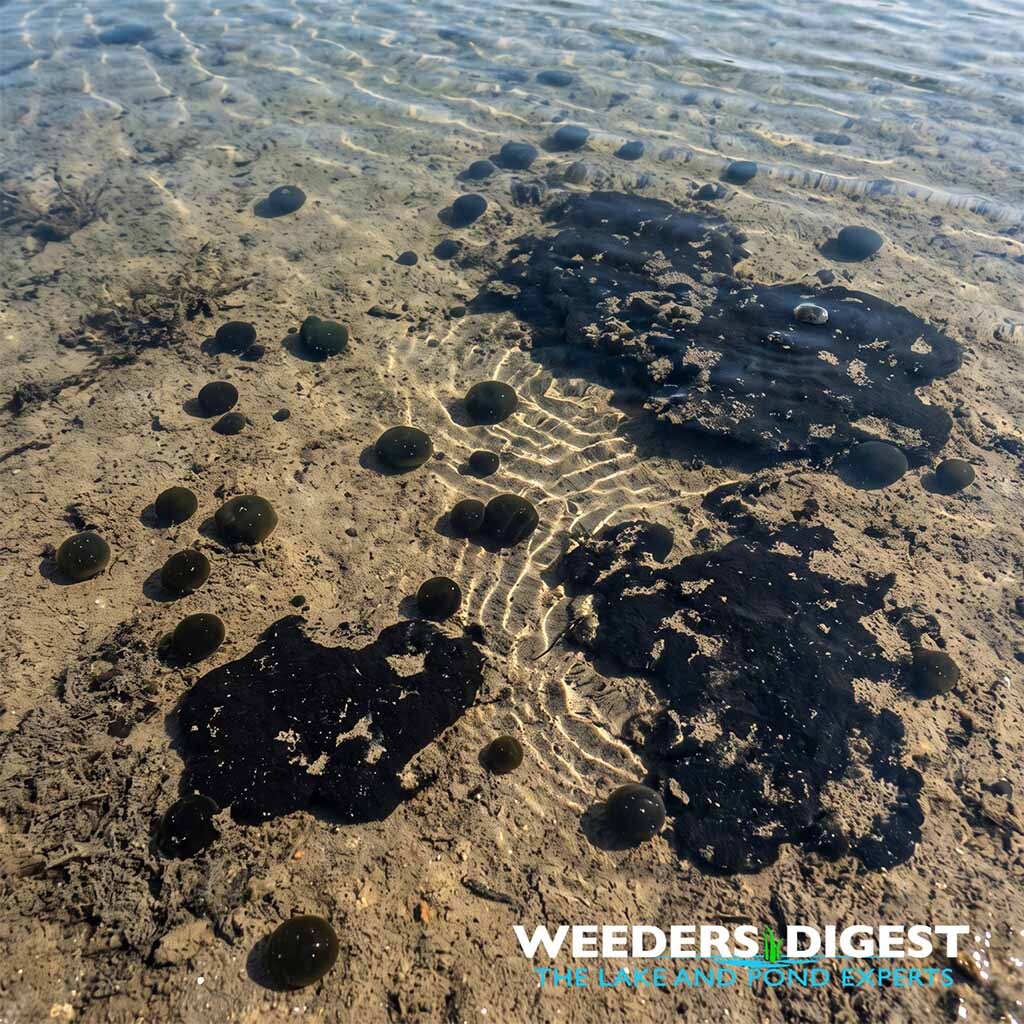
The black spots or jelly-like blobs resting in your shallow water are most likely benthic cyanobacteria—specifically Nostoc or Lyngbya—or localized accumulations of decaying organic muck. While property owners frequently mistake these dark clusters for true algae or even frog eggs, they are actually primitive, photosynthetic bacteria that thrive on excess nutrients and sunlight along the bottom of a pond or lake. As aquatic technicians, we frequently walk shorelines and observe what appears to be scattered black gravel in the shallows, only to feel the distinct, slippery, gelatinous texture that immediately confirms a thriving cyanobacteria colony.
These organisms sit quietly on the sediment, soaking up warmth and utilizing dissolved phosphorus to multiply. Whether your waterbody is experiencing a cyanobacteria bloom or simply dealing with dark, oxygen-deprived leaf detritus, the presence of these black spots indicates that the shallow aquatic environment has become overloaded with organic material.
The Science Behind It:
To accurately categorize the black spots in shallow aquatic zones, we must first distinguish between eukaryotic algae and prokaryotic cyanobacteria. Although commonly referred to as "blue-green algae," cyanobacteria lack a membrane-bound nucleus and specialized organelles. When these organisms adopt a benthic, or bottom-dwelling, lifestyle, they often manifest as dark, submerged structures on the sediment. A primary biological culprit is Nostoc pruniforme, a cyanobacterium that forms spherical colonies of twisted trichomes enveloped within a firm gelatinous matrix. Researchers at the UNH Center for Freshwater Biology have documented that these colonies can reach up to 22 centimeters in diameter, though they frequently appear as dark, nearly black spheres ranging from 1 to 6 millimeters across muddy lake bottoms. Their dark coloration is an evolutionary adaptation caused by water-soluble phycobilins, which are pigments that allow the organism to tolerate variable ultraviolet radiation and utilize limited light at the bottom of the water column.
Another common biological source for these dark patches is Lyngbya wollei, a filamentous cyanobacterium that forms dense, dark green to black mats directly on the lake floor. According to research published in the journal Freshwater Science, these mats actively induce dark, anoxic (oxygen-depleted) conditions at the sediment level, which accelerates both nutrient mineralization and atmospheric nitrogen fixation. Lyngbya is notorious for remaining inconspicuous on the bottom until metabolic gas bubbles become trapped within its tangled filaments, causing large, musty-smelling black mats to dislodge and float to the surface. This benthic dominance shifts the biological structure of the shallows, reducing the carrying capacity for native invertebrates and juvenile fish that rely on healthy, rooted macrophyte vegetation.
If the black spots are not biological colonies, they are likely pockets of highly degraded organic muck. When leaves, twigs, and aquatic weeds die, they sink to the shallow sediment and undergo bacterial decomposition. Under healthy conditions, aerobic bacteria break this material down efficiently. However, as layers build up and dissolved oxygen is consumed, the environment becomes anaerobic, causing the organic matter to transform into a dense, black, foul-smelling sludge. Environmental factors heavily dictate this decomposition cycle; for instance, as water temperatures drop, standard summer bacteria slow down and are not as effective at processing the detritus.
Removing this accumulated muck or mitigating established benthic cyanobacteria mats requires mechanical intervention and structural sediment management. Because the roots of the problem are tied to deep nutrient overloading and anoxic sediment, addressing it is a substantial task. We must acknowledge that removing years of compacted black muck is a big, labor-intensive project that cannot be sugarcoated as an easy undertaking. Furthermore, mechanical intervention for the aquatic weeds that contribute to this organic load must be done thoughtfully. When utilizing an aquatic weed cutter, it is crucial to ensure that the tool cleanly slices plants at the base rather than pulling out the roots, which prevents the resuspension of trapped sediment nutrients back into the water column where they can feed further cyanobacteria growth.