

Balancing Your Fishery: How Much Aquatic Vegetation Do Bass and Crappie Really Need?
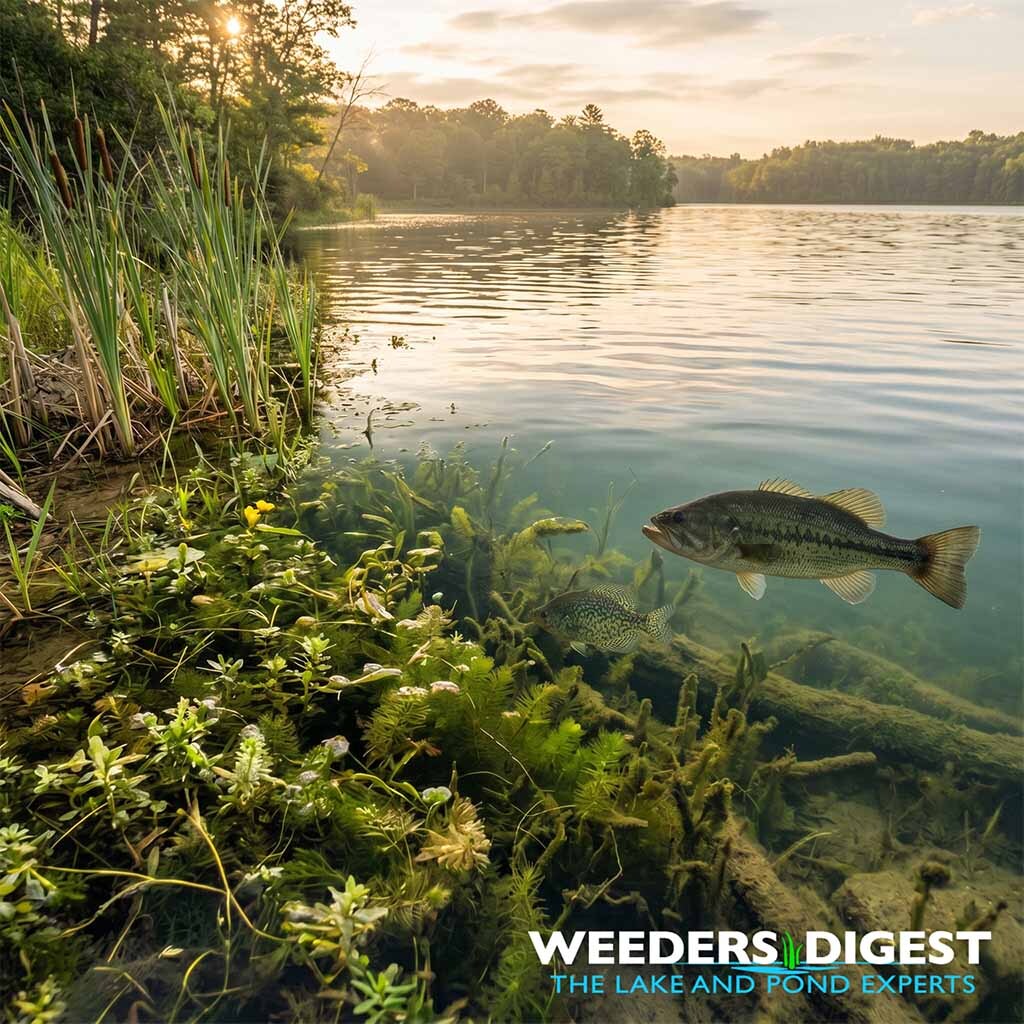 |

Summary:
Your lake or pond needs a moderate, intermediate level of aquatic vegetation to support healthy populations of largemouth bass and crappie. While vegetation is essential for providing refuge for juvenile fish and hosting the invertebrates they eat, having too much or too little can actually harm your fishery. A balanced approach—typically targeting 20% to 40% coverage—creates a productive environment where predator fish can successfully hunt and prey fish have enough cover to reach maturity.
In my years managing lake properties, I have seen many owners struggle with the "all or nothing" mindset. Often, a client will want every weed eradicated to clear a path for swimming or aesthetics, only to find that their bass populations become stunted or disappear entirely due to a lack of nursery habitat. Conversely, allowing a lake to become choked with overgrown, dense vegetation creates a stagnant "dead zone" where large predators cannot effectively move or strike, ultimately leading to a collapse in the size and health of your sport fish. Finding that middle ground is the secret to a thriving, balanced ecosystem.
The Science Behind It:
The ecological relationship between submerged aquatic vegetation (SAV) and freshwater sport fish is defined by the concept of "optimal complexity." Research consistently demonstrates that intermediate levels of plant coverage—generally cited in the 10% to 25% range for juvenile largemouth bass—provide the most favorable conditions for both growth and survival. Studies have shown that when vegetation coverage sits within this intermediate tier, juvenile bass exhibit higher growth rates and better overwinter survival compared to environments with extremely low (less than 5%) or excessively high (greater than 30%) coverage. This occurs because intermediate density provides a necessary "Goldilocks" zone: it offers enough structural refugia to protect young fish from predation, but remains sparse enough to allow predators to maintain efficient foraging maneuvers.
When vegetation becomes excessive, the physical structure begins to impede the hunting success of larger predators. Data from research on recreational canals and lakes has indicated that fish standing crops can be up to four times higher in moderately vegetated sections compared to those where plant coverage exceeds 70%. In overly dense environments, water stagnation often reduces dissolved oxygen levels, which can lead to localized stress and mortality in sensitive fish species. Furthermore, heavy vegetation blocks the movement of larger fish, forcing them to expend excessive energy to navigate or strike, which leads to a decline in body condition.
Conversely, areas devoid of vegetation or with very low coverage lack the structural complexity required for diverse fish communities. Aquatic plants are not merely aesthetic; they serve as critical nursery habitats. Studies have recorded total fish densities ranging from 6,000 to 800,000 fish per acre in vegetated areas, emphasizing the massive disparity between vegetated and weed-free zones. Native SAV facilitates a higher abundance of macroinvertebrates and periphyton, which form the base of the food web. Without this habitat, the ecosystem lacks the "biological engine" required to sustain populations of largemouth bass and crappie.
For crappie specifically, the relationship is nuanced. Unlike largemouth bass, which are highly specialized for hunting in structural environments, crappie generally prefer more open water but still require proximity to vegetated areas for spawning success and early life-stage survival. Research suggests that excessive vegetation can actually deter crappie spawning colonies, as they favor specific nesting substrates that are often outcompeted by dense plant growth. By managing for intermediate, patchy distribution of plants rather than uniform coverage, a manager creates a mosaic of habitat types that serves both the ambush-style hunting of the bass and the open-water tendencies of the crappie.
Ultimately, the goal is to maintain a healthy, heterogeneous landscape. By monitoring plant density annually, one can prevent the progression toward the extremes of barrenness or total coverage. This balanced, data-driven approach ensures that the lake remains a robust recreational fishery, maintaining the biological productivity necessary to support top-tier predators while keeping the water quality high and the environment stable for the entire food chain.