

Can a Small Patch of Open Water Save Your Lake's Winter Wildlife?
 |

Summary:
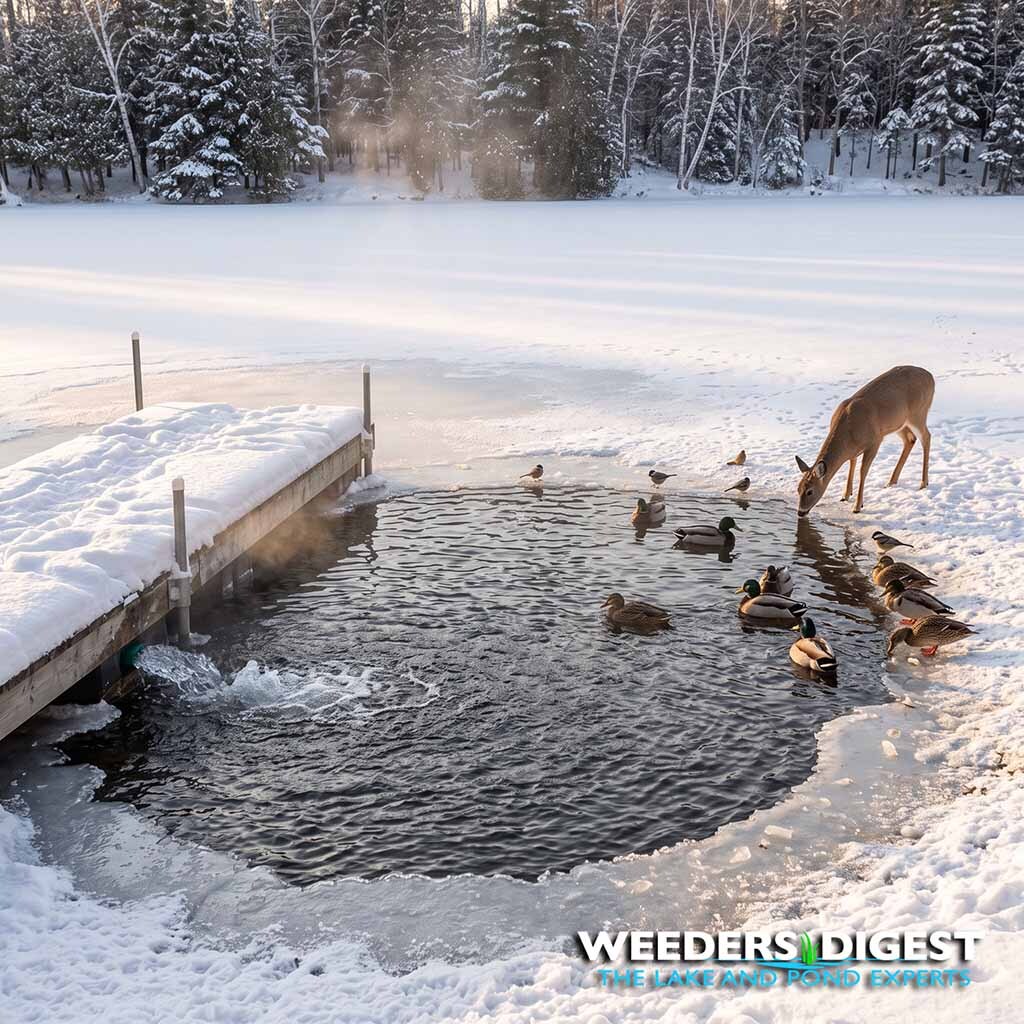
Yes, maintaining a small opening in the winter ice sheet significantly boosts the survival rate of local aquatic and terrestrial wildlife by preventing fatal oxygen starvation and providing vital hydration. When a waterbody freezes over, it functions like a sealed container, cutting off the natural diffusion of atmospheric oxygen and trapping lethal decomposition gases beneath the surface. Keeping just 1% to 2% of a pond or bay ice-free enables critical gas exchange, recharges dissolved oxygen levels, and provides an accessible watering hole for overwintering waterfowl, mammals, and songbirds that would otherwise struggle with severe dehydration.
During late-January site evaluations across frozen northern bays, our pond experts routinely witness dramatic shifts in water chemistry under sealed icecaps. Even in lakes with deep winter water columns, we frequently observe schools of panfish and game fish crowded tightly beneath solitary dock bubblers or naturally sustained current seams, actively seeking out the narrow pocket where atmospheric oxygen is entering the water. Without that deliberate opening, those fish populations quickly succumb to winterkill as organic lake muck quietly consumes the remaining oxygen reserve.
A small, carefully regulated winter opening provides a vital ecological refuge rather than a hazard. By circulating warmer, denser bottom water to the surface or mechanically disrupting ice formation, you create a localized micro-habitat. This opening sustains benthic invertebrates, prevents fish die-offs, and ensures local wildlife has consistent access to life-supporting open water throughout prolonged sub-zero freezes.
The Science Behind It:
The primary driver of winter wildlife mortality in frozen northern waterbodies is winterkill, an ecological collapse triggered by prolonged sub-ice hypoxia. In a standard temperate lake during late autumn, water reaches its maximum density at approximately 39.2°F (4°C) and sinks, setting up inverse winter thermal stratification where freezing 32°F (0°C) water rests immediately under the ice sheet while denser, warmer water remains near the substrate. Once ice and opaque snow pack seal the surface, sunlight penetration halts, reducing photosynthetically active radiation (PAR) to near zero and shutting down oxygen production by phytoplankton and benthic macrophytes.
Under complete ice cover, the lake operates as a closed thermodynamic and biochemical system governed by biochemical oxygen demand (BOD) and sediment oxygen demand (SOD). Research published by limnologists at the University of Minnesota and aquatic extension programs reveals that unmanaged organic muck and benthic decomposing plant material continually strip oxygen from the water column throughout winter. Standard game fish species require dissolved oxygen (DO) levels above 4.0 to 5.0 milligrams per liter (mg/L) for optimal survival; levels dropping below 2.0 to 3.0 mg/L induce acute respiratory stress, and extended exposure beneath 1.0 to 2.0 mg/L causes near-total fish mortality.
Aeration and de-icing studies demonstrate that maintaining open water on as little as 1% to 2% of the overall surface area provides sufficient atmospheric contact to safeguard the broader waterbody. This surface opening facilitates two-way gas transfer: it allows ambient oxygen to dissolve into the circulating water column while permitting accumulated toxic gases—specifically hydrogen sulfide (H2S), carbon dioxide (CO2), and methane (CH4) produced by anaerobic digestion in sediment—to vent harmlessly into the atmosphere.
Furthermore, terrestrial animals and non-migratory waterfowl depend on these open waters for physiological thermoregulation and hydration. Forcing mammals to ingest snow or frozen slush lowers their core body temperature, wasting critical caloric energy that is already scarce during mid-winter. Maintaining open water adjacent to shoreline structures allows wildlife to drink safely without risking hypothermia from walking over thin, unpredictable ice sheets.
Our Recommendation for Managing Winter Water Movement:
To safeguard aquatic life from winterkill without destabilizing the surrounding lake ice, targeted, directional water movement is far superior to uncontrolled, widespread bubbling. Rather than aggressively disturbing the bottom sediment layer—which can inadvertently spike sediment oxygen demand and super-cool the bottom sanctuary layer—waterfront property owners require continuous, controlled directional thrusting.
Using an adjustable directional circulation system, such as our AquaThruster Muck & Weed Blower collection, allows you to maintain a steady stream of moving water right at the surface or along a dock edge. This targeted flow creates a clean, predictable ice opening that keeps vital gas exchange active and vents toxic anaerobic gases while keeping thin ice localized strictly to your chosen perimeter. Setting up proper directional circulation preserves your game fish population through the deepest freezes while providing local wildlife with an accessible, reliable winter lifeline.
Sources / References:
- University of Minnesota Extension & St. Anthony Falls Laboratory: Evaluation of Aeration Methods and Dissolved Oxygen Depletion in Ice-Covered Lakes (ResearchGate: https://www.researchgate.net/publication/250981506_Evaluation_of_Two_Methods_of_Aeration_to_Prevent_Winterkill)
- Ohio State University Extension / SWCD Limnology Bulletin: Winter and Summer Fish Kill Mechanics in Temperate Ponds (https://www.athensswcd.org/uploads/3/0/1/0/30105193/winter_and_summer_fish_kills_in_ponds.pdf)
- Grace College Center for Lakes & Streams: Winter Aquatic Habitat, Dissolved Oxygen Dynamics, and Fish Torpor (https://lakes.grace.edu/what-you-should-know-about-fish-and-their-habitat-during-winter/)