

Choosing Your Weapon: Understanding Contact vs. Systemic Aquatic Herbicides
 |

Summary:
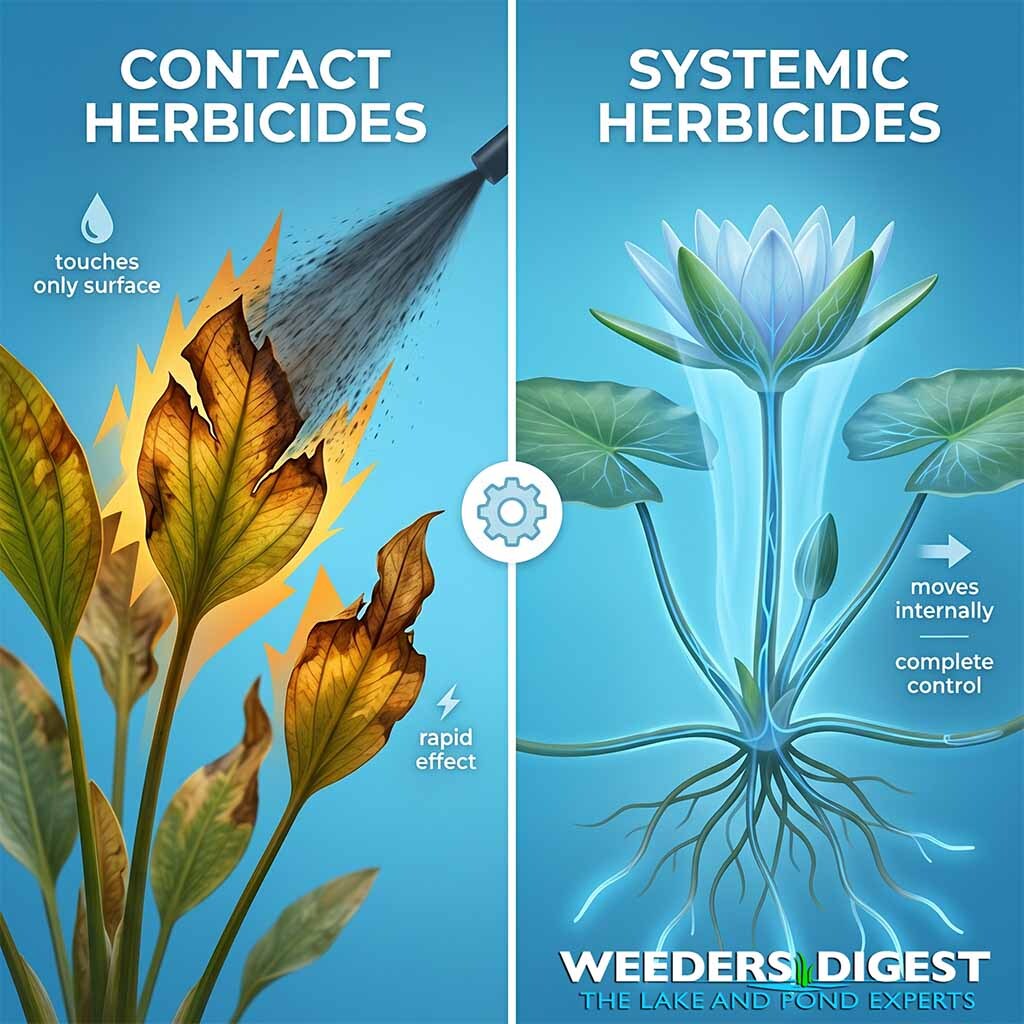
The fundamental difference between contact and systemic aquatic herbicides is how they move within the plant: contact herbicides destroy only the specific tissues they touch, while systemic herbicides are absorbed and transported throughout the entire plant to reach roots and growing points. Contact herbicides act rapidly, often showing visible results in hours or days, which makes them effective for quick, localized knockdown of surface-level vegetation. In contrast, systemic herbicides are slower-acting, often requiring days to weeks to fully manifest their effects, but they provide much more thorough control by reaching the plant’s internal structures.
From my experience in the field, managing a lake is rarely a "one-size-fits-all" scenario. A common mistake I see homeowners make is choosing a fast-acting contact herbicide for a deep-rooted, perennial infestation, like mature cattails or water lilies. Because the product doesn't move internally, the plant simply sheds the burnt leaves and regrows from the energy stored in its robust root system. If you want true long-term management of persistent, perennial weeds, you need the slow, deep-reaching power of a systemic herbicide, whereas you should reserve contact products for quick maintenance of annual, non-rooted weeds or for clearing navigation paths where rapid results are required.
The Science Behind It:
The efficacy of aquatic herbicides is defined by their "mode of action"—the specific biochemical process they disrupt within a plant’s cells. Contact herbicides, such as diquat or flumioxazin, operate by inducing rapid cellular damage at the point of entry. These chemicals often disrupt photosynthesis or damage cell membranes, leading to the formation of reactive oxygen species that physically destroy the plant tissue upon exposure. Because they do not move through the plant's vascular system, they are generally non-selective, killing any green tissue they coat. The rapid decomposition of this tissue is a critical management factor; because large-scale application can lead to a sudden collapse of biomass, it can deplete dissolved oxygen levels, potentially triggering localized fish kills in dense, stagnant water bodies.
Systemic herbicides, such as 2,4-D, triclopyr, or glyphosate, are designed for internal translocation. They are absorbed by leaves or stems and moved through the plant's phloem (the tissue that transports sugars) or xylem (the tissue that transports water) to "sink" sites, such as the meristems (growing points) and roots. By interfering with essential metabolic processes—such as amino acid production or hormonal growth regulation—systemic herbicides effectively starve or distort the plant from the inside out. For instance, bispyribac-sodium, a systemic herbicide, specifically inhibits the acetolactate synthase (ALS) enzyme, halting the production of essential amino acids required for plant growth.
Quantitative efficacy is heavily dependent on the duration of exposure. Research from the University of Florida indicates that control using systemic herbicides is highly dependent on contact time, meaning that even though the chemical is systemic, the water must hold a lethal concentration long enough for the plant to absorb a sufficient dose. Furthermore, biological degradation of these herbicides occurs through photolysis, hydrolysis, and microbial activity. Studies have shown that microbial degradation can vary significantly, with specific bacterial strains demonstrating the ability to reduce herbicide concentrations by up to 90% within 104 hours in contaminated soil settings, illustrating how complex environmental factors dictate the success rate of any chemical intervention.
The selection between these two categories must also consider the risk of resistance. The Weed Science Society of America (WSSA) emphasizes that repeated use of a single mode of action can lead to resistant plant populations. Because contact herbicides like those in the bipyridylium group act by creating free electrons that destroy membranes almost immediately, they have different selection pressures compared to systemic herbicides that act as synthetic growth regulators. Incorporating different modes of action is therefore essential for long-term ecological stability in managed ponds and lakes.