

Could Your Local Waterway Turn into a Flood Zone? How Invasive Aquatic Weeds Threaten Your Property
 |

Summary:
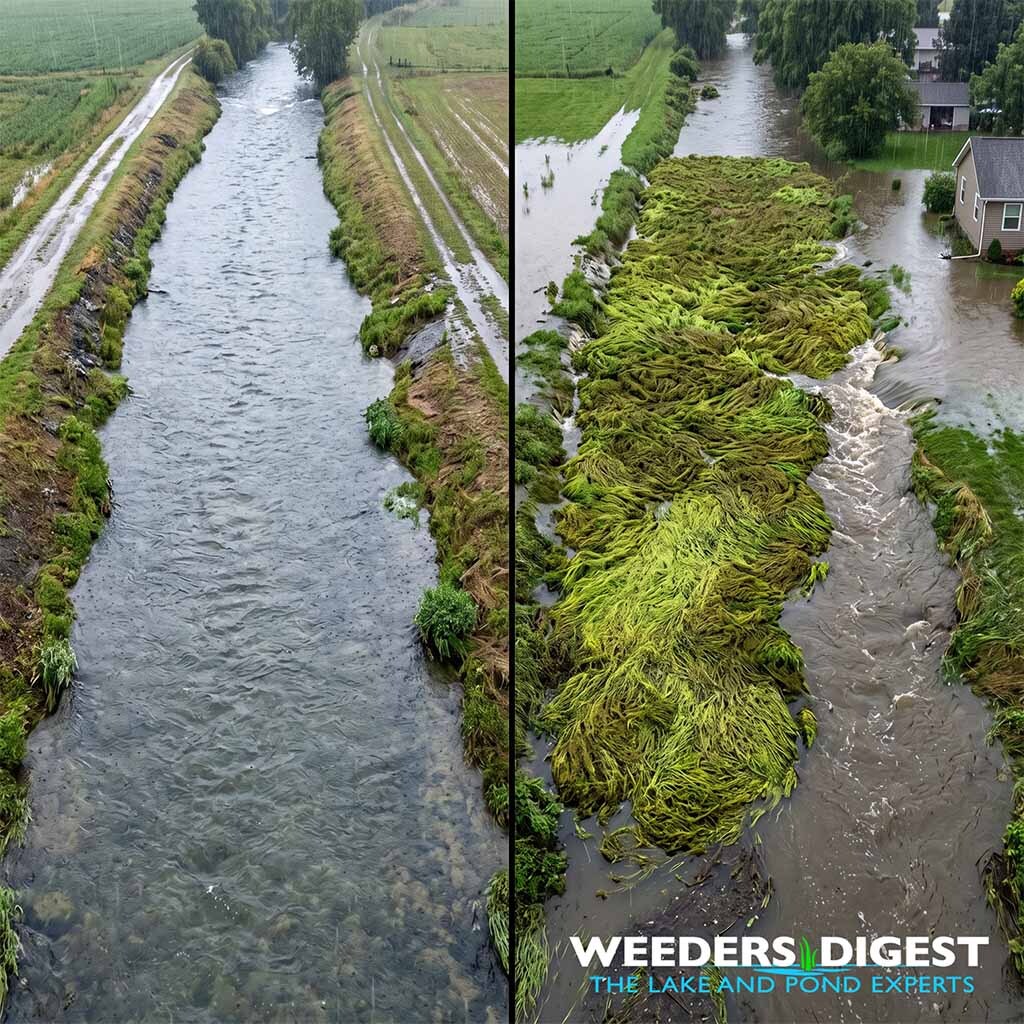
Have you ever noticed thick, tangled mats of weeds choking out your favorite lake, pond, or stream? While these invasive plants are certainly an eyesore and a nuisance for boating or swimming, they carry a much more serious hidden danger. Those dense walls of vegetation act like natural dams, physically blocking the free flow of water and setting the stage for significant flooding. When heavy rains hit, water that would normally rush downstream instead gets trapped behind these massive botanical barricades, causing water levels to rise rapidly and spill over the banks into nearby properties.
These aquatic invaders, unlike our native plants, grow at an incredibly aggressive rate and form impenetrable layers from the water bed all the way to the surface. When a storm rolls in, the drainage channels and local creeks that are supposed to whisk excess water away are simply too clogged to do their job. The water has nowhere to go but up and out, turning what should have been a routine rainstorm into a destructive flood event that can damage homes, roads, and local infrastructure.
Understanding this dynamic is critical because it shifts how we view weed management from a simple aesthetic preference to an urgent matter of public safety. By allowing invasive aquatic vegetation to spread unchecked, communities are inadvertently raising their own flood risks. Recognizing the physical barrier these plants create is the first step toward proactive management, ensuring that local waterways remain clear, safe, and capable of handling whatever Mother Nature sends their way.
The Science Behind It:
The relationship between invasive aquatic macrophytes and increased inundation risk is rooted in the principles of open-channel hydrodynamics and hydraulic resistance. When invasive species such as Eichhornia crassipes (water hyacinth) or Hydrilla verticillata form hyper-dense monocultures, they drastically alter the physical architecture of the water column. According to extensive hydrological modeling published in journals such as MDPI Water, vegetation in open channels significantly increases the hydraulic roughness coefficient, most commonly quantified using Manning's n or the Darcy-Weisbach friction factor. This elevated frictional resistance retards the mean flow velocity, effectively diminishing the channel's conveyance capacity and leading to a proportional increase in the required hydraulic head, which manifests as elevated flood stages.
The mechanical obstruction provided by these biological matrices is not merely a surface phenomenon; submerged invasive macrophytes occupy substantial volumetric space within the benthic and pelagic zones. Research on flow resistance due to aquatic vegetation, such as the comprehensive studies highlighted by Nicosia et al. and earlier foundational work by Nikora et al., demonstrates that the ratio of canopy height to mean flow depth is a critical determinant of hydraulic roughness. When invasive species reach the water surface and engage in a quasi-smooth or skimming flow regime, they create immense drag forces. This drag forces incoming discharge to lose kinetic energy, prompting a rapid conversion to potential energy in the form of rising water levels that eventually overtop natural or engineered embankments.
Furthermore, the structural integrity of invasive aquatic beds exacerbates sediment deposition, initiating a negative feedback loop that permanently alters the channel morphology. Because the dense vegetative stands reduce the kinetic energy of the water, suspended solids precipitate out of the flow and accumulate around the root and stem structures. Over successive seasons, this accelerated sedimentation physically reduces the cross-sectional area of the channel. As documented in scientific reviews on flow resistance at the reach scale, this morphological constriction means that even moderate precipitation events can exceed the newly diminished volumetric capacity of the waterway, triggering flood events at discharge volumes that would previously have been safely contained.
Beyond the direct reduction of channel conveyance, the displacement of water volume by the sheer biomass of the invasive species plays a non-trivial role in flood dynamics. High-yielding invasive aquatic plants produce massive amounts of organic matter that literally takes up space where water would normally reside. During high-flow events or flash floods, the combined effect of reduced flow velocity, severe channel constriction from trapped sediment, and massive biomass displacement results in a catastrophic failure of the natural drainage system. Consequently, active management of macrophyte density is an ecological necessity and a fundamental requirement for maintaining the hydrological safety and flood mitigation capabilities of engineered and natural watersheds.
Sources / References:
- Flow Resistance in Open Channel Due to Vegetation at Reach Scale: A Review. (MDPI) https://www.mdpi.com/2073-4441/13/2/116
- Flow Resistance due to Aquatic Vegetation in Streams and Flumes. (IRIS UniPA) https://iris.unipa.it/retrieve/76ba15ab-f230-4db6-be0e-b8367f61c658/2025_Nicosia_et_al_Flow%20Resistance%20due%20to%20Aquatic%20Vegetation%20in%20Streams%20and%20Flumes.pdf