

Decoding Fall Turnover: What is Actually Happening Beneath the Surface of Your Lake or Pond
 |

Summary:
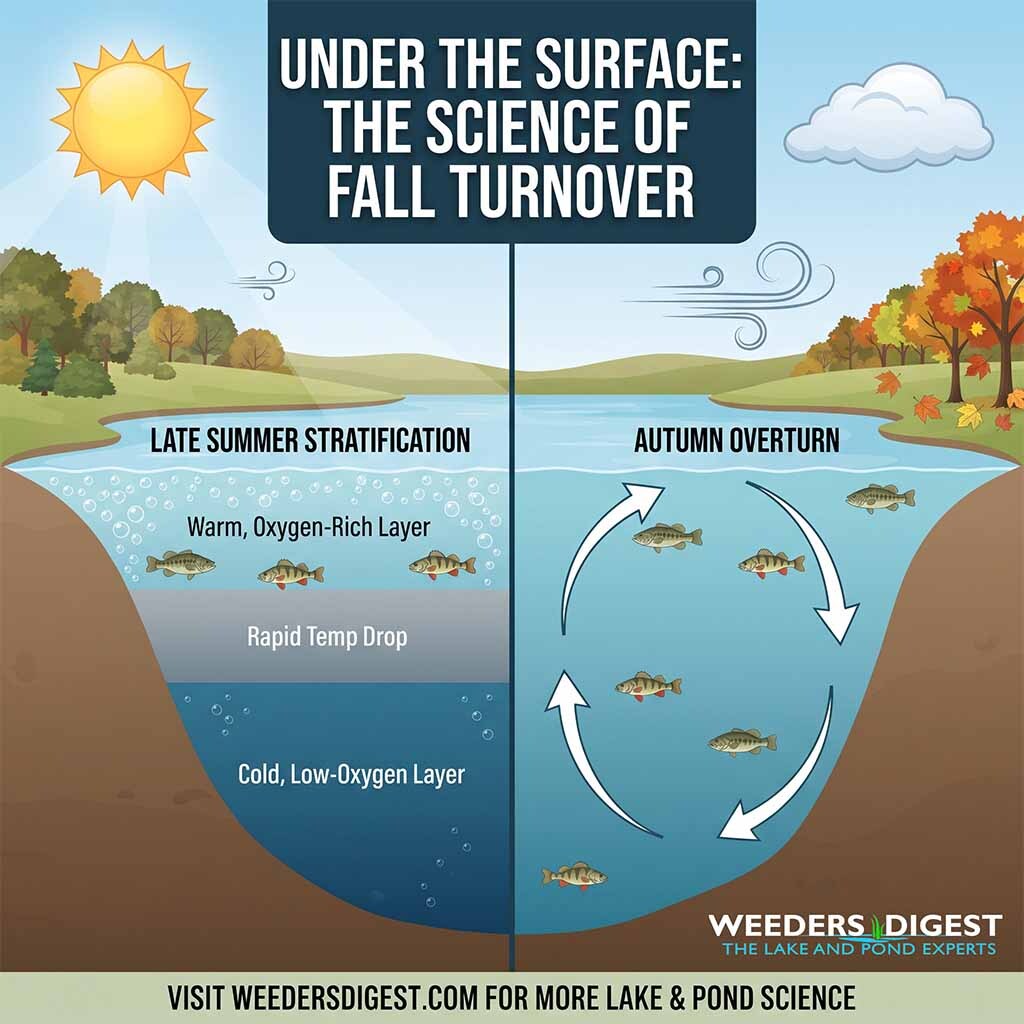
Fall turnover is the natural physical process where cooling autumn air temperatures lower the temperature of the upper water layer in a lake, causing it to become denser, sink, and mix the entire water column from top to bottom. As summer fades, the distinct thermal layers that previously locked a lake into isolated zones begin to break down. We frequently observe that this seasonal transition catches property owners off guard when the water suddenly appears murky or emits a distinct earthy odor. This temporary shift is simply the body of water redistributing dissolved oxygen and accumulated nutrients, ultimately preparing the aquatic ecosystem to safely endure the coming winter freeze.
The Science Behind It:
The mechanics of fall turnover are rooted in the unique thermal and density properties of freshwater. During the warm summer months, medium-to-deep lakes undergo thermal stratification, dividing into three distinct layers. The uppermost layer, the epilimnion, is warmed by the sun and mixed by the wind, keeping it oxygen-rich. Below this lies the metalimnion (containing the thermocline), a transitional zone where water temperature drops rapidly with depth. At the bottom sits the hypolimnion, a cold, isolated layer cut off from atmospheric oxygen and sunlight. In this lowest zone, decomposing organic matter consumes the remaining oxygen, frequently creating anoxic (oxygen-depleted) conditions while accumulating dissolved nutrients like phosphorus from bottom sediments.
As ambient air temperatures drop in the autumn, the warm surface waters of the epilimnion begin to cool. Water reaches its maximum density at approximately 4 degrees Celsius (39.2 degrees Fahrenheit). When surface water cools and approaches this temperature, its density increases, causing it to become heavier and sink downward. This downward movement displaces the lighter, warmer water below, forcing it upward.
Aided by seasonal winds, this convective mixing breaks down the remaining thermal barrier of the thermocline. Research into temperate lake dynamics highlights that this overturn period completely reorganizes the water column chemistry. For instance, studies tracking greenhouse gas budgets during autumn turnover note that roughly 46% of methane accumulated in the anoxic hypolimnion can be rapidly mixed and emitted to the atmosphere, transitioning the water column from anoxic to entirely oxic. Similarly, data on dissolved oxygen profiles show that fall mixing re-oxygenates the deep benthic zones, preventing catastrophic winter fish kills by ensuring oxygen is distributed throughout the entire depth before ice cover forms.
However, this vertical mixing also redistributes the nutrient reservoir accumulated at the lake bed over the summer. Phosphorus and nitrogen trapped in the bottom waters are brought up into the photic zone. According to long-term watershed monitoring data, this internal nutrient loading can occasionally trigger late-season algae or cyanobacteria blooms if sunlight and warm weather linger. Understanding these physical and chemical shifts helps pond experts explain why a lake temporarily turns turbid or smells earthy during the autumn months.