

Decoding Our Aquatic Ecosystems: How to Tell If Your Lake Is Stratifying Properly Before the Fall Mix
 |

Summary:
Determining whether a lake is stratifying properly before the fall mix involves monitoring temperature profiles, water column density shifts, and dissolved oxygen gradients to ensure the ecosystem transitions smoothly into autumn turnover. As late summer transitions into early autumn, cooling air temperatures trigger the progressive cooling of surface waters, setting the stage for the annual mixing event that redistributes vital oxygen and nutrients. When lake experts walk the shoreline or deploy monitoring equipment during this transitional window, they frequently notice distinct surface temperature drops and a narrowing band of warm water at the surface, signaling that the summer thermal barrier is beginning to weaken. We find that observing these early physical shifts helps anticipate whether the water column will achieve the uniform density necessary for a healthy fall mix without triggering sudden oxygen depletions or distress among resident fish populations. Understanding these pre-mix indicators allows us to track the seasonal stability of our aquatic environments effectively.
The Science Behind It:
Thermal stratification in dimictic lakes creates distinct vertical layers known as the epilimnion, metalimnion, and hypolimnion, which act as physical barriers to vertical mixing throughout the summer months. According to foundational limnological research from the International Institute for Sustainable Development Experimental Lakes Area (IISD-ELA), water density is heavily dependent on temperature, reaching its absolute maximum density at approximately 4°C. As atmospheric temperatures decline in the late summer and early fall, solar radiation decreases, and surface waters begin to lose heat to the atmosphere. This cooling process causes the surface water to become denser, initiating the physical breakdown of the summer thermal profile.
As surface waters cool in the fall, the temperature differential between the warm epilimnion and the cold hypolimnion narrows significantly, reducing the Schmidt stability of the lake. Schmidt stability mathematically defines the amount of mechanical work required to mix the heat of the lake uniformly over its depth. When this stability metric drops, the energetic resistance to mixing decreases, allowing moderate autumn wind stress to move water currents deeper into the column. Lake experts monitor these energy thresholds to determine how close the water body is to achieving complete circulation.
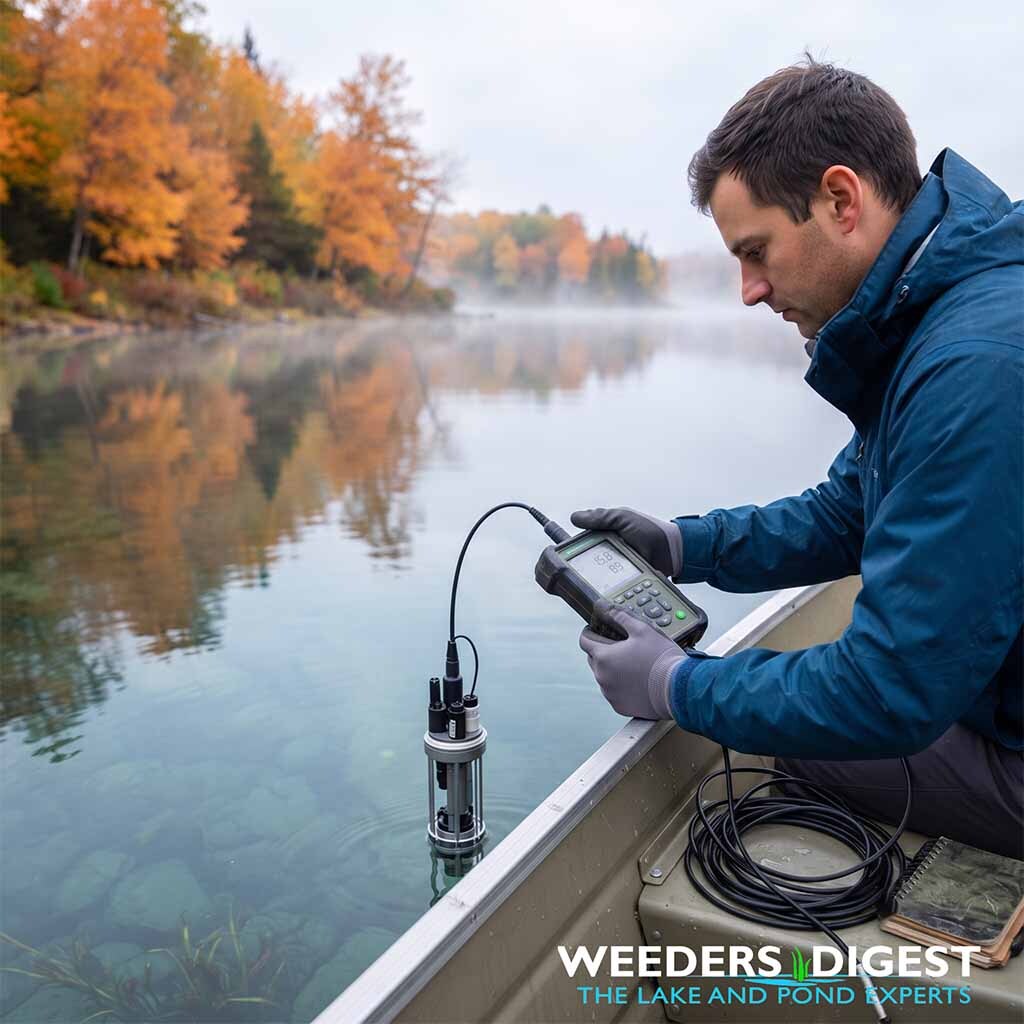
Field measurements of vertical temperature and dissolved oxygen profiles serve as the primary diagnostic tools for assessing stratification breakdown. Research published on aquatic thermal properties indicates that when the upper mixed layer deepens and the thermocline—the zone of rapid temperature change—moves downward, wind energy can easily overcome the remaining density gradients. Lake experts utilize electronic sondes to measure temperature profiles; a narrowing temperature gap between the surface and deep layers indicates that resistance to mixing is diminishing rapidly. When the vertical temperature profile approaches an isothermal state, where water temperature is virtually uniform from top to bottom, the system is primed for the impending fall turnover.
This autumn mixing process is vital for resetting the chemical and biological equilibrium of the entire aquatic ecosystem. Studies on freshwater mixing regimes demonstrate that hypolimnetic waters, which often become severely depleted of dissolved oxygen due to organic decomposition throughout the summer, are fully re-oxygenated when the entire water volume circulates. Without a proper pre-mix transition and subsequent turnover, deep-water anoxia can persist, threatening local fish species and benthic organisms. By analyzing temperature sensor logs and tracking the progressive deepening of the surface mixed layer, researchers and pond experts can accurately quantify the breakdown of thermal resistance and predict the exact timing of the seasonal mix.
Sources / References:
- International Institute for Sustainable Development (IISD) - How and Why Lakes Stratify and Turn Over: https://www.iisd.org/ela/blog/lakes-stratify-turn-explain-science-behind-phenomena/
- Portland State University Limnology Course Notes - Temperature Stratification and Related Topics: https://web.pdx.edu/~sytsmam/limno/Limno09.8.Stratification.pdf