

Decoding Spring Overturn: How Long Does Your Lake Take to Mix?
 |

Summary:
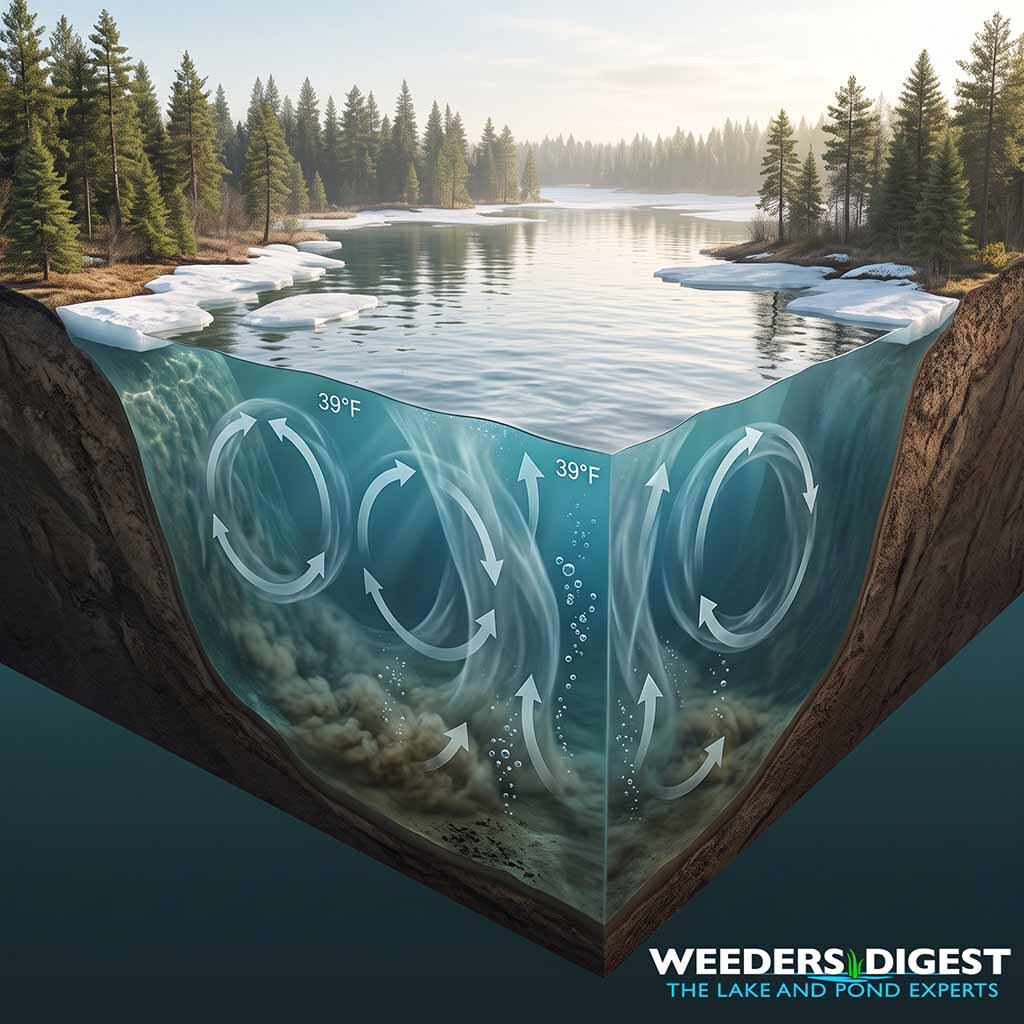
In a typical deep-water, dimictic lake, the actual spring turnover event generally lasts anywhere from several days to a few weeks, most frequently stabilizing over a window of 7 to 21 days depending on lake volume, wind fetch, and spring air temperatures. The turnover sequence begins immediately following ice-out when surface water warms from near freezing up toward maximum freshwater density at 39.2°F (4°C). Once the entire vertical water column reaches an isothermal state, resistance to mixing disappears, allowing spring winds to physically circulate the entire lake from surface to sediment.
When our lake experts visit shoreline properties right around ice-out, waterfront owners often describe their water turning murky, brownish, or smelling distinctively sulfury almost overnight. We routinely observe shoreline bays and dock slips catching floating debris, decomposing leaf litter, and foul sediment plumes that have surged up from the lake bottom during this mixing window. Once strong sunlight and mild air warm the upper layer past 40°F–45°F, summer thermal stratification rapidly takes hold, effectively locking the turnover window shut until late autumn.
The Science Behind It:
Limnologically, deep freshwater lakes across mid-latitude temperate zones operate as dimictic systems, meaning they circulate vertically twice per year: once in spring and once in autumn. Under winter ice cover, these lakes maintain an inverse thermal stratification where buoyant 32°F (0°C) water rests against the ice ceiling while the denser, relatively warmer 39.2°F (4°C) water remains parked at the benthic zone. As described in Robert G. Wetzel’s foundational treatise Limnology: Lake and River Ecosystems (2001), liquid freshwater reaches its absolute maximum density at 3.98°C. As surface ice melts, the epilimnetic water warms and sinks downward through free convection, eroding the winter density barrier until the entire water column is isothermal at approximately 4°C.
At this isothermal stage, the resistance to vertical mixing—known formally in physical limnology as the Brunt–Väisälä buoyancy frequency (N20) or thermal stability—approaches zero. Because there is no longer a density gradient separating the upper epilimnion from the bottom hypolimnion, wind shear driving across the lake's fetch readily pushes top-layer water across the basin, generating deep vertical convection cells and internal waves that cycle all the way to the lake floor.
According to long-term limnological monitoring from university extension programs and research published in Nature Communications on lake phenology (Woolway et al., 2021), this vernal holistic mixing period typically persists for 1 to 3 weeks in medium-to-deep temperate lakes. However, the duration is exceptionally volatile: research indicates that small, deep, wind-sheltered lakes can complete and cap spring mixing in as little as 3 to 7 days if rapid solar heating quickly pushes surface temperatures above 8°C to 10°C, inducing early thermal resistance. Conversely, in expansive, high-fetch lakes subjected to sustained spring gales, complete holomictic circulation can continue uninterrupted for 4 to 6 weeks until summer stratification locks in place.
This circulation period exerts profound geochemical and biological impacts on the entire aquatic ecosystem. As documented by research from the Wisconsin Limnology Center and the International Institute for Sustainable Development (IISD), spring turnover is the primary biological vehicle delivering dissolved oxygen down into the depleted hypolimnion, while simultaneously upwelling concentrated pulses of legacy phosphorus, orthophosphates, and ammonium from benthic muck into the photic zone. Studies show that this sudden internal nutrient loading frequently triggers early-season diatom surges and filamentous green algae blooms within days of turnover completion.
Our Recommendation for Managing Post-Turnover Sediment & Muck:
When spring turnover upwells nutrient-dense benthic muck and resuspends organic sediment across your swimming area, natural shoreline contours and dock configurations often act as sediment traps. Without targeted intervention, this stagnant material rapidly settles in shallow swimming zones and dock bays, providing the exact nutrient bed required for nuisance summer weed propagation and dense algal growth.
Because manual clearing cannot halt the continuous settling of microscopic, post-turnover organics, creating directional water velocity is scientifically necessary. Deploying continuous horizontal water velocity via specialized high-thrust blowers—such as the AquaThruster Muck & Weed Blower collection—mechanically alters the settling dynamic. By maintaining continuous laminar water movement along the benthic contour, these automated tools prevent newly turned-over sediment from precipitating around docks, sweeping decaying organic muck into deeper areas before it establishes root-anchored vegetation beds.
Sources / References:
- Wetzel, R. G. (2001). Limnology: Lake and River Ecosystems (3rd ed.). Academic Press. https://www.elsevier.com/books/limnology/wetzel/978-0-12-744760-5
- Woolway, R. I., Sharma, S., Weyhenmeyer, G. A., et al. (2021). Phenological shifts in lake stratification under climate change. Nature Communications, 12, 2318. https://doi.org/10.1038/s41467-021-22657-4
- University of Wisconsin–Madison Center for Limnology. (2020). Learn Your Lakes: Spring Turnover. https://blog.limnology.wisc.edu/2020/04/06/learn-your-lakes-spring-turnover/