

Decoding the Depths: Finding Fish When Late August Water Temperatures Peak
 |

Summary:
When late August water temperatures peak, fish locate comfortable microclimates by seeking out the thermocline and utilizing vertical stratification boundaries where water temperature and dissolved oxygen intersect. Late summer introduces intense thermal stress to aquatic environments, forcing ectothermic species to alter their typical distribution patterns dramatically. When walking down to the shoreline during a late August afternoon, pond experts frequently observe surface waters nearly devoid of active feeding as target species retreat into deeper, thermally stable zones. We understand that finding fish during this sweltering annual peak requires looking past surface-level casting and focusing instead on the hidden physical layers of the water column.
The Science Behind It:
As ectotherms, fish experience bodily metabolic rates that are directly dictated by ambient water temperatures, a relationship described by the Q10 temperature coefficient where uncompensated metabolic processes increase two-to-threefold with every 10°C rise in environmental temperature. By late August, solar radiation has heated the upper stratum of the lake, known as the epilimnion, driving water temperatures past the optimal thermal preference windows for many sport fish species. Concurrently, this intense stratification creates a deep, cold bottom layer called the hypolimnion, which becomes severely depleted of dissolved oxygen as organic matter decomposes through microbial respiration.
Trapped between these two extreme environments lies the thermocline—a narrow transitional layer characterized by a rapid temperature drop with increasing depth. Research into thermal stratification highlights that while fish prefer cooler temperatures to slow down accelerated summer metabolisms, their physiological lower limits for dissolved oxygen often restrict them from lingering in the deepest waters. According to fisheries management guidelines published by state natural resource agencies, late-summer fish concentration is dictated by this precise physiological compromise, where species suspend themselves right along the upper edge of the thermocline or near localized cool-water upwellings and spring inflows.
The behavioral adjustments observed during this peak temperature window also involve shifts in temporal feeding patterns. Because standard metabolic rates peak alongside environmental warmth, fish experience heightened energy demands coupled with reduced aerobic efficiency. Studies tracking freshwater habitat usage indicate that fish cope with these dual stressors by restricting heavy movement to low-light periods—such as dawn and dusk—when surface temperatures temporarily dip and zooplankton or forage fish migrate vertically. During midday hours, these populations remain tightly bound to structural refuges or suspended just above oxygenated thermal boundaries, minimizing energy expenditure while waiting for more favorable feeding conditions.
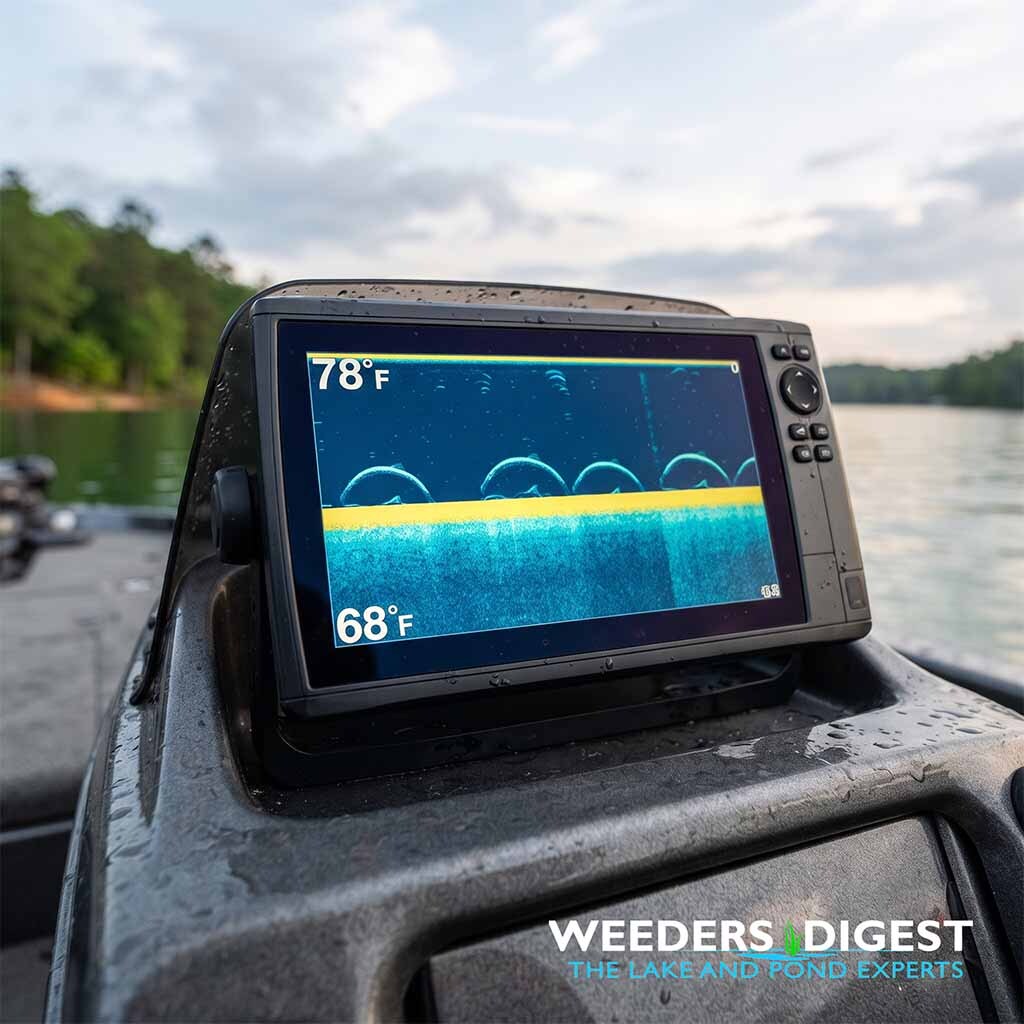
Understanding these limnological mechanics transforms late-season strategies from guesswork into precise ecological targeting. By utilizing modern high-resolution sonar to locate the distinct acoustic density gradient of the thermocline, lake experts can pinpoint precisely where game fish are suspended. Recognizing that water bodies with higher turbidity or unique wind-driven internal seiches can shift these thermal layers closer to the surface ensures that adjustments are made dynamically to match local environmental conditions rather than relying on generalized depth assumptions.
Sources / References:
- Iowa Department of Natural Resources (DNR) - Fishing the Thermocline for Better Summer Success: https://www.iowadnr.gov/news-release/2015-07-08/fishing-thermocline-better-summer-success
- PMC (PubMed Central) - Effects of temperature on feeding and digestive processes in fish: https://pmc.ncbi.nlm.nih.gov/articles/PMC7678922/
- Canadian Meteorological and Oceanographic Society (CMOS) Bulletin - Thermal stratification in lakes determines where fish are, but also modifies how well acoustic telemetry can detect them: https://bulletin.cmos.ca/thermal-stratification-in-lakes-determines-where-fish-are-but-also-modifies-how-well-acoustic-telemetry-can-detect-them/