

Do Fish Seek Out the Open Water Created by Winter De-Icers?
 |

Summary:
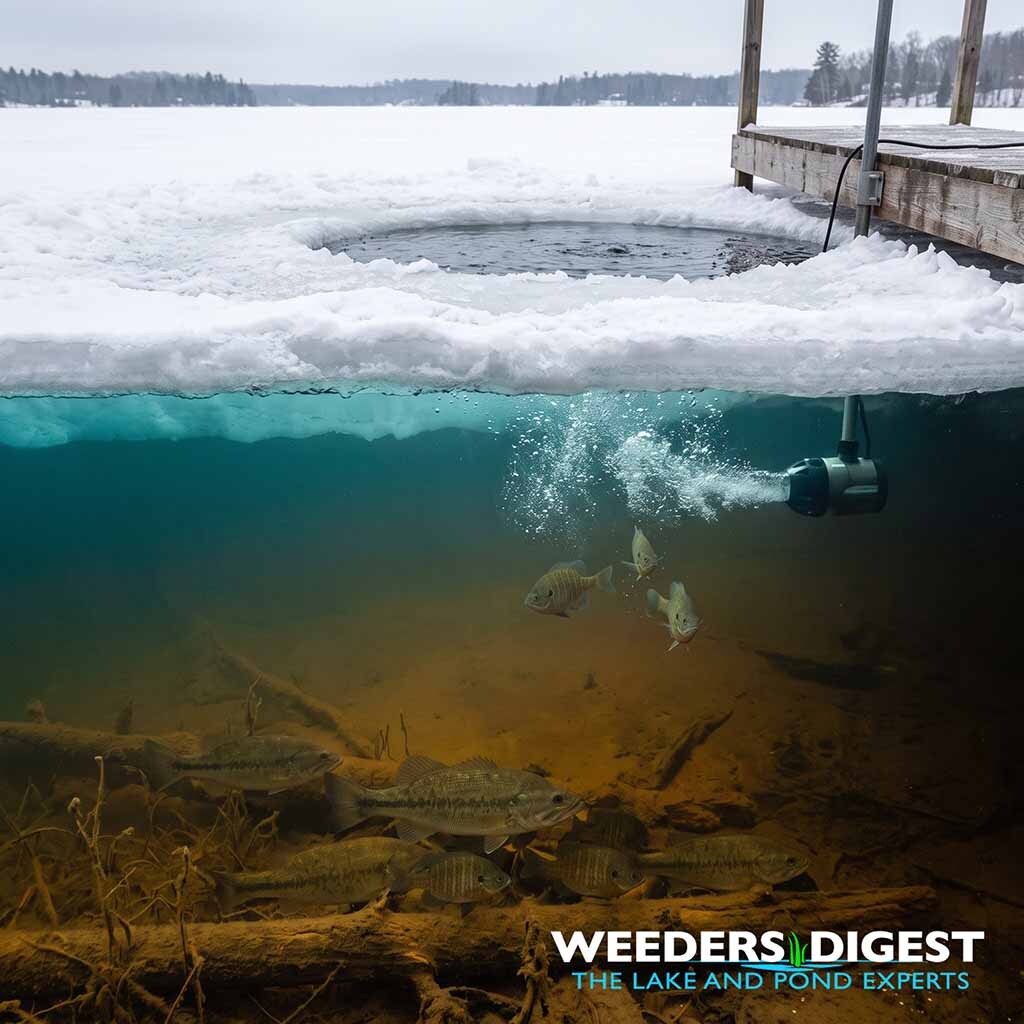
Fish do not actively seek out surface openings created by winter de-icers unless severe oxygen depletion forces them into an emergency survival response. Under normal sub-ice conditions, freshwater fish avoid surface openings because surface waters are near freezing (0°C to 1°C) and expose them directly to light and avian or terrestrial predators. Fish are ectothermic, so they naturally retreat toward the lake bottom where inverse thermal stratification stabilizes water at its densest, warmest state of 4°C (39.2°F).
However, when prolonged snowpack and heavy ice choke off sunlight, photosynthesis stops and benthic microbial decomposition rapidly consumes the remaining dissolved oxygen. As hypolimnetic oxygen drops below critical survival thresholds, fish abandon their preferred warm bottom refuge and are chemically forced upward. In these emergency conditions, gamefish will crowd directly into the aerated, open water maintained by dock de-icers or diffused aerators, exhibiting surface piping behavior to capture life-saving oxygen.
In our winter field observations across northern lakes, our lake experts frequently monitor clear ice formations around dock arrays. Healthy bass, pike, and bluegills remain suspended near deep drop-offs and mid-depth weedlines well away from the turbulence of surface agitators. It is only when mid-winter core samples reveal anoxic bottom water that we observe lethargic fish schooling directly in de-icer plumes or gasping along open slush margins.
The Science Behind It:
Under a sealed winter ice sheet, a freshwater waterbody operates as a closed biogeochemical system governed by inverse thermal stratification. Because freshwater achieves its maximum density at 3.98°C (~4°C), the heaviest water sinks to the lake floor while colder, less dense water rests immediately beneath the ice. Research from the University of Minnesota and aquatic ecological surveys published in Water Resources Research demonstrates that sediment beds generate high biochemical oxygen demand (BOD) as organic matter decomposes. When early snow accumulation of even 4 inches blocks more than 90% of solar radiation, submerged macrophytes and phytoplankton cease oxygen production and die, initiating massive heterotrophic respiration.
As microbial decomposition strips oxygen from the sediment-water interface upward, dissolved oxygen levels begin a steady decay. According to fisheries research from the University of Florida Extension and university limnology departments, optimum gamefish physiological function requires dissolved oxygen levels above 5.0 mg/L. Most freshwater species, including largemouth bass (Micropterus salmoides) and bluegill (Lepomis macrochirus), exhibit acute physiological distress when dissolved oxygen drops into the 2.0 to 4.0 mg/L range, and sustained concentrations below 1.0 to 2.0 mg/L are lethal.
When oxygen depletion progresses, fish are forced to make a physiological trade-off: abandon their thermally stable, warm 4°C sanctuary near the bottom or face asphyxiation from winterkill. Fish respond by moving up into the colder, shallower water column to find usable oxygen gradients. If a localized de-icer or surface aerator is operating, gas transfer occurs at the air-water interface, re-oxygenating the immediate perimeter while venting trapped, toxic hydrogen sulfide and methane. Fish detect these micro-refugia via chemosensory and branchial receptors, homing in on the localized oxygen plume.
University aeration studies demonstrate that standard winter de-icers and high-velocity circulators operate by drawing warmer water from depth and directing it toward the surface to prevent ice formation. While this mechanism reliably protects docks, piers, and boat lifts from expansion and jacking damage, improper deployment can inadvertently supercool the water column or disturb the sediment boundary layer, accelerating biological oxygen demand if benthic silt is violently churned. The ultimate survival of the fish depends on maintaining adequate oxygen throughout the lake without eliminating the critical thermal layering that keeps fish alive during prolonged freezes.
Our Recommendation for Managing Winter De-Icing & Dissolved Oxygen
Balancing property protection with a healthy winter fishery requires equipment that targets water movement with absolute precision. High-velocity surface circulators are essential for preventing catastrophic ice jacking around dock pilings and boat lifts, but running raw, unshielded bottom thrust can disrupt thermal stratification and disturb sensitive sediment.
To safeguard both your shoreline infrastructure and local fish populations, we recommend directional, high-efficiency water circulators engineered for adjustable depth placement. Utilizing tools like our AquaThruster Muck & Weed Blower collection allows waterfront owners to tailor operational angles, ensuring consistent surface turbulence to keep dock zones open without scouring the benthic floor. For full-pond winter health, pairing perimeter de-icing with mid-depth, low-velocity diffused aeration maintains life-saving dissolved oxygen zones without stripping away the essential 4°C deep-water thermal refuge your fish rely on to survive until spring thaw.
Sources / References:
- University of Illinois Urbana-Champaign Extension. Under the Ice: What Winter Means for Your Pond. (https://extension.illinois.edu/news-releases/under-ice-what-winter-means-your-pond)
- University of Florida IFAS Extension. Dissolved Oxygen for Fish Production. (https://ask.ifas.ufl.edu/publication/FA002/pdf)
- Stefan, H. G., et al. Evaluation of Two Methods of Aeration to Prevent Winterkill. Water Resources Research / University of Minnesota St. Anthony Falls Hydraulic Laboratory. (https://www.researchgate.net/publication/250981506_Evaluation_of_Two_Methods_of_Aeration_to_Prevent_Winterkill)