

Do Lake Weeds Actually Die in October, or Are They Just Hibernating in Your Lake?
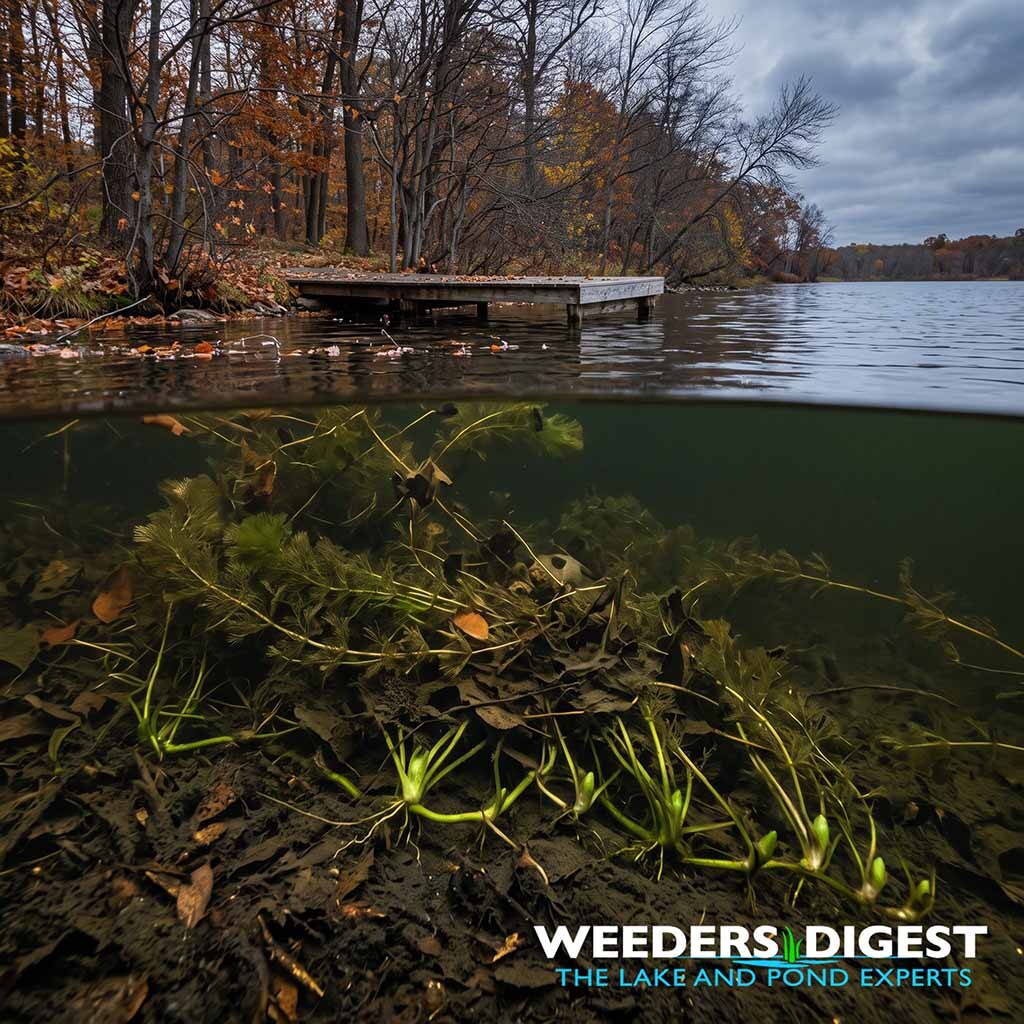 |

Summary:
Most perennial lake weeds do not disappear when fall arrives. As days shorten and water temperatures drop, many species lose or reduce their visible stems and leaves while surviving through roots, root crowns, rhizomes, seeds, or specialized winter buds. Annual species finish their life cycle and leave seeds behind. Eurasian watermilfoil typically survives through its roots and lower stems, while curly-leaf pondweed follows a different cycle, producing turions that often begin sprouting again during fall and early winter.
This seasonal change often makes a lake look much cleaner from the surface. Dying foliage collapses, breaks apart, or settles toward the lake bottom, while living plant structures remain below. The timing varies by species, water depth, light, sediment conditions, and weather. In northern lakes, some plants remain dormant through winter, while others, including curly-leaf pondweed, continue slow growth beneath the ice.
The dead plant material left behind also becomes part of the lake’s decomposition cycle. Bacteria and fungi break down leaves and stems, a process that consumes dissolved oxygen and returns nutrients to the water and sediment. Under heavy vegetation loads and prolonged low-oxygen conditions, this organic material contributes to soft sediment and muck buildup. This process is natural, but excessive plant growth increases the amount of organic material settling into shallow areas.
By spring, surviving roots, root crowns, rhizomes, seeds, and turions give established aquatic plants a head start as growing conditions improve. This explains why the same shoreline areas often develop nuisance vegetation year after year. A weed-free appearance in October does not always mean the plants are gone. In many cases, the structures responsible for the next season’s growth are already established below the surface.
The Science Behind It:
The phenological transition observed in aquatic macrophytes during October is governed by physiological dormancy rather than systemic mortality. Submersed vascular macrophytes survive freezing surface conditions using specialized vegetative structures, primarily turions, subterranean rhizomes, and dormant root crowns. Perennial invaders such as Eurasian watermilfoil (Myriophyllum spicatum) translocate non-structural carbohydrates from their canopy leaves down into their basal crowns and root systems as water temperatures decline. Conversely, curly-leaf pondweed (Potamogeton crispus) produces hundreds of compact, serrated vegetative buds called turions during late spring and summer, which sink into the sediment and initiate cold-water germination as early as late autumn and winter beneath the ice.
When aquatic macrophyte canopies collapse, the organic mass settles directly into the benthic boundary layer, triggering rapid microbial decomposition. Peer-reviewed research evaluating the winter decomposition dynamics of macrophytes reveals that the majority of vegetative mass loss occurs within the initial 10 to 14 days of submergence, even under frigid surface conditions. During this initial breakdown phase, microbial respiration spikes dramatically, driving dissolved oxygen concentrations in the immediate microenvironment close to zero (anoxia). Quantitative studies published in aquatic ecology journals (such as Water) demonstrate that macrophyte decomposition under ice and in cold regimes can release substantial amounts of internal nutrient loading back into the water column, converting upwards of 40% to 60% of decomposing plant nitrogen and phosphorus directly into sediment-bound organic muck and bioavailable nutrients.
This benthic nutrient recycling establishes an internal autotrophic feedback loop. As leaves and stems decay, lignin and cellulose combine with fine mineral particles to form a soft, anaerobic muck layer. In a healthy, well-mixed water column, aerobic bacteria break down organic detritus efficiently. Under stagnant conditions, however, cold-water stratification and oxygen depletion prevent organic matter from fully degrading. The result is an accumulation of black, hydrogen-sulfide-rich muck that acts as a protected, nutrient-dense incubator for dormant root systems throughout the winter months.
Consequently, while the water column appears clear in late October, the ecosystem is absorbing a heavy biochemical shock. The combination of viable resting propagules (rhizomes and turions) lying embedded within newly fertilized muck deposits ensures that nuisance weed beds return earlier, denser, and more resilient every subsequent season.
Sources / References:
- MDPI Water Journal: Winter Decomposition of Emergent Macrophytes Affects Water Quality
- University of Arkansas at Pine Bluff Extension: Winter Drawdown for Aquatic Weed Control and Pond Management
- University of Florida IFAS Extension: A Beginner's Guide to Water Management—Aquatic Plants in Lakes