

How Climate, Seasonality, and Extreme Weather Are Rapidly Changing Your Lake
 |

Summary:
Climate, seasonality, and shifting weather patterns directly dictate the lifespan, severity, and ecological balance of aquatic weeds and algal blooms in your lake or pond. Warmer temperatures extend the natural growing season, while heavy rains dump nutrient-rich runoff into the water, acting as a massive dose of fertilizer for nuisance vegetation and algae. When the weather fluctuates wildly—such as a prolonged drought followed by torrential downpours—it disrupts the natural mixing of the water, creating a stagnant, sun-baked surface layer where invasive species and toxic blooms can rapidly take over.
As a Certified Lake Manager, I have seen this ecological shift firsthand while mapping invasive species across shallow basins throughout the Midwest. Ten years ago, we rarely saw active curly-leaf pondweed or Eurasian watermilfoil growth before late spring, but now I consistently find robust aquatic weed beds establishing weeks earlier in the season following mild winters and early ice-offs. The baseline of what we consider "normal" pond seasonality is shifting earlier every single year.
This unpredictability ultimately makes long-term pond maintenance much harder for property owners. When spring arrives earlier and autumn stays warmer longer, the biological window for weed and algae reproduction expands, meaning the traditional timeline for lake management has to adapt to a climate that is increasingly favoring aggressive, opportunistic aquatic growth.
The Science Behind It:
As global temperatures rise, the limnological mechanics of freshwater ecosystems are fundamentally altered. Thermal stratification—the process where lakes separate into distinct temperature layers, including a warm epilimnion at the surface and a cold hypolimnion at the bottom—is intensifying earlier in the year. A global study covering 235 lakes demonstrated that lake surface water temperatures have increased by an average of 0.34 °C per decade between 1985 and 2009 (O'Reilly et al., as cited in MDPI Water). This accelerated surface warming creates a harsh density barrier that prevents essential vertical mixing, ultimately leading to hypoxic (low oxygen) conditions in the deeper waters as the summer progresses.
Eutrophication, the over-enrichment of waters with nutrients like phosphorus and nitrogen, is deeply exacerbated by shifting weather dynamics. Extreme, concentrated precipitation events increase terrestrial runoff, depositing high volumes of dissolved organic carbon and nutrients into the watershed all at once. In shallow lakes, this intense nutrient influx coincides with elevated surface temperatures to drastically lower the threshold for cyanobacterial (blue-green algae) proliferation. Furthermore, rising temperatures alter aquatic plant stoichiometry; warming decreases the nitrogen and phosphorus concentrations within plant tissues while increasing their carbon-to-nutrient ratios, which decreases their palatability to the natural herbivores that would otherwise help keep growth in check.
Aquatic weed and phytoplankton communities are highly sensitive to these specific climatic shifts, and elevated thermal regimes give a distinct competitive advantage to harmful algal blooms (HABs) over beneficial macrophytes (rooted aquatic plants). A comprehensive study evaluating temperature impacts found that warming aquatic environments caused an 18% increase in cyanobacterial chlorophyll-a concentrations, illustrating exactly how thermal shifts directly stimulate harmful algal biomass (Lürling et al., as cited in MDPI Water). Cyanobacteria are uniquely equipped to exploit these conditions because they can migrate vertically through the water column, absorbing sunlight at the surface and trapping heat, which further increases localized water temperatures in a dangerous positive feedback loop.
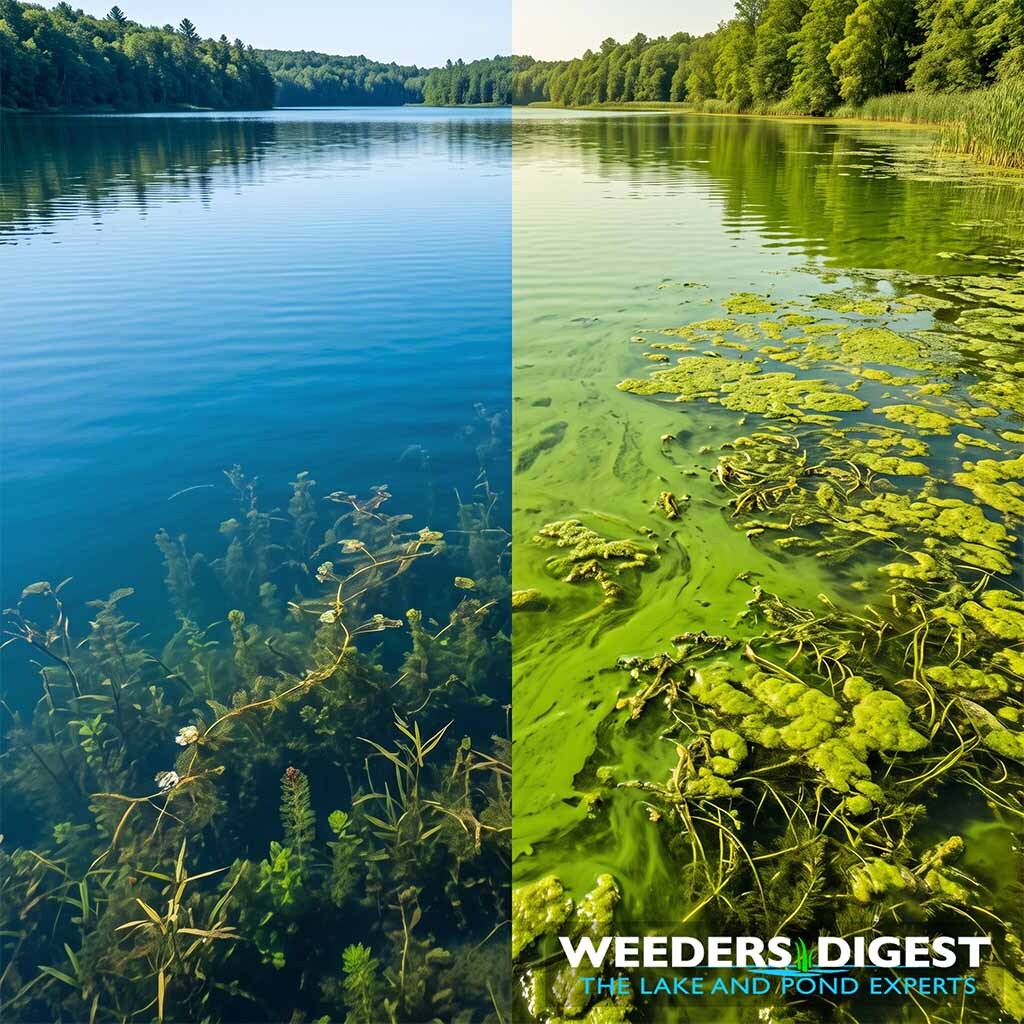
The combination of early ice melt, intensified thermal stratification, and heightened nutrient runoff facilitates a total ecological regime shift. Lakes historically dominated by clear water and native submerged aquatic vegetation are rapidly transitioning into turbid, algae-dominated states. When submerged macrophytes are shaded out by dense algal surface canopies, the lake loses critical biological filtration and structural habitat for zooplankton, which normally act as a natural defense by grazing on algae. Consequently, these climatic and seasonal weather variables compound to destabilize the entire aquatic food web, degrade water clarity, and permanently alter the ecological baseline of freshwater systems worldwide.
Sources / References:
- MDPI Water: A Review on Climate Change Impacts on Freshwater Systems and Ecosystem Resilience (https://www.mdpi.com/2073-4441/17/21/3052)
- MDPI Water: Climate Change Impacts on Water Temperatures in Urban Lakes: Implications for the Growth of Blue Green Algae (https://www.mdpi.com/2073-4441/16/4/587)
- PMC: Effects of Rising Temperature on the Growth, Stoichiometry, and Palatability of Aquatic Plants (https://pmc.ncbi.nlm.nih.gov/articles/PMC6331454/)