

How High Water Events and Floods Can Spread Aquatic Weeds to Your Lake
 |

Summary:
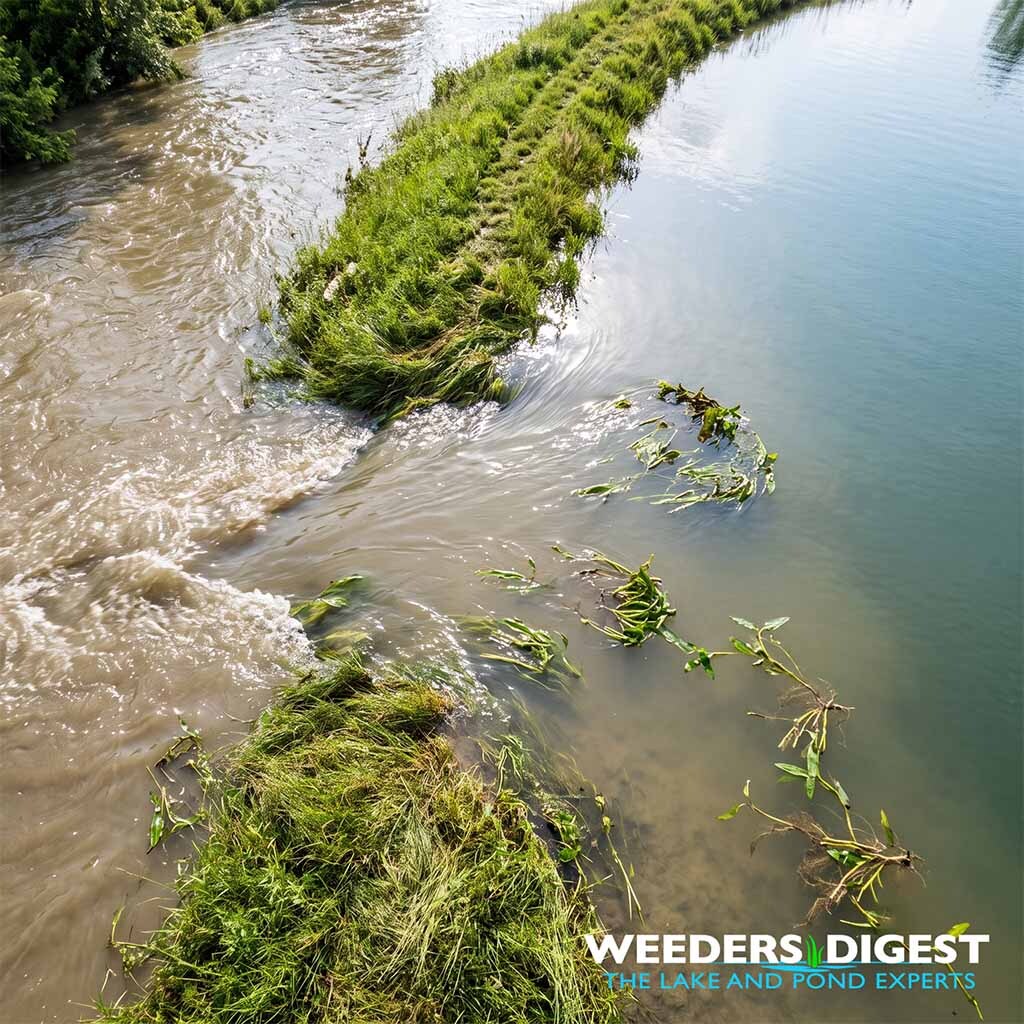
High water events and flooding spread aquatic weeds between basins by physically carrying plant fragments, seeds, and root structures across natural land barriers that normally separate distinct bodies of water. When lake levels rise and overflow their banks, the excess water acts as a high-speed transport system, linking isolated ponds, streams, and lakes that would never interact under normal conditions. This sudden hydrological connectivity allows invasive plants to hitch a ride on the current, floating downstream or spilling into adjacent basins to establish new colonies.
As a Certified Lake Manager who has spent years surveying post-flood shorelines, I regularly see this dynamic play out after major spring torrents or heavy summer storms; a lake with no history of Eurasian watermilfoil will suddenly develop a sprawling patch right where an overflowing creek or flooded ditch drained into it. These floodwaters do not just move water, but rather they carry heavy loads of topsoil, nutrients, and biological material that eventually settle in the newly connected basins. Once the floodwaters recede and the waterbodies become isolated again, the newly introduced weed fragments quickly take root in the nutrient-rich sediment left behind.
Because many invasive aquatic plants do not need seeds to reproduce, even a tiny stem snapped off by rushing floodwaters can spawn a massive infestation in a new habitat. The fast-flowing water easily rips these fragile stems from their parent plants and sweeps them into neighboring lakes. Homeowners and lake associations often assume their weed problems originate exclusively from contaminated boat trailers, but severe weather and changing water levels are equally powerful forces that can transform a pristine basin into a weed-choked waterbody practically overnight.
The Science Behind It:
The dispersal of aquatic vegetation through water movement is known ecologically as hydrochory, a fundamental mechanism that drives plant community dynamics in riverine and floodplain ecosystems. During high-water events, temporary hydrological connectivity unites disparate geographic basins, allowing for the widespread transport of plant propagules. A propagule is any plant material capable of generating a new individual, which can include generative structures like seeds, or vegetative structures such as stolons, tubers, and stem fragments. Flooding increases sheer stress on existing submerged vegetation, physically detaching these reproductive structures and entraining them in the water column where they are transported well beyond their native catchment area.
The biological success of flood-driven dispersal is heavily dependent on propagule buoyancy and viability. Research investigating the dispersal capacity of riparian fen species reveals that vegetative propagules possess an extraordinary ability to survive long-term suspension in water. A study conducted by Soomers et al. demonstrated that the buoyancy of vegetative propagules ranges from 25 days to over six months, with more than 50% of the tested propagules remaining fully viable and capable of rooting after floating for half a year. This prolonged viability ensures that plant fragments swept up in a major flood event or seasonal inundation have ample time to reach a new basin, settle into the substrate as flow velocities decrease, and successfully establish a new population.
Once floodwaters breach a new basin, the physical architecture of the receiving ecosystem dictates where these newly introduced propagules will aggregate. Hydrogeomorphic processes—the interaction between water flow and the earth's surface—cause suspended matter to drop out of the water column in areas of low kinetic energy. Recent field trials investigating riverine systems found that existing patches of aquatic vegetation act as highly efficient biological filters. Specifically, existing aquatic plants retain 56% more propagules and fine sediment than unvegetated, open channel locations. Consequently, when floodwaters introduce invasive fragments into a new lake, those fragments are disproportionately trapped by native plant beds, placing the highly competitive invaders directly into optimal littoral habitats.
Invasive aquatic species are particularly adapted to exploit this episodic connectivity due to their reliance on asexual fragmentation and rapid phenotypic plasticity. When introduced to a novel, nutrient-loaded environment left in the wake of a flood, these vegetative fragments immediately initiate rhizome expansion rather than expending energetic resources on seed germination. Because flood events simultaneously transport propagules and deposit organic-rich fine sediments into the receiving basin, the resulting ecological conditions perfectly overlap with the physiological requirements of the invading species, driving rapid colonization that alters the benthic community structure long after the floodwaters recede.
Sources / References:
- https://www.researchgate.net/publication/257569206_The_Dispersal_Capacity_of_Vegetative_Propagules_of_Riparian_Fen_Species
- https://www.researchgate.net/publication/379902589_Riverine_aquatic_plants_trap_propagules_and_fine_sediment_Implications_for_ecosystem_engineering_and_management_under_contrasting_land_uses