

How I Use Macroinvertebrate Surveys to Prove Your Lake Weed Management is Working
 |

Summary:
Macroinvertebrate surveys serve as an exceptionally reliable, living report card to measure the long-term success of lake weed management by indicating whether a balanced, healthy ecosystem has successfully replaced a choked, nuisance weed infestation. When we alter the plant community in a lake or pond—whether by cutting back aggressive weeds or selectively treating invasive species—we drastically alter the underwater habitat. By collecting and identifying the tiny, spineless creatures living on the lake bottom and among the remaining vegetation, we can determine if the water body is truly healing or if it is still trapped in an unhealthy state. A diverse population of these small organisms proves that the underwater environment has stabilized and can support a vibrant food web.
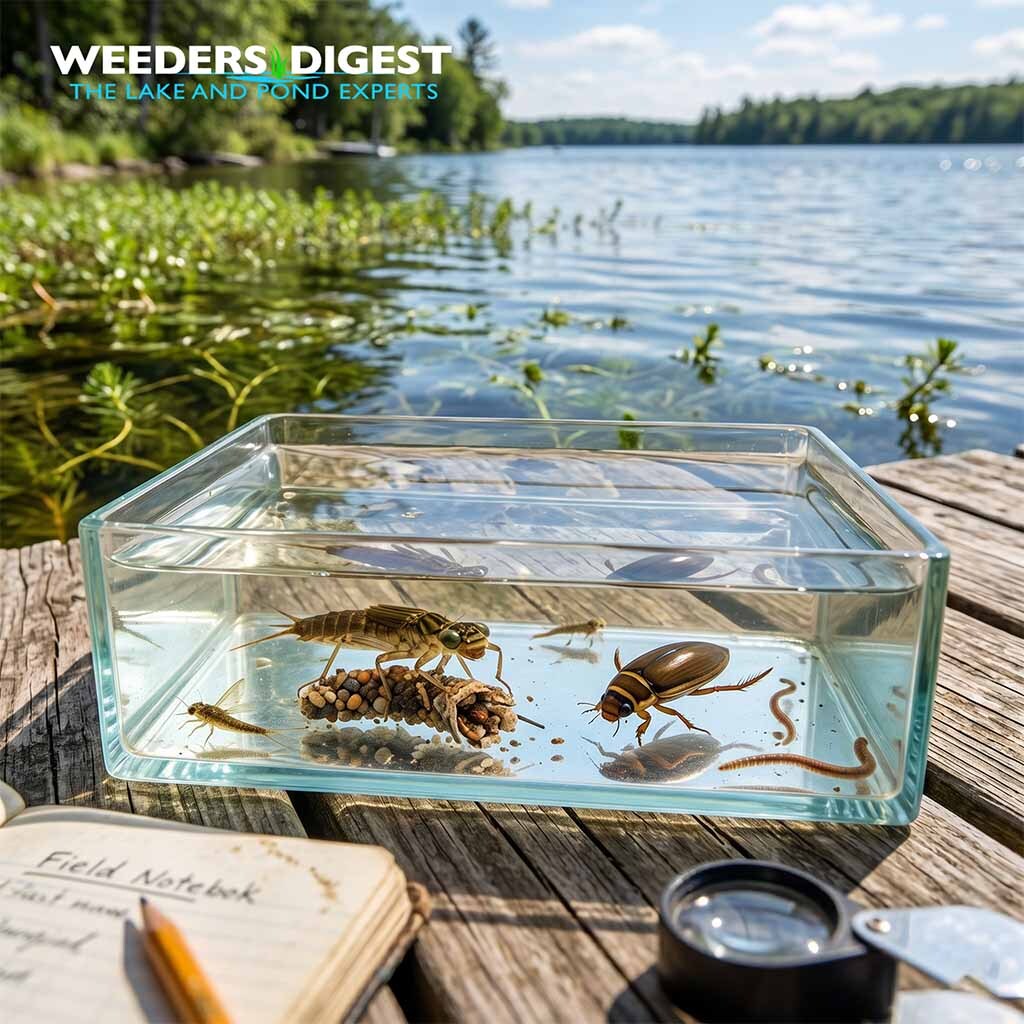
During a routine post-management inspection on a local lake where dense, tangled beds of invasive weeds had been carefully controlled, I remember dipping a standard mesh net into the newly established native pondweed beds. Instead of pulling up a stagnant, muddy soup of midge larvae, the sorting tray swarmed with agile dragonfly nymphs, creeping water beetles, and delicate caddisfly cases. This immediate biological activity provided undeniable, real-world proof that our selective weed control efforts had successfully restored a healthy, functioning ecosystem that chemistry or visual inspections alone could never fully capture.
For shorelines and ponds, successful weed management is never just about clearing water for swimming or boating; it is about rebuilding a resilient aquatic neighborhood. When an invasive weed takes over, it acts like an overcrowded apartment complex, trapping sediment and lowering dissolved oxygen levels, which drives out desirable aquatic life. When weed management succeeds, the monoculture is broken up, native plants return, and macroinvertebrates quickly recolonize the area. Monitoring these tiny critters gives lake managers and waterfront owners the exact data they need to verify that their maintenance strategies are fostering long-term ecological balance.
The Science Behind It:
Aquatic macrophytes, the large vascular plants and macroalgae within a littoral zone, act as the primary structural matrix for shallow lakes and ponds. Benthic and epiphytic macroinvertebrates—spineless organisms visible to the naked eye that inhabit bottom sediments and plant surfaces—rely heavily on these plants for refuge, foraging substrates, and reproductive sites. Consequently, tracking shifts in macroinvertebrate community structures provides a highly precise bioindicator framework for measuring how successfully a weed management strategy has restored an ecosystem's ecological equilibrium.
In aquatic ecology, shallow lakes often exhibit alternative stable states: a clear-water state dominated by submersed macrophytes and a turbid-water state dominated by planktonic algae. Successful weed management aims to control invasive monocultures while maintaining or restoring native macrophyte beds, preventing a collapse into the turbid state. According to a study by Pan et al. (2015) published in Freshwater Science, macroinvertebrate assemblages change in parallel with these regime shifts. In healthy, macrophyte-dominated systems, diverse epiphytic macroinvertebrates such as gastropods of the Bithyniidae family function as scrapers, consuming biofilms off native leaves. When weed infestations are managed improperly or suffer catastrophic collapse without native replacement, scraper density drops abruptly, paving the way for opportunistic, pollution-tolerant collector-gatherers like Tubificidae (segmented worms) and Chironomidae (non-biting midge larvae) to dominate the benthic zone.
The quantitative correlation between plant volume and macroinvertebrate health highlights the utility of these biological surveys. Pan et al. (2015) examined macroinvertebrate structures across 20 shallow lakes and determined that planktonic chlorophyll-a concentrations and the specific wet biomass of submersed macrophytes were the foundational variables structuring the entire macroinvertebrate community. Taxon richness decreased markedly along a gradient of degrading plant architecture and increasing eutrophication. By measuring the macroinvertebrate multi-metric index or tracking the ratio of sensitive Ephemeroptera, Plecoptera, and Trichoptera (EPT) taxa against tolerant Chironomidae, lake technicians can mathematically gauge the ecological recovery trajectory following weed harvesting or herbicide applications.
The benefits of tracking these organisms extend to the upper tiers of the aquatic food web via trophic cascades. A long-term ecological evaluation published in the Journal of Aquatic Plant Management (2011) illustrated that managing invasive Eurasian watermilfoil (Myriophyllum spicatum) to facilitate native plant recovery directly rebalanced macroinvertebrate herbivore guilds. Over a multi-year monitoring period, the suppression of dense milfoil canopies allowed native macrophytes to expand, which stabilized macroinvertebrate diversity. This structural shift caused a positive cascade in the fish community, shifting it from an undesirable population of stunted pumpkinseed sunfish (Lepomis gibbosus) to a highly balanced, robust community of predator and prey fish. The macroinvertebrates served as a critical energetic bridge, transforming the nutrients tied up in plant biomass into available forage for sports fish.
Implementing standardized macroinvertebrate sampling protocols—such as a time-limited kick-and-sweep method using a 500-micrometer mesh D-frame net—yields quantifiable indices like the Biological Monitoring Working Party (BMWP) score and the Average Score Per Taxon (ASPT). When lake managers analyze post-management areas, high BMWP scores confirm that weed reduction was executed with minimal non-target toxicity and that the remaining or recovering native plant community is structurally complex enough to support sensitive organisms. Conversely, a post-treatment sample showing low macroinvertebrate richness or a community entirely dominated by burrowing worms alerts the manager that the system remains under environmental or oxygen stress. Therefore, these surveys are not merely auxiliary data points; they are definitive tools to validate the authentic ecological success of any aquatic plant management program.