

How Lake Circulators Keep Your Waterfront Ice-Free All Winter
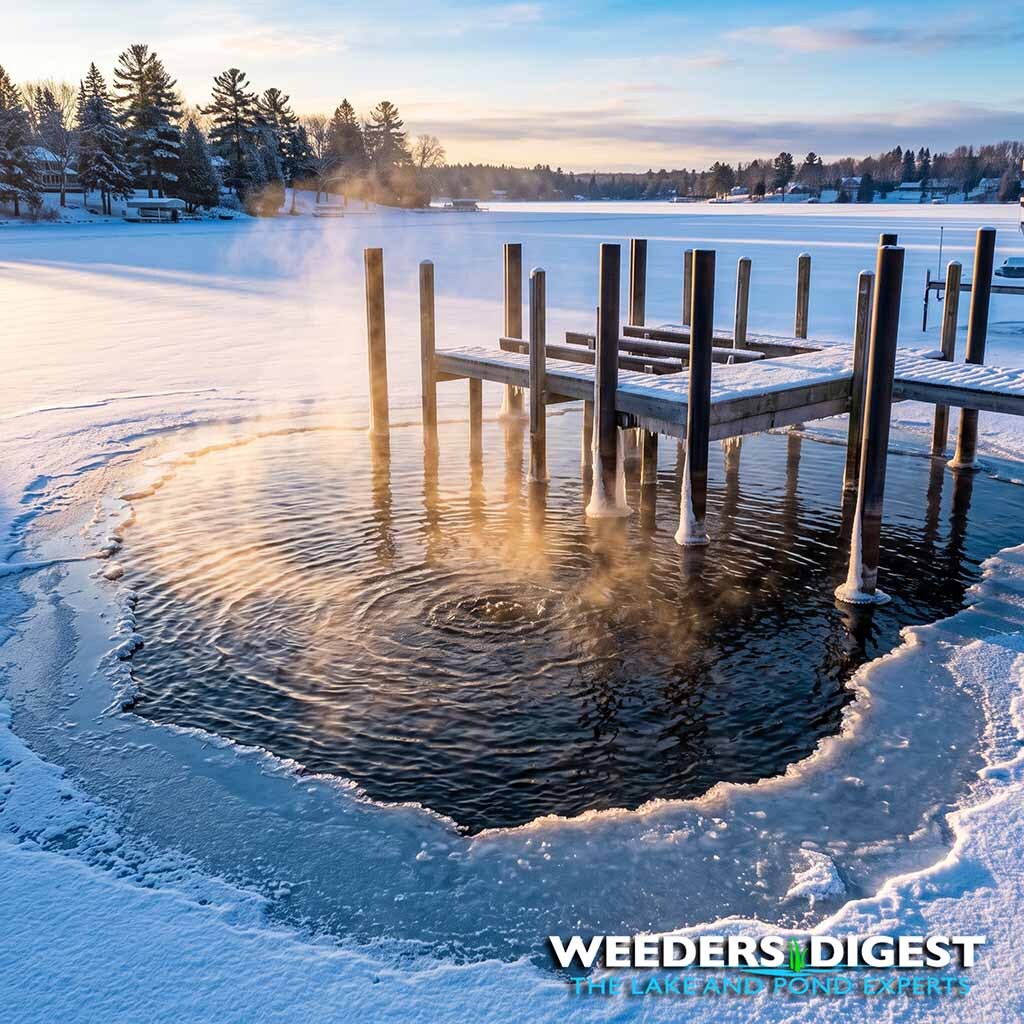 |

Summary:
Water circulators keep a section of a lake open all winter by drawing denser, warmer water from the lower lake strata and driving it continuously toward the surface to overcome the latent heat of freezing. Rather than relying on heated elements, a circulator harnesses the lake's natural thermal reserves combined with continuous kinetic agitation to prevent surface ice crystals from binding to docks, pilings, and boat lifts. Because liquid freshwater exhibits an anomalous density profile where it reaches peak density at roughly 39.2°F (4°C), this warmer reservoir remains insulated beneath winter surface waters until mechanical currents direct it upward.
In our winter field observations across northern lakes, waterfront structures suffer the most destructive jacking and lateral crushing not from static freezing, but when ice sheets contract, shift, and expand against immobile pilings. We frequently observe docks pushed entirely off-kilter when left in stagnant bays, whereas docks fitted with continuous directional circulation maintain a stable, localized thermal moat that completely isolates the structure from sheet-ice pressure.
The Science Behind It:
The mechanical prevention of ice formation depends on the unique thermodynamic properties of freshwater, specifically its density curve and inverse thermal stratification. In physical chemistry and limnology, water behaves anomalously compared to almost all other liquids: as it cools below 39.2°F (4°C), hydrogen bonding causes water molecules to align into an open hexagonal lattice, reducing its density. Consequently, water at 32°F (0°C) is less dense (approximately 0.9998 g/cm³) than water at 39.2°F (1.0000 g/cm³), causing freezing water to float while the relatively warmer 39.2°F layer settles naturally along the benthic zone.
According to the U.S. Army Corps of Engineers Cold Regions Research and Engineering Laboratory (CRREL) in their foundational ice engineering guidelines (EM 1110-2-1612), maintaining an ice-free opening in sub-freezing conditions relies on tapping the lake's thermal reserve and delivering an upward convective heat flux. Water circulators accomplish this by functioning as high-volume axial flow pumps. Submerged below the surface, the impeller draws from the warmer benthic or intermediate water column and projects a directional thermal plume upward, effectively transferring calories of latent heat directly against atmospheric heat loss at the water-air interface.
Beyond thermal transfer, the kinetic energy introduced by a high-velocity circulator disrupts the phase change of water from liquid to solid. For sheet ice to form, quiescent conditions are required for frazil ice crystals to nucleate, coalesce, and form a rigid skim across the surface. Water has a high latent heat of fusion—requiring the extraction of approximately 334 Joules (about 80 calories) of thermal energy per gram to freeze. The continuous fluid shear and turbulent eddy diffusion generated by an engineered circulator prevent frazil crystals from establishing cohesive bonds, sweeping supercooled surface water outward before crystallization can bridge structural gaps.
Limnological research from institutions like the University of Wisconsin–Madison Center for Limnology highlights that winter lakes under ice establish stable inverse stratification, sealing bottom heat that is continually replenished by geothermal flux from the underlying sediment. When a circulator is angled strategically, it converts this deep thermal storage into a protective, self-sustaining surface barrier. By combining directional thermal convection with kinetic shear stress, circulators protect waterfront infrastructure even when ambient air temperatures drop far below zero.
Our Recommendation for Managing Winter Waterfront Ice:
Preventing winter structural damage requires targeted directional thrust rather than generic bubbling. To maintain an open barrier around your dock and boat lift without over-disturbing bottom sediment, your system must move large volumes of water efficiently without dissipating velocity.
We recommend utilizing an industrial-grade directional circulator capable of mounting securely to dock brackets or pilings. The AquaThruster Muck & Weed Blower collection offers continuous, high-thrust flow designed for multi-season utility: functioning as an aggressive sediment and muck mover during summer, and transforming into a directional thermal circulator in winter to protect cribs, legs, and lifts from catastrophic ice jacking.
Sources / References:
- U.S. Army Corps of Engineers. Ice Engineering (Engineer Manual EM 1110-2-1612). Cold Regions Research and Engineering Laboratory (CRREL). https://www.publications.usace.army.mil/
- University of Wisconsin–Madison Center for Limnology. Thermal Stratification and Lake Dynamics. https://limnology.wisc.edu/
- International Institute for Sustainable Development (IISD) Experimental Lakes Area. The Science of Thermal Stratification of Lakes. https://www.iisd.org/ela/