

How Your Lake's Fall Biomass Die-Off Triggers a Massive Nutrient Spike
 |

Summary:
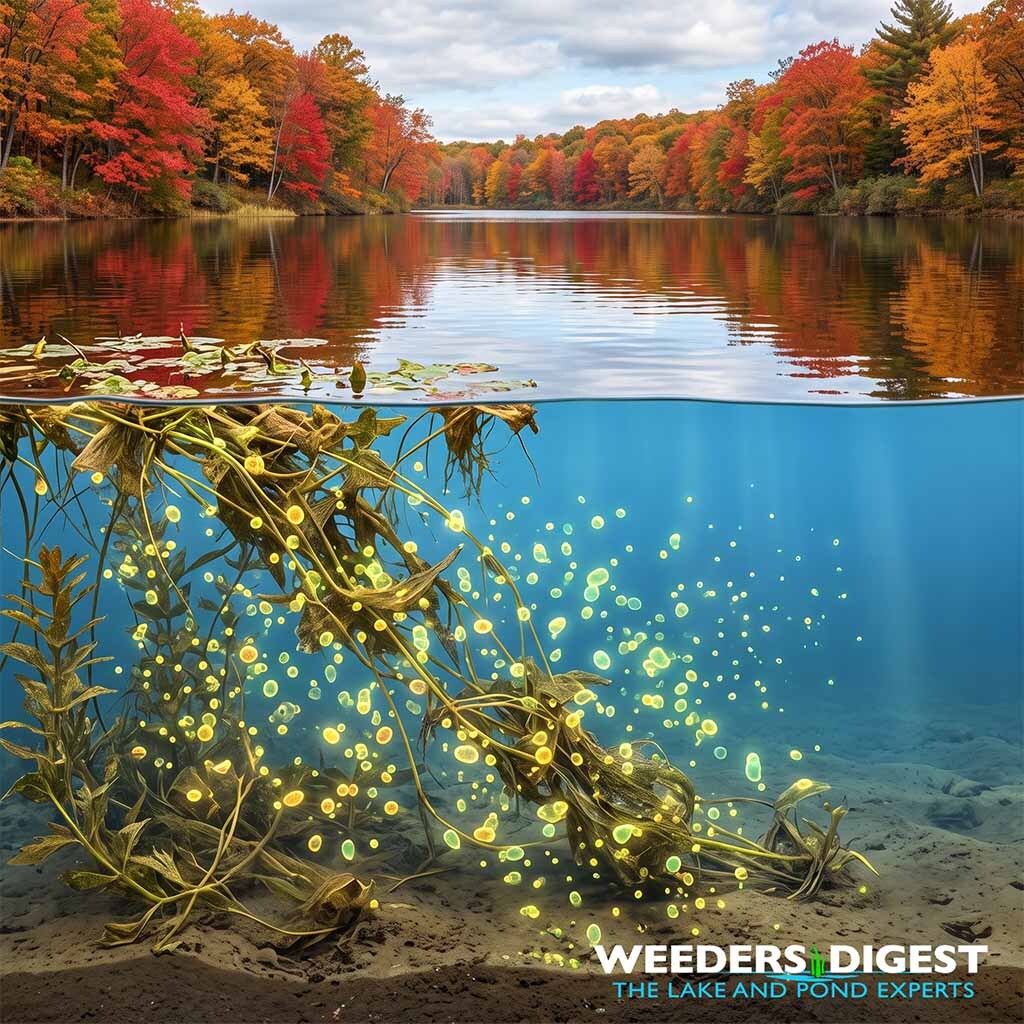
The annual fall biomass die-off spikes nutrient levels in your pond because decaying aquatic plants rapidly release all the phosphorus and nitrogen they consumed during the summer back into the water as they rot. During the growing season, healthy submerged and floating weeds act like a biological sponge, actively absorbing excess nutrients from the water and bottom sediment to fuel their own physical growth. However, as the days get shorter and temperatures drop in the autumn, these plants naturally die, collapse, and sink to the bottom of the pond.
Once these dead aquatic plants settle on the pond floor, naturally occurring aquatic bacteria immediately begin to break them down. This decomposition process is incredibly fast and operates much like a compost pile in your backyard, except the breakdown happens entirely underwater. As the plant tissues begin to disintegrate, the cell walls break open and bleed their stored fertilizers directly into your water column, triggering a massive spike in overall nutrient concentrations right before winter sets in.
As a Certified Lake Manager, I regularly get emergency phone calls in late October and November from pond owners who are completely panicked by a sudden, severe algae bloom right as the weather gets cold. I always have to explain to them that this isn't a new pollution issue or a chemical runoff problem; it is the invisible, delayed consequence of a heavy summer weed population dying off and dumping a full season's worth of fertilizer back into the ecosystem all at the exact same time.
Because this nutrient dump happens so quickly, it overwhelms the water's natural filtration capacity. This not only leads to unexpected late-season algae blooms, but it also heavily fuels the muck and sludge accumulation at the bottom of the pond. Ultimately, allowing large volumes of plant mass to die and rot in the water ensures that the pond is perfectly fertilized to grow an even thicker, more aggressive crop of aquatic weeds the very next spring.
The Science Behind It:
The transition of aquatic macrophytes from a state of active growth to decay is initiated by a biological process known as senescence. Senescence is the natural, genetically programmed aging and degradation of plant tissue triggered by environmental cues such as decreasing photoperiods and dropping ambient water temperatures. During this phase, submerged and emergent macrophytes transition from acting as a vital nutrient sink to becoming a highly concentrated nutrient source. As photosynthesis halts and cellular maintenance ceases, the structural integrity of the plant collapses, leaving the organic matter highly susceptible to microbial colonization and fragmentation.
As specialized aquatic bacteria and fungi colonize the decaying plant litter, they initiate a secondary mechanism that severely impacts the aquatic ecosystem: a dramatic increase in Biological Oxygen Demand (BOD). Biological Oxygen Demand is the precise amount of dissolved oxygen required by aerobic microorganisms to break down organic material within a specific volume of water. As bacterial populations explode to consume the massive influx of decaying macrophyte biomass, their respiration rapidly depletes the dissolved oxygen available in the water column. This aggressive consumption of oxygen frequently leads to localized hypoxic (low oxygen) or anoxic (zero oxygen) zones near the benthic layer, which can easily stress or suffocate fish and sensitive macroinvertebrates.
The most chemically disruptive element of this decomposition phase is the rapid leaching of stored elements, specifically phosphorus and nitrogen. Because different elements are bound differently within the plant's cellular structure, their release occurs asynchronously, with highly soluble elements leaching out incredibly fast. A recent peer-reviewed study in the journal MDPI Environments analyzing the decomposition dynamics of the submerged macrophyte Potamogeton crispus revealed that total phosphorus (TP) release follows an asymptotic exponential model, demonstrating a remarkably brief half-life of only 12.2 days. This means that exactly half of the macrophyte's entirely stored phosphorus inventory is dissolved directly back into the water column in less than two weeks of initial senescence.
This rapid flush of elements drives a phenomenon defined as internal loading, which is the recycling of dissolved nutrients from within the lake's own sediment and biomass rather than from external watershed runoff. The same MDPI study identified that a localized macrophyte biomass loading of just 30 grams serves as a critical ecological threshold. Once this biomass threshold is exceeded during a concentrated die-off, the nutrient flux completely overwhelms the self-purification and retention capacities of the water body. This unchecked internal loading directly feeds winter-hardy phytoplankton and overwintering cyanobacteria, fundamentally altering the biogeochemical cycling of the lake and ensuring hypereutrophic conditions for the subsequent growing season.