

How Your Yard Can Save Your Pond: Using Rain Gardens and Bioswales to Block Nutrients
 |

Summary:
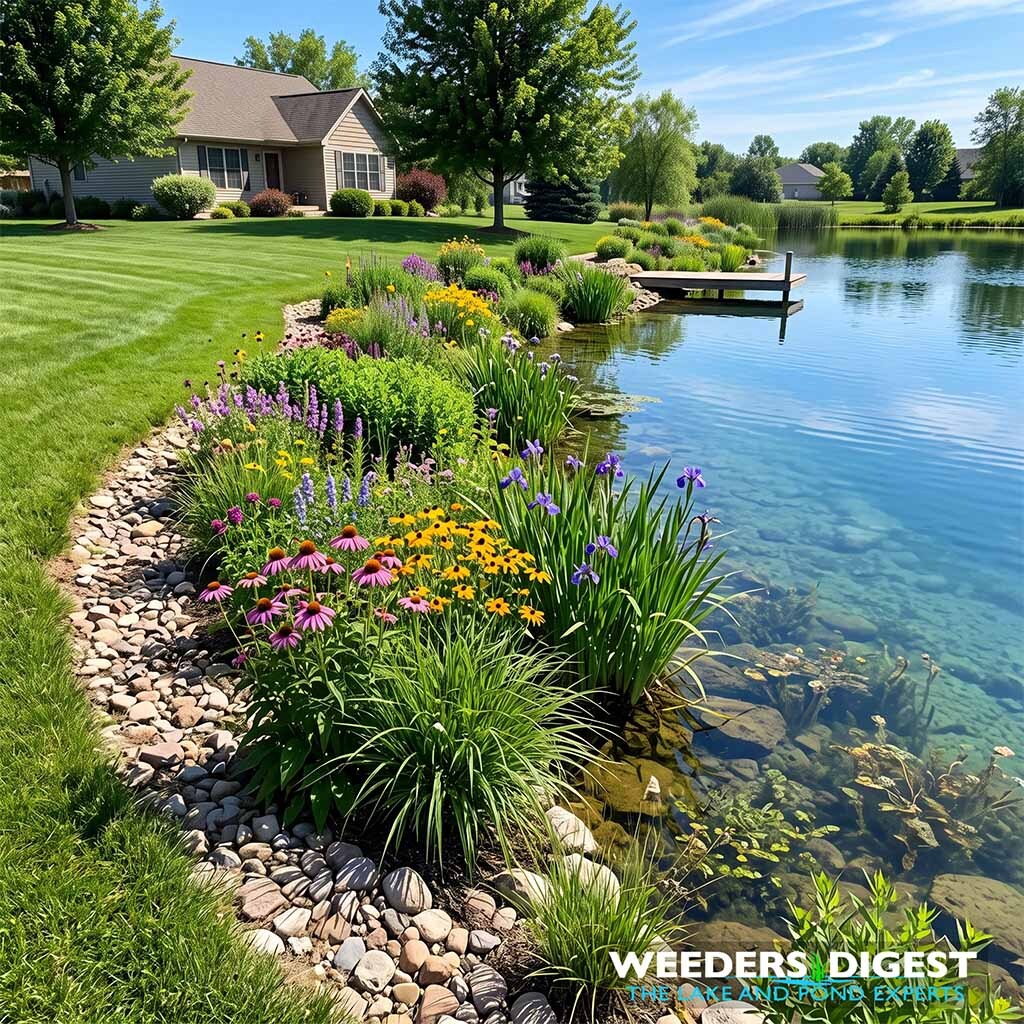
Rain gardens and bioswales prevent pond nutrients from arriving by acting as natural terrestrial filters that capture, absorb, and biologically break down phosphorus and nitrogen from stormwater runoff before it reaches your waterbody. Whenever it rains, the water sheeting across your lawn, driveway, and roof picks up fertilizers, pet waste, and organic debris. If this water flows directly into a pond, it delivers a massive dose of ecological fuel that drives rapid algae growth and murky water conditions.
By intercepting this runoff, rain gardens and bioswales act like a highly efficient sponge. They are designed as shallow, planted depressions that temporarily hold rainwater, allowing it to slowly seep into the ground rather than rushing into the local watershed. The native plants and specialized soil media within these features work together to trap sediments and consume the dissolved nutrients, effectively starving the pond of the elements that cause devastating water quality issues.
In my years evaluating troubled waterbodies as a Certified Lake Manager, I constantly see properties where heavily fertilized turf slopes straight down into the water, inevitably leading to explosive summer algae blooms. However, when property owners install a strategically placed bioswale or rain garden in the runoff path, I can physically see the reduction in sediment plumes after a storm, and within a single season, the pond's entire ecological trajectory shifts toward clear, balanced water.
The Science Behind It:
Bioretention systems, including rain gardens and bioswales, function as critical Low Impact Development (LID) strategies designed to mimic pre-development hydrological conditions. Their primary mechanism of action relies on the attenuation of peak stormwater flow and the reduction of total runoff volume through infiltration. By slowing the velocity of surface water, these systems force the deposition of suspended solids. Because a significant fraction of nutrient pollution—particularly phosphorus—travels bound to these sediment particles, the physical settling process acts as the first and most crucial line of defense against allochthonous nutrient loading into lentic ecosystems.
The sequestration of phosphorus within these systems is largely driven by chemical and physical processes within the bioretention soil media. When stormwater infiltrates the engineered soil matrix, dissolved phosphorus undergoes sorption—binding to clay particles, iron, and aluminum oxides present in the soil. Research detailed by Davis et al. (2009) in the Journal of Environmental Engineering and synthesized by Dietz (2007) demonstrates that bioretention cells routinely achieve total phosphorus (TP) load reductions ranging from 65% to 85%. This massive reduction prevents the primary limiting nutrient from triggering cultural eutrophication in receiving waters.
Nitrogen removal requires a more complex, microbially driven biogeochemical pathway known as the nitrogen cycle. Total nitrogen (TN) in stormwater typically arrives as nitrate, nitrite, or organic nitrogen. To effectively remove these compounds, a bioswale must facilitate both nitrification (converting ammonia to nitrate in aerobic zones) and denitrification (converting nitrate to inert nitrogen gas in anaerobic zones). The same studies indicate that properly engineered bioretention systems achieve total nitrogen reductions of 40% to 50%, heavily relying on the careful design of soil depth and moisture retention to create the anoxic micro-environments necessary for denitrifying bacteria to thrive.
The biological component of this filtration is heavily dependent on phytoremediation driven by deep-rooted native macrophytes and terrestrial vegetation. The root networks of these plants maintain soil permeability over time, preventing the system from clogging with fine sediments. Furthermore, the rhizosphere—the biologically active zone immediately surrounding the plant roots—hosts dense communities of symbiotic microbes. These microorganisms perform the metabolic breakdown of complex organic pollutants, while the plants themselves actively uptake dissolved nitrogen and phosphorus to fuel their own vegetative growth, locking the nutrients into plant biomass.
Ultimately, the interception of these elemental loads completely alters the trophic dynamics of the downstream lake or pond. By drastically reducing the influx of external nitrogen and phosphorus, the waterbody is no longer subjected to the nutrient super-saturation that favors opportunistic cyanobacteria (blue-green algae) and aggressive invasive aquatic vegetation. This ecological buffering stabilizes dissolved oxygen levels and preserves the benthic habitat, highlighting how terrestrial watershed management directly dictates aquatic ecological health.