

Is It Harmful Algae or Late-Season Duckweed on Your Lake?
 |

Summary:
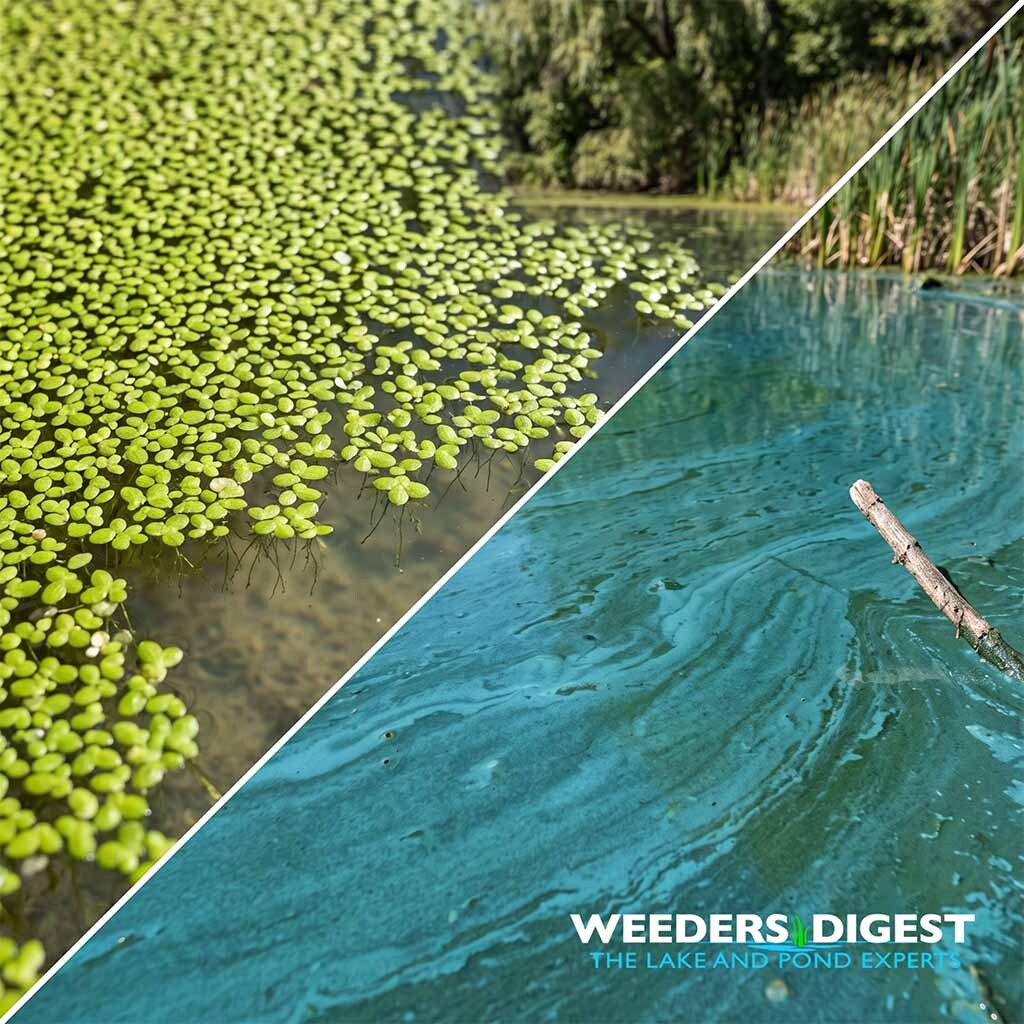
The primary difference between late-season duckweed and harmful algae is that duckweed is a tiny, free-floating plant with visible leaves and roots, whereas harmful algae is a microscopic bacteria that forms a paint-like scum on the surface of the water. As lake experts, we frequently get calls in late summer from waterfront owners convinced their pond has a toxic algae bloom, only for us to scoop up a handful of the green mat and reveal the tiny, individual fronds of harmless duckweed.
While a dense layer of duckweed can look like a continuous green film from a distance, closely examining the water reveals its distinct, grainy texture. Conversely, harmful blue-green algae has no distinct plant structure and will slip right through your fingers or disintegrate when disturbed.
Understanding this distinction is vital for your peace of mind, as misidentifying these aquatic features can lead to unnecessary panic over water safety and ecology. We encourage all property owners to look closely at the water before assuming the worst.
The Science Behind It:
At a biological level, duckweed (Lemna spp.) and harmful blue-green algae (cyanobacteria) belong to completely different kingdoms of life and interact with aquatic ecosystems in vastly different ways. Duckweed is a true angiosperm, meaning it is a flowering aquatic plant possessing vascular tissue, chloroplasts for photosynthesis, and a distinct anatomy. Each individual duckweed plant consists of a small leaf-like structure called a frond, which typically measures about the diameter of a pencil eraser, and features a distinct root system that dangles into the water column to absorb nutrients. These plants reproduce asexually, allowing them to rapidly cover the surface of slow-moving, nutrient-rich waters as the season progresses. Because duckweed physically shades the water below, it can occasionally cause oxygen depletion if a mat covers an entire waterbody for an extended period, but it does not produce chemical toxins.
In contrast, what we commonly refer to as blue-green algae is not actually an algae or a plant at all, but a phylum of photosynthetic bacteria known as cyanobacteria. These microscopic organisms lack a nucleus and true organelles, instead forming single cells, filaments, or colonies that float in the water column. Cyanobacteria are notorious for rapidly multiplying into harmful algal blooms when specific environmental conditions align, specifically when the water column becomes heavily loaded with nutrients, conditions are calm and sunny, and surface water temperatures rise higher than 75 degrees Fahrenheit. Unlike the macroscopic fronds of duckweed, a cyanobacteria bloom typically manifests as a viscous, amorphous mass that resembles pea soup or spilled green paint floating on the water's surface.
The most critical ecological difference between these two organisms is their capacity for toxicity. Certain genera of cyanobacteria possess the genetic pathways required to synthesize potent cyanotoxins. When these bacterial cells multiply rapidly, they release these secondary metabolites into the surrounding water, posing severe health hazards to the kidneys, liver, and nervous systems of humans, pets, and local wildlife that ingest or come into contact with the contaminated water. Duckweed, as a macroscopic plant, does not possess the biological mechanisms to produce these toxins, making it entirely safe to handle and generally beneficial to the aquatic environment.
Distinguishing between the two in the field often relies on basic mechanical disruption, commonly referred to by pond experts as the stick test. When a sturdy stick is dragged through a mat of duckweed, the water separates cleanly, and the individual granular plants with their tiny leaves and root structures become immediately apparent. If the same disruption is applied to a cyanobacteria bloom, the mass behaves like a colloidal suspension, swirling and breaking apart like dye in the water without leaving distinct, fibrous, or structural pieces behind. By understanding the physiological parameters and structural differences of these two organisms, property owners can accurately monitor their waterfronts and evaluate true ecological risks.
Sources / References:
- Clemson University Cooperative Extension. "Duckweed and Watermeal." https://hgic.clemson.edu/factsheet/duckweed-and-watermeal/
- Texas A&M AgriLife Extension. "Duckweed - AquaPlant." https://aquaplant.tamu.edu/plant-identification/alphabetical-index/duckweed/
- Minnesota Pollution Control Agency. "Blue-green algae and harmful algal blooms." https://www.pca.state.mn.us/air-water-land-climate/blue-green-algae-and-harmful-algal-blooms
- Utah State University Extension. "HAB Field Observations." https://extension.usu.edu/waterquality/utahwaterwatch/HAB-observations