

Is That Late Summer Foam on My Shoreline Dangerous or Just Natural?
 |

Summary:
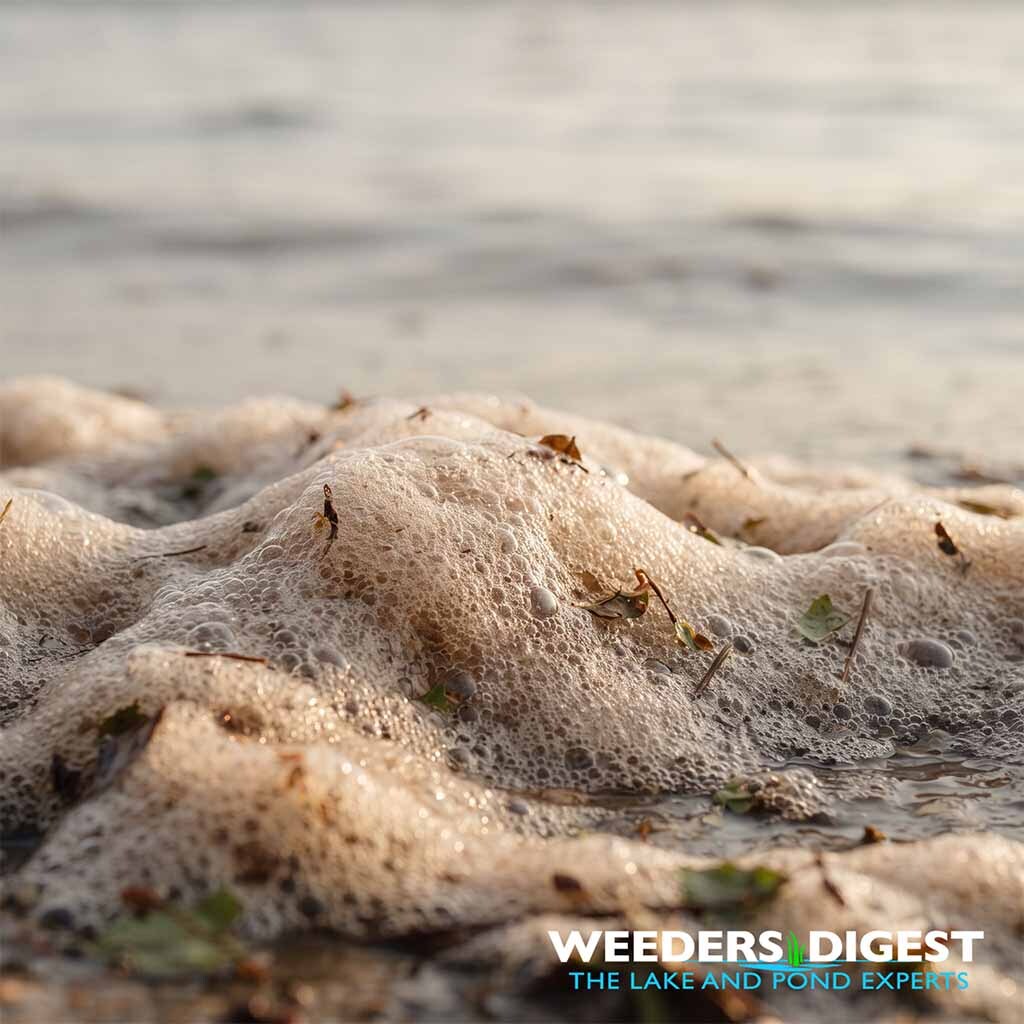
In the vast majority of cases, the foam appearing on your shoreline during late summer is a natural, harmless occurrence caused by the breakdown of organic matter in the water. As aquatic plants and algae undergo their seasonal life cycles, they release organic compounds—such as proteins and fats—that act as natural surfactants, effectively reducing the surface tension of the water and allowing bubbles to form and stabilize when agitated by wind or waves. While this foam can sometimes accumulate in thick, persistent lines along the shore, it is typically an indication of a productive, active aquatic ecosystem rather than a sign of pollution.
As a lake manager who has spent countless hours walking shorelines, I have learned that the best way to distinguish between natural and unnatural foam is to use your senses. Natural foam usually carries an earthy, fishy, or "cut grass" odor and often appears off-white, light tan, or brownish as it collects sediment and organic debris. In contrast, if you ever encounter foam that is bright, stark white, smells like perfume, or appears near a pipe or discharge point, you should exercise caution and report it to local authorities, as this may indicate human-made surfactants like detergents.
The Science Behind It:
The formation of aquatic foam is a mechanical and chemical process governed by the reduction of surface tension at the gas-liquid interface. When organic substances—often referred to as Dissolved Organic Carbon (DOC)—are released during the decomposition of aquatic vegetation, they function as natural surfactants. These molecules possess both hydrophilic (water-attracting) and hydrophobic (water-repelling) components, allowing them to adsorb at the interface between air and water, thereby displacing water molecules and stabilizing the film around air bubbles.
Research indicates that the stability and prevalence of this foam are highly dependent on the concentrations of these organic surfactants and the intensity of water agitation. In a study examining the interactions at the gas-liquid interface, it was observed that surfactant-induced foam stability can be significantly influenced by water chemistry, including the presence of inorganic ions such as Calcium (Ca^2+) and Magnesium (Mg^2+). Under moderate conditions, these ions can actually enhance foam strength by shielding electrostatic repulsions between surfactant molecules, allowing for more compact and stable interfacial films. However, when ionic concentrations exceed specific thresholds, such as 60 mM, these interactions can lead to surfactant aggregation and the formation of insoluble precipitates, which ultimately inhibit foam stability.
In the context of lake ecology, the seasonal timing is critical. Late summer provides the perfect conditions for this phenomenon: higher water temperatures accelerate the metabolic rates of microbial decomposers, and the end-of-season senescence of aquatic plants leads to a surge in available organic surfactants. When wind speeds increase or surface waves move toward a windward shore, these bubbles are pushed out of the water column and congregate along the shoreline.
While natural foam is largely benign, there is an important ecological distinction regarding Harmful Algal Blooms (HABs). When large-scale algal blooms die off, the resulting foam can concentrate high levels of organic matter and, in some cases, cyanotoxins. In these instances, the foam serves as a transport mechanism, and toxins can occasionally become airborne when bubbles burst, potentially causing eye irritation or respiratory distress for those nearby. It is therefore recommended that property owners avoid direct contact with unusually thick or discolored foam, especially if the water body has a history of toxic bloom events.