

Is Your Lake Hiding a Secret? Why My Team Uses eDNA Testing to Find Invisible Invaders
 |

Summary:
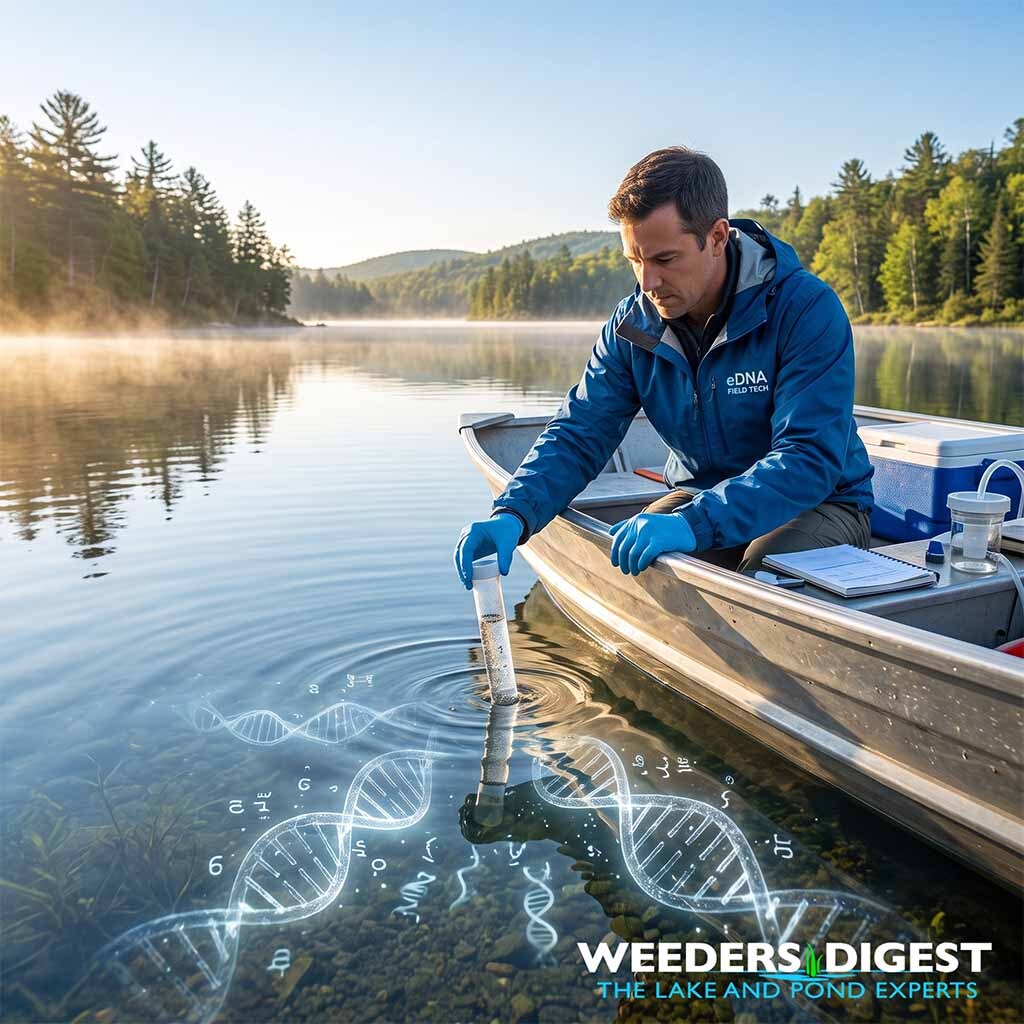
Environmental DNA (eDNA) testing is a biological monitoring method that analyzes simple water samples for microscopic genetic material shed by aquatic organisms, allowing us to detect invasive plants and animals before they become visible to the naked eye. Whenever fish, mussels, or plants live in a body of water, they constantly leave behind tiny traces of themselves in the form of skin cells, scales, feces, or decomposing tissue. By scooping up a few liters of water and running it through specialized laboratory equipment, we can identify the exact genetic fingerprints floating in your pond. This means we no longer have to wait until an invasive species has completely taken over a waterway to know it is there.
As a Certified Lake Manager, I have conducted routine water quality checks on community lakes that looked completely pristine, only for an eDNA pull to reveal the early stages of a zebra mussel invasion. Catching that invisible genetic footprint early on allowed us to quarantine the area and adjust our management plan immediately, ultimately saving the homeowner association thousands of dollars in future mitigation and infrastructure repair costs. It shifts aquatic management from being purely reactive to highly proactive.
Instead of relying entirely on physically netting fish or raking up weeds to see what is living beneath the surface, eDNA provides a highly sensitive surveillance net. The water itself acts as a massive genetic soup, and reading it gives us a comprehensive understanding of the ecosystem. It is an incredibly powerful diagnostic tool for anyone looking to protect their aquatic resources from the rapid spread of hidden ecological threats.
The Science Behind It:
Environmental DNA (eDNA) analysis relies on the principle that aquatic environments act as a continuous sink for the genetic material of the organisms inhabiting them. As species interact with their environment, they continuously shed biological material—including epidermal cells, mucus, gametes, and metabolic waste—into the water column. Limnologists and aquatic biologists capture this material by passing field-collected water samples through fine-pore filters, which concentrate the suspended organic matter. Once transported to a laboratory, the captured genetic material undergoes DNA extraction and is subjected to quantitative polymerase chain reaction (qPCR) or droplet digital PCR (ddPCR). These techniques use custom-designed primers that bind strictly to the targeted DNA sequences of specific invasive species, amplifying the genetic markers until they reach a detectable threshold, thereby confirming the organism's presence.
The efficacy of eDNA detection vastly outperforms conventional biological surveys, particularly in systems where target species exist at low densities or are highly evasive. Traditional sampling methods, such as benthic dredging, electrofishing, or seining, often result in high rates of false negatives during the early stages of an invasion. Research analyzing the utility of multi-method occupancy modeling has quantified this discrepancy. According to a study by Schmelzle and Kinziger (2016) assessing regional-scale monitoring of aquatic species, the probability of detecting a target organism using eDNA methods was calculated at 0.74, which is nearly double the 0.39 detection probability associated with traditional seining methods. This heightened sensitivity allows for the identification of pioneer populations that would otherwise remain undetected by standard visual or physical sampling protocols.
While eDNA is heavily utilized for invasive fish and invertebrates, its application to invasive aquatic vegetation is heavily governed by temporal and physiological factors. Unlike animals that constantly shed cells through movement and waste, aquatic macrophytes release the bulk of their genetic material during specific life stages. A comprehensive mesocosm and field study by Kuehne et al. (2020) investigated the eDNA detectability of two highly invasive aquatic plants, Myriophyllum spicatum (Eurasian watermilfoil) and Egeria densa (Brazilian elodea). The researchers found that eDNA detection was actually less reliable while the plants were actively growing. Instead, peak detection probabilities and highest eDNA concentrations occurred as a function of increasing senescence, as the plant tissues began to naturally decompose and release cellular contents into the surrounding water.
Understanding the degradation rate of eDNA in the water column is critical to interpreting positive detections. eDNA does not persist indefinitely; it is a highly transient biomolecule that degrades rapidly due to ultraviolet radiation, temperature fluctuations, and endogenous microbial activity. In typical freshwater ecosystems, suspended DNA fragments degrade to undetectable levels within a matter of days to a few weeks. This rapid degradation is highly advantageous for ecological monitoring, as it ensures that a positive eDNA signal represents the contemporary, current presence of the target organism, rather than historical remnants of a species that passed through the environment months or years prior.
Sources / References:
- Kuehne, L. M., Ostberg, C. O., Chase, D. M., Duda, J. J., & Olden, J. D. (2020). Use of environmental DNA to detect the invasive aquatic plants Myriophyllum spicatum and Egeria densa in lakes. Freshwater Science, 39(3), 521-533. https://www.journals.uchicago.edu/doi/10.1086/710106
- Schmelzle, M. C., & Kinziger, A. P. (2016). Using occupancy modelling to compare environmental DNA to traditional field methods for regional-scale monitoring of an endangered aquatic species. Molecular Ecology Resources, 16(4), 895-908. https://pubmed.ncbi.nlm.nih.gov/26677162/