

Maximizing My Shoreline: How I Combine Liquid and Granular Treatments for Complete Control
 |

Summary:
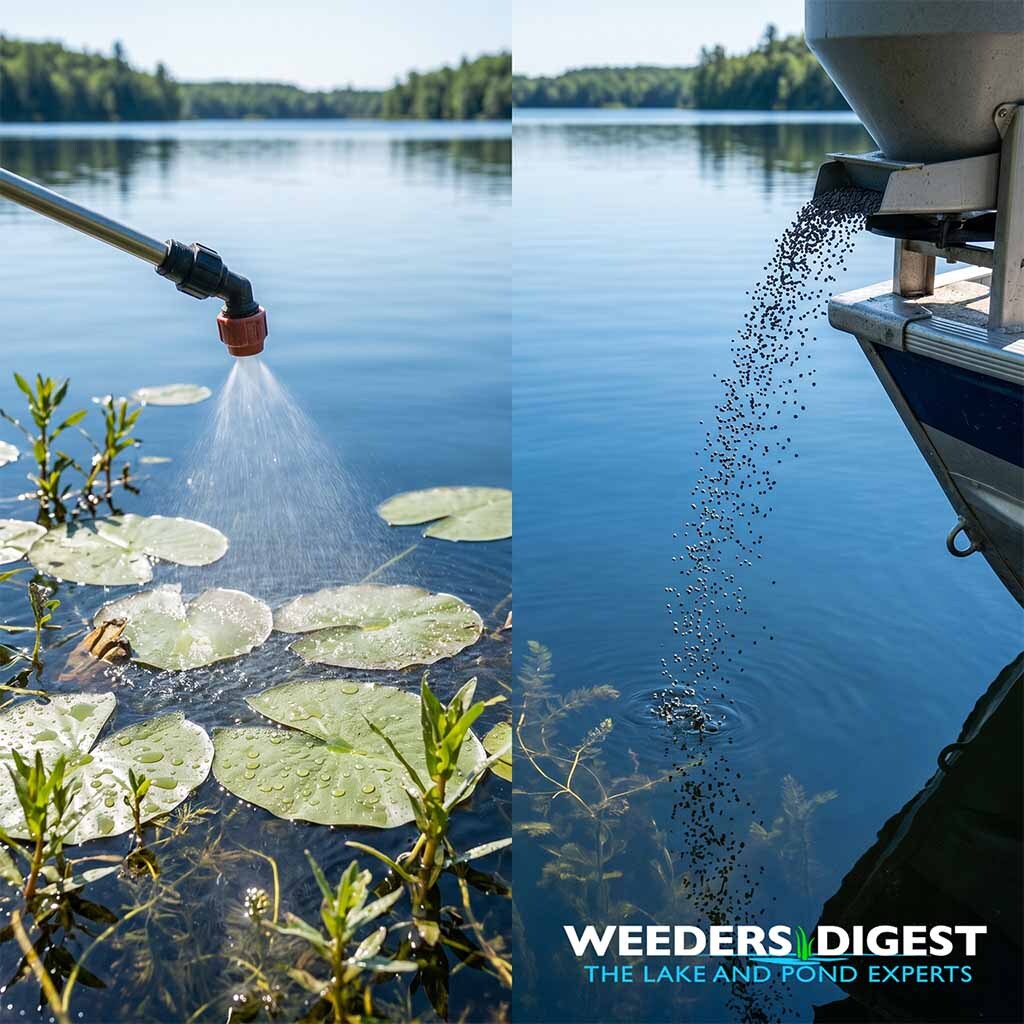
Combining liquid and granular aquatic herbicide formulations is one of the most effective strategies I use to achieve multi-layer control of invasive or nuisance aquatic vegetation. By utilizing both types of treatments, you address the different growth zones of weeds—targeting floating and emergent leaves with liquid sprays while deploying granular treatments to sink deep into the water column to manage submerged growth and root systems. This dual-action approach ensures that you are treating the plant from the top down and the bottom up, which is essential for comprehensive vegetation management.
When I am out on the water conducting a site assessment, I often notice that relying on a single method leaves gaps in coverage. For instance, a pond may have a thick canopy of surface-dwelling weeds like duckweed or water lilies, while simultaneously harboring a dense forest of submersed pondweed or hydrilla beneath the surface. If you only spray the top, the submerged plants continue to thrive, and if you only use granules, the surface canopy may block the product from reaching the bottom. Combining these methods allows me to tailor the treatment to the specific architectural complexity of the pond’s plant community, ensuring that each layer of the infestation is met with the appropriate chemical contact.
The Science Behind It:
Integrated aquatic weed management relies on the fundamental distinction between herbicide formulations, which dictate how an active ingredient interacts with its target. Aquatic herbicides are generally classified as either contact or systemic. Liquid formulations, often applied via sprayers, are designed to coat the waxy cuticle of floating or emergent leaves. According to the North Central Regional Aquaculture Center (NCRAC), these formulations are highly effective at providing quick knockdown of surface foliage, provided they are paired with appropriate surfactants to penetrate the plant's protective outer layer. Granular formulations, by contrast, utilize carrier materials such as clay particles to sink through the water column, delivering the active ingredient directly into the benthos where submerged plant colonies reside.
The synergy between these two delivery systems addresses the vertical stratification of aquatic ecosystems. Research from Oklahoma State University highlights that herbicide effectiveness is heavily dependent on identifying the specific weed type and choosing the correct formulation; for example, granular endothall formulations are specifically engineered for submersed control, while certain liquid 2,4-D formulations excel at managing emergent species. By layering these applications, the applicator can achieve a higher degree of total biomass reduction. The use of granular carriers is particularly advantageous in targeted areas, as these formulations minimize the risk of wind drift, which is a common technical limitation during liquid spray operations.
Furthermore, the mechanics of these applications must account for the density of the plant canopy. A key quantitative finding in aquatic management is the need for "adequate distribution," where practitioners calibrate equipment to apply specific chemical concentrations—often measured in parts per billion (ppb)—to ensure success. Systemic herbicides like fluridone, for instance, are often applied at rates ranging from 100 to 200 ppb to ensure enough material reaches the plant tissue before dilution occurs in the larger water body. Combining a surface-applied liquid that breaks the canopy with a sinking granular application ensures that the target plants are exposed to the herbicide for the necessary duration to disrupt their physiological processes.
Success in these operations is also highly dependent on environmental variables, particularly water temperature and dissolved oxygen (DO) levels. Best management practices dictate that treatments should be performed when water temperatures are between 70°F and 80°F, as plant metabolism is at its peak, facilitating maximum chemical uptake. However, rapid decomposition of large quantities of treated vegetation can lead to critical drops in DO, potentially causing fish kills. By utilizing a multi-layered approach, professionals can often treat smaller, strategic segments of a pond, thereby managing the rate of decomposition more effectively than a broadcast application of a single, highly concentrated liquid.