

My Field Guide to Wetland Giants: Decoding the Battle Between Phragmites and Your Local Cattails
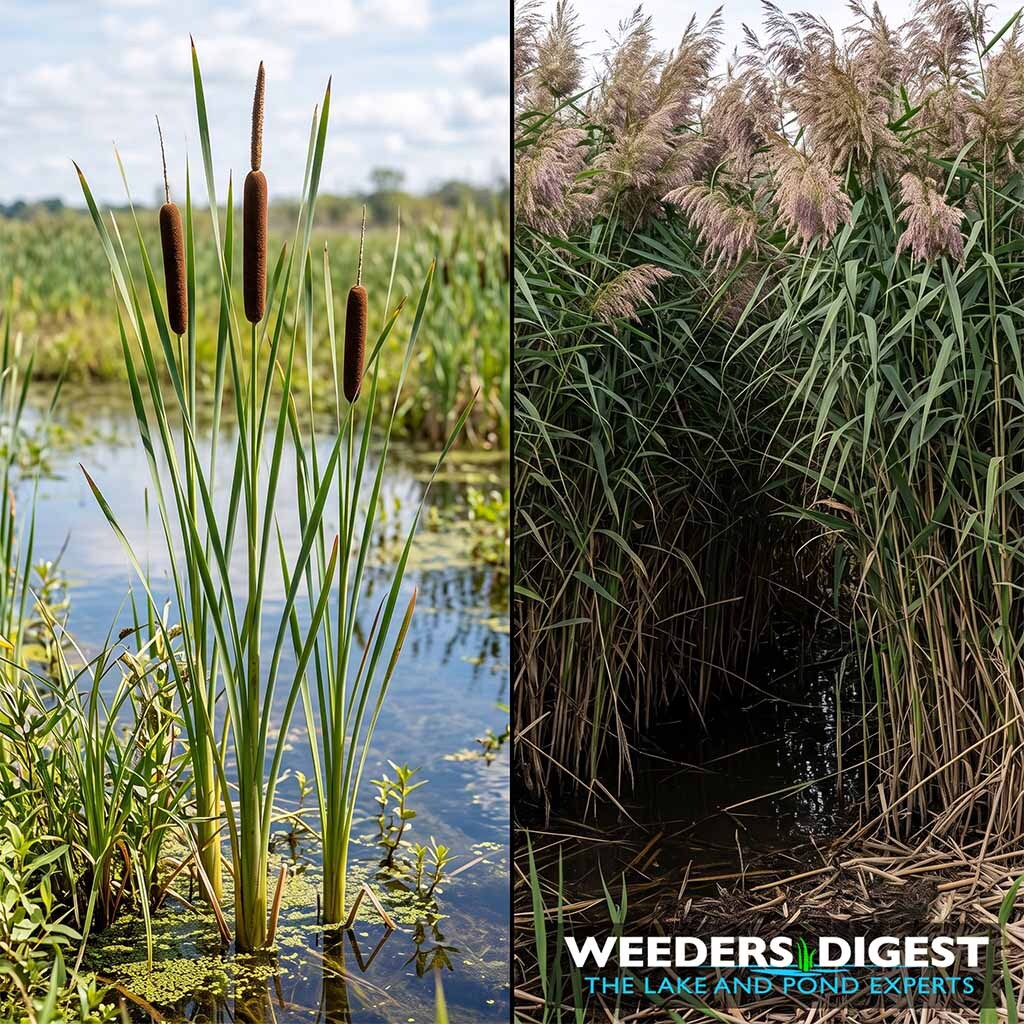 |

Summary:
Phragmites (common reed) and Typha (cattails) are both towering emergent grasses found in shallow waters and wetlands, but the critical biological difference lies in the aggressive, dense growth patterns and chemical warfare tactics utilized by nonnative Phragmites to outcompete and permanently displace the more ecologically beneficial native cattail. While both plants function as nutrient filters and stabilize shorelines, cattails generally grow in balanced harmony with native flora and provide easily accessible food and nesting habitat for wildlife. In contrast, the invasive strains of Phragmites rapidly spread through deep, extensive underground runners to form completely impenetrable, monotypic (single-species) stands that choke out all other plant life and severely diminish local biodiversity.
As a Certified Lake Manager, I can’t tell you how many times a waterfront property owner has proudly shown me their "robust new cattails," only for my heart to sink when I recognize the stiff, feathery plumes of invasive Phragmites dominating the shoreline. It takes just a few seasons for this aggressive grass to turn a diverse, vibrant wetland ecosystem into a towering wall of dead reeds that not even deer or turtles can navigate through. Distinguishing between the two in the field usually comes down to the seed heads; cattails have the iconic, brown, cigar-shaped spikes, while Phragmites sports large, fluffy, purplish-brown or golden panicles (branched flower clusters) that look like tiny wheat sheaves.
If you are trying to manage a shoreline, understanding the biology of these two plants is the only way to successfully intervene. Cattails can be managed with selective cutting or minor environmental tweaks, but Phragmites requires highly strategic, multi-year remediation efforts because leaving just a small fragment of its root system behind guarantees it will return with a vengeance.
The Science Behind It:
The ecological divergence between Phragmites australis (specifically the nonnative Eurasian haplotype M) and Typha species (cattails) is fundamentally rooted in their respective competitive advantages and biomass allocation strategies. Both are large, clonal macrophytes—aquatic plants that grow in or near water and are large enough to be seen with the naked eye. However, research conducted by the University of Rhode Island demonstrated that in comparative greenhouse experiments, nonnative Phragmites haplotypes produced significantly more aboveground biomass and a dramatically higher above-to-below ground biomass ratio than native wetland grasses, regardless of nitrogen, phosphorus, or water availability. This disproportionate aboveground growth allows Phragmites to quickly overtop and shade out neighboring Typha communities.
Quantitatively, the growth metrics of nonnative Phragmites are staggering when compared to native emergent vegetation. Field studies evaluating wetland invasions show that Phragmites forms exceptionally dense monocultures, consistently producing aboveground biomass ranging from 1 to 3 kilograms per square meter. In mature stands, this invasive reed can produce over 100 live culms (stems) per square meter and reach towering heights of up to 4 meters. By contrast, Typha stands, while highly productive, are structurally less dense, allowing sunlight to penetrate the canopy and support a more diverse understory of wetland flora. The sheer physical density of Phragmites limits the cycling of phosphorus and other nutrients by increasing rhizosphere oxidation, which permanently binds these elements in the wetland sediment, depriving competing plants of essential nutrients.
Beyond physical crowding and resource monopolization, Phragmites australis possesses a biochemical advantage through a mechanism known as allelopathy. Allelopathy is a biological phenomenon where one plant produces biochemicals that influence the growth, survival, and reproduction of other organisms. Emerging ecological research indicates that gallic acid, emanating from the deep root and rhizome networks of Phragmites, acts as a highly potent allelopathic agent. As the plant's litter decomposes, the gallotannins are converted into gallic acid, heavily suppressing the seed emergence and structural growth of surrounding Typha populations in a toxic negative feedback loop.
Furthermore, the decomposition rates and litter accumulation between the two species drastically alter the physiochemical environment of the wetland. A 2012 study out of Eastern Michigan University investigating carbon transformations in Great Lakes marshes found that annual mass loss from plant litter was significantly greater in Phragmites-invaded sites compared to pre-invaded Typha sites. The dense, woody litter generated by Phragmites resists rapid breakdown, altering the wetland's hydrology by raising the soil surface elevation and drying out the marsh over time. This hydrological shift further disadvantages Typha, which requires deeper, more consistent inundation to thrive, ultimately cementing the dominance of the invasive Phragmites.
Sources / References:
- https://digitalcommons.uri.edu/cgi/viewcontent.cgi?article=1093&context=nrs_facpubs (DigitalCommons@URI - Nonnative Phragmites australis Invasion into Utah Wetlands)
- https://journals.plos.org/plosone/article/file?id=10.1371/journal.pone.0044420&type=printable (PLOS ONE - Positive Effects of Nonnative Invasive Phragmites australis on Larval Bullfrogs)
- https://commons.emich.edu/cgi/viewcontent.cgi?referer=&httpsredir=1&article=1806&context=theses (Eastern Michigan University - Effects of invasion by the common reed on carbon transformations in a Great Lakes marsh)