

My Guide to How Accumulated Muck Alters Your Pond’s Natural Thermal Profile
 |

Summary:
Accumulated organic muck acts as a thermal trap, directly influencing the stability and temperature distribution of your pond’s water layers. When organic matter builds up on the bottom, it doesn’t just take up space; it creates an environment where decomposition processes are restricted to the sediment surface, consuming precious dissolved oxygen and preventing the natural mixing that keeps a pond’s temperature profile uniform. In many cases, this sediment layer creates a "thermal curtain" effect, where the water below a certain depth remains artificially isolated from the surface-warmed layers, potentially leading to sharp temperature gradients that stress fish and encourage anaerobic, low-oxygen conditions.
In my years of field work, I have often encountered ponds that appear healthy on the surface but, upon sonar analysis or depth-sampling, reveal a "muck-heavy" bottom that has completely inhibited the natural turnover of the water column. You might notice your pond water feels surprisingly cool even in mid-summer or that fish are gasping at the surface early in the morning. This is often a sign that the bottom layer of water is cut off by a thermocline that has been exacerbated by the accumulation of organic sediment, preventing the beneficial exchange of oxygen and heat that keeps an aquatic ecosystem balanced.
The Science Behind It:
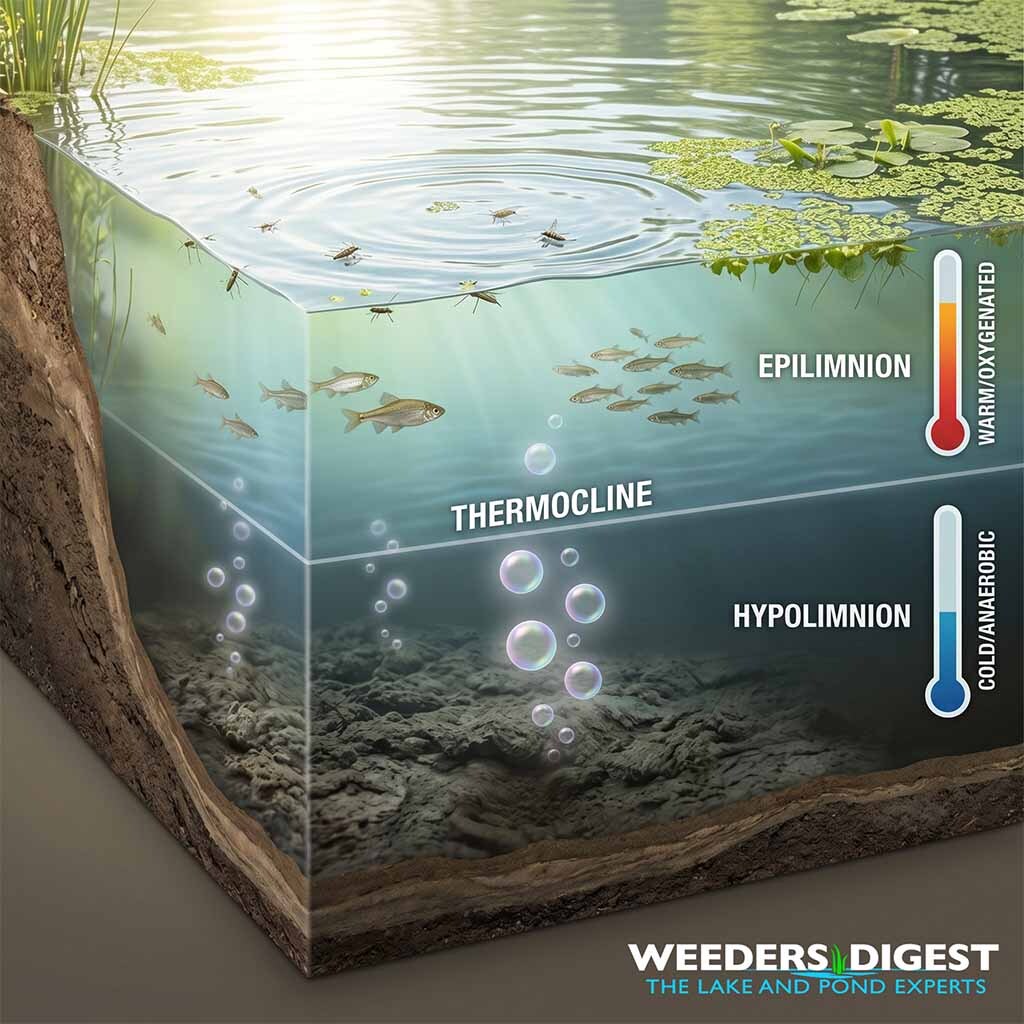
The thermal profile of a pond is governed by the physical properties of water, which reaches its maximum density at approximately 4°C. During warmer months, solar radiation heats the surface water (the epilimnion), causing it to become less dense and float atop the cooler, denser water (the hypolimnion). A transition zone known as the thermocline (or metalimnion) forms between these layers, acting as a physical barrier to vertical mixing. When organic matter—often referred to as "muck"—accumulates on the pond floor, it fundamentally alters this stratification process. As decomposition occurs, microbial activity at the sediment-water interface consumes dissolved oxygen. Because the thermocline restricts the influx of oxygen-rich water from the surface, the bottom environment rapidly becomes anaerobic (lacking oxygen).
Research indicates that the rate of decomposition is highly temperature-dependent, with microbial activity often doubling for every 10°C increase in temperature within the 0–35°C range. However, this decomposition is inefficient in anaerobic conditions. In sediment-heavy ponds, the accumulation rate of organic matter can average approximately 1 cm per year. While aerobic decomposition typically converts organic matter into carbon dioxide and water efficiently, the anaerobic conditions created by thick muck layers force microbial communities to rely on slower, less effective pathways. This leads to the buildup of humic substances and gases like methane and hydrogen sulfide, which can further impact water quality and heat absorption.
Furthermore, suspended and bottom-lying organic particulates significantly influence the pond's thermal absorption. While clear water allows light to penetrate deeper into the water column, high concentrations of suspended organic matter and dark, thick sediment layers absorb solar radiation more readily, potentially increasing the surface and near-surface water temperature. This localized heating can strengthen the thermocline, further isolating the bottom water and preventing the seasonal mixing—or "turnover"—that is critical for maintaining healthy dissolved oxygen levels across all depths.
Maintaining a stable thermal profile requires consistent mixing to disrupt these persistent temperature layers. Without mechanical intervention such as bottom-diffused aeration, the cold, oxygen-depleted layer beneath the thermocline expands throughout the summer. This expansion not only reduces the habitable volume for fish, which may be forced into a narrow, oxygenated zone above the thermocline, but also creates a "dead zone" where nutrient cycling is halted. By preventing the formation of an unyielding thermal curtain, aeration promotes a more uniform temperature distribution, which allows oxygen to penetrate to the benthic zone, facilitating more efficient aerobic decomposition of the underlying organic muck.