

My Guide to Riparian Buffers: How Your Shoreline Protects Your Water
 |

Summary:
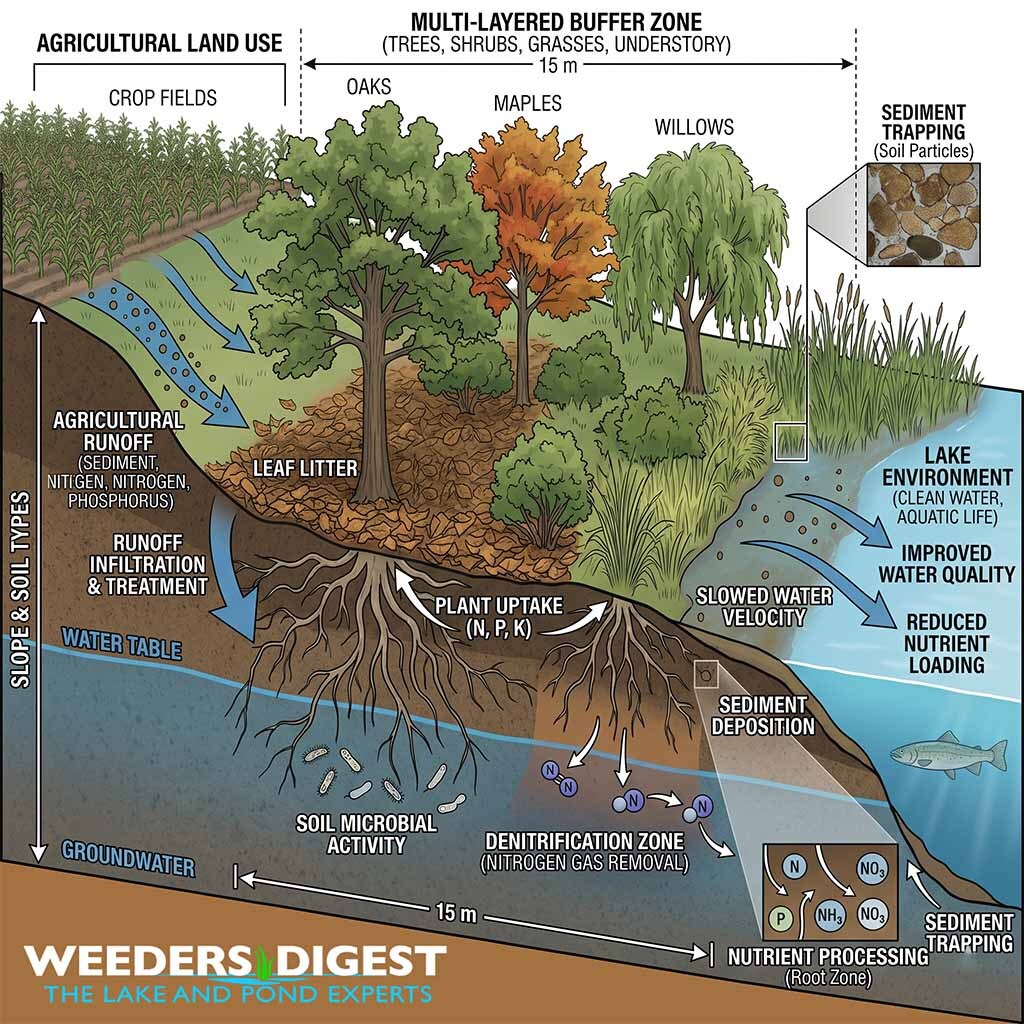
Riparian buffers are essentially your lake or pond’s first line of defense, acting as a natural, vegetated filter that strips pollutants from agricultural runoff before they can reach your water. By maintaining a strip of trees, shrubs, and native grasses along your shoreline, you create a physical and biological barrier that slows down incoming water and allows sediment and nutrients to settle before entering the aquatic ecosystem. This process is critical for preventing the excess nutrient loading that often triggers unsightly and harmful algal blooms.
In my years of managing private ponds and larger lake systems, I have seen firsthand that the most resilient waterbodies are those where landowners resist the urge to mow right up to the water’s edge. When I walk a property and see a well-established, diverse riparian buffer, I almost always find clearer water and healthier, more balanced fish populations compared to properties with manicured lawns that extend directly to the shoreline. Even a relatively small, thoughtfully planted buffer can drastically reduce the "green water" issues that plague many agricultural-adjacent ponds.
The Science Behind It:
The efficacy of riparian buffers is rooted in the interplay of hydrology, soil chemistry, and plant biology. As agricultural runoff—often laden with nitrogen, phosphorus, and sediment—moves across the landscape, it gains velocity. When this runoff encounters a riparian buffer, the dense root systems and above-ground biomass of perennial vegetation function as a mechanical "shock absorber." This reduction in flow velocity is the most critical step; it forces heavy sediments to drop out of suspension. Research indicates that properly designed buffers can filter up to 90% of sediment carried by runoff, with total phosphorus removal efficacy often averaging between 51% and 55% in many managed systems.
Nutrient transformation follows the initial phase of sediment deposition. Phosphorus, which is frequently bound to soil particles, is trapped alongside those sediments. Nitrogen, however, often exists in the form of dissolved nitrates. These are addressed through a combination of plant uptake—where the vegetation actively incorporates the nitrogen into its own biomass—and microbial processing in the soil. Within the root zone, specific soil microbes can perform denitrification, a process that converts nitrates into nitrogen gas, effectively removing them from the water pathway entirely.
The physical dimensions of a buffer play a significant role in its success. Research has consistently demonstrated that width is a primary determinant of nutrient retention efficiency. In a study comparing buffer widths, researchers found that 15-meter wide buffers were often more than twice as efficient at removing nitrogen from runoff compared to 8-meter wide zones. This relationship highlights that while any buffer is better than none, increasing the lateral distance between the farm field and the water provides more time for infiltration, more surface area for nutrient absorption, and a greater opportunity for biological processing.
It is important to note that environmental conditions can influence these mechanics. Buffers are most effective when they maintain high infiltration capacity, which can be compromised if soils become overly compacted or saturated. Furthermore, in colder climates, a significant portion of annual nutrient loading often occurs during rapid snowmelt when the soil is still frozen and impermeable. Under these specific conditions, the filtration efficiency of traditional buffers can temporarily decline, emphasizing the need for comprehensive watershed management that includes both shoreline buffers and upstream drainage practices.
Sources / References:
- Natural Resources Conservation Service (NRCS) - Technical Note: Riparian Buffers and Sediment/Nutrient Filtration
- Frontiers in Water - Efficacy of Riparian Buffers in Phosphorus Removal: A Meta-Analysis
- Environmental Science & Engineering Magazine - Riparian Buffer Zones and Nitrogen Loading Research