

My Strategy for Transforming Your Eroding Bank into a Stable, Living Shoreline
 |

Summary:
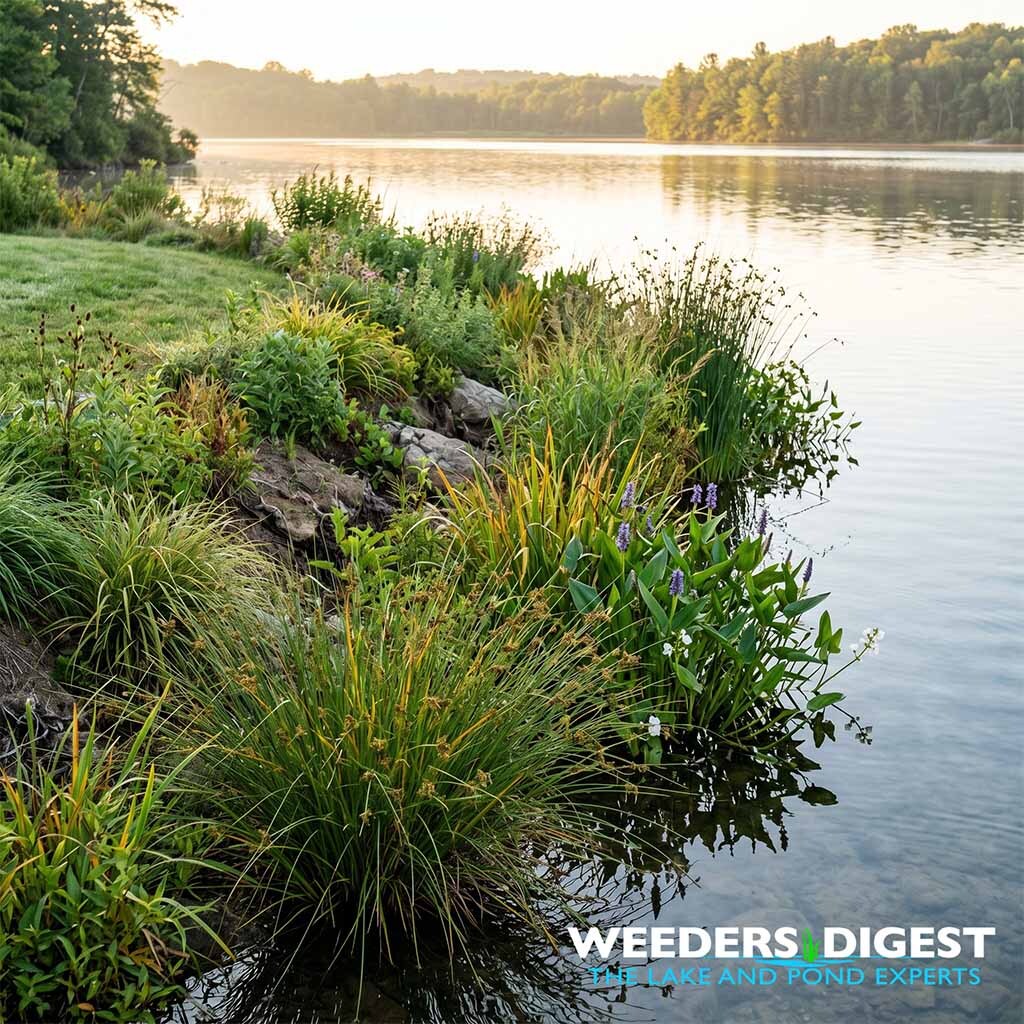
Native shoreline plants are the most effective natural defense for stabilizing your pond or lake bank because their deep, complex root systems physically anchor the soil and absorb erosive wave energy. When you replace shallow-rooted turf grass with a curated buffer of native sedges, grasses, and shrubs, you are essentially installing a living, self-repairing "rebar" that holds your property in place. Unlike man-made seawalls, which often deflect wave energy and cause scouring in front of the structure, native vegetation works with the water to dissipate energy and promote soil health.
In my time managing private ponds, I have walked hundreds of properties where the owner was fighting a losing battle against a "vertical drop" at the water's edge. Often, they have tried to fix it with heavy rip-rap or constant sod replacement, only to watch the soil wash out from underneath. The difference is always the same: a successful shoreline relies on the biology of the root zone. By simply giving nature the right plant palette—like native rushes and deep-rooted prairie grasses—the bank begins to "knit" itself together, becoming stronger and more resilient with every passing season.
The Science Behind It:
The mechanical superiority of native riparian vegetation over non-native turf grass, such as Poa pratensis (Kentucky Bluegrass), is rooted in the divergent architectural strategies of their subterranean biomass. While traditional turf grass typically exhibits root depths limited to 2 to 6 inches, native perennial species—such as Schizachyrium scoparium (Little Bluestem)—frequently establish root systems reaching depths of 3 to 5 feet or more, according to research from the University of Wisconsin-Stevens Point. This vertical stratification allows native plants to pin the vulnerable topsoil layers directly to the more stable subsoil strata.
This process is governed by the principle of root reinforcement, where the tensile strength of the plant roots significantly increases the shear strength of the soil matrix. As documented by studies in ecological restoration journals, these deep, dense root networks increase the macroporosity of the soil, which drastically improves infiltration rates. By allowing rainwater and runoff to percolate into the ground rather than sheeting across the surface, these plants reduce the hydrodynamic forces that trigger bank "sloughing" and catastrophic soil failure.
Furthermore, the stems of native emergent and riparian plants provide essential hydraulic roughness. When waves strike a manicured lawn, the water encounters a frictionless surface that promotes erosion at the toe of the bank. Conversely, a diverse buffer of native sedges and rushes breaks the velocity of incoming wave energy, causing suspended sediments to settle rather than erode. This biological binding, combined with the reduction of surface runoff energy, transforms an unstable slope into a dynamic, self-stabilizing ecosystem.