

Navigating Our Waters: How August Oxygen Depletion Forces Fish into New Zones
 |

Summary:
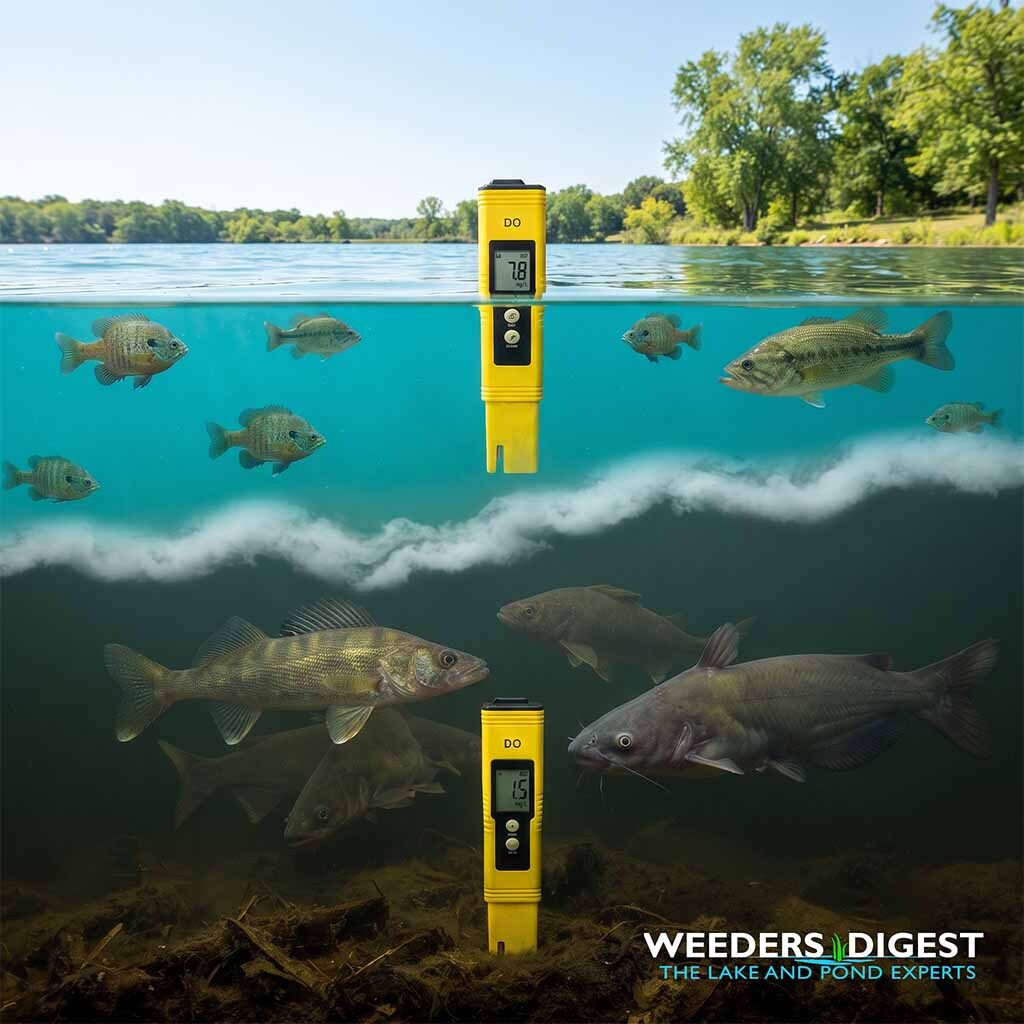
As August arrives, shifting oxygen levels and intense summer heat force fish into distinct vertical zones within our lakes and ponds. During peak summer stratification, declining dissolved oxygen levels in deep waters force fish to migrate away from the bottom layers and squeeze into narrow, habitable bands of the water column. When monitoring local water bodies, pond experts frequently observe fish suspended at specific intermediate depths, trapped between dangerously warm surface water and oxygen-depleted bottom zones. We find that this seasonal phenomenon radically changes aquatic behavior as fish seek out the optimal balance between temperature and respiration needs.
The Science Behind It:
During the peak of summer in August, temperate water bodies undergo thermal stratification, dividing the water column into three distinct density-related layers: the warm, well-oxygenated epilimnion; the transitional metalimnion (containing the thermocline); and the cold, dense hypolimnion. While the surface epilimnion remains warm from intense solar radiation and atmospheric mixing, the isolated hypolimnion experiences severe oxygen depletion. This occurs because decomposing bacteria consume organic matter at the sediment level without receiving oxygen replenishment from the atmosphere or photosynthetic activity.
According to research compiled by the Michigan Sea Grant, dissolved oxygen concentrations below $2\text{ mg/L}$ classify water as hypoxic, while values approaching $0\text{ mg/L}$ become anoxic, creating biological "dead zones" where fish and other aquatic organisms cannot survive. Water quality standards indicate that cold-water fish generally require minimum oxygen concentrations of $7\text{ mg/L}$, whereas warm-water species require at least $5\text{ mg/L}$ to avoid physiological stress. Because surface waters in August often exceed the preferred thermal thresholds for many gamefish species, and bottom waters drop below critical oxygen minimums, fish are compressed into a narrow vertical band known as the habitat squeeze.
This habitat squeeze forces species like trout, bass, and panfish to abandon their preferred benthic feeding grounds and congregate where temperature and dissolved oxygen tolerances overlap. In highly eutrophic lakes, where algal blooms accelerate deep-water respiration and decomposition, this squeeze becomes exceptionally severe. Consequently, fish metabolic rates increase due to warmer ambient temperatures while their available living space contracts, altering predator-prey dynamics and forcing aquatic populations into unnatural proximity until autumn cooling initiates lake turnover.
Sources / References:
- Michigan Sea Grant: Dissolved Oxygen and Lake Stratification — https://www.michiganseagrant.org/lessons/lessons/by-broad-concept/physical-science/dissolved-oxygen-and-lake-stratification/
- Wikipedia: Epilimnion & Lake Stratification — https://en.wikipedia.org/wiki/Epilimnion