

Navigating the Shifting Tides: How Late-Summer Water Level Drops Redefine Fish Hideouts
 |

Summary:
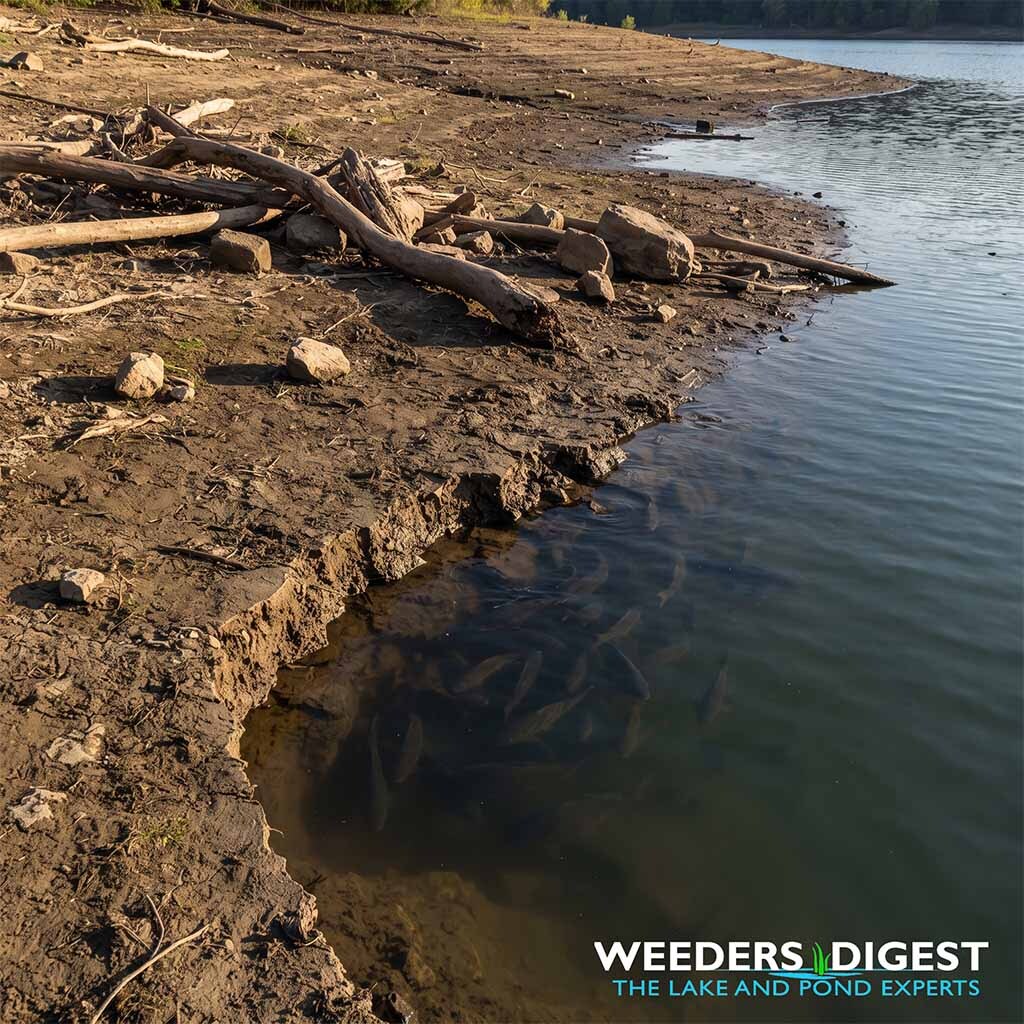
When late-summer evaporation and reduced inflows cause water levels to recede, fish must quickly adapt to shifting cover and declining shallow-water refuges. As lake and pond experts observing seasonal shifts firsthand, we frequently notice how shoreline habitats transform over just a few weeks, forcing resident fish populations to abandon traditional shallow zones. When water recedes, submerged aquatic vegetation beds dry out or compress, and woody debris or rocky ledges that once provided dense overhead security can become exposed or sit in perilously shallow water. Consequently, gamefish and forage species alike are compelled to relocate, compressing their distribution into deeper offshore drop-offs, remaining deeper weed edges, or localized spring-fed pockets. Understanding these behavioral adjustments is essential for anyone tracking aquatic ecosystem health during the most thermally stressful months of the year.
The Science Behind It:
The structural mechanics of aquatic ecosystems rely heavily on littoral zone complexity, which provides critical refuge, spawning substrate, and foraging grounds for fish assemblages. During late summer, hydrological drawdowns—whether driven by natural meteorological evaporation or artificial water management—drastically alter the physical characteristics of the nearshore environment. Research on reservoir and lake dynamics indicates that as water levels decline, habitat conditions experience a rapid homogenization, characterized by a significant reduction in submerged macrophyte abundance, loss of riparian shade, and the flattening of structural diversity.
In a notable long-term assessment of reservoir littoral zones, investigators documented dramatic vertical recessions—such as multi-meter drops—that fundamentally altered fish-environment relationships. As water receded from high-water baselines, the spatial distribution of coarse substrates and dense vegetation contracted, weakening the statistical correlation between habitat complexity and fish assemblage structure. When littoral structural complexity diminishes past a specific ecological threshold, fish communities undergo a spatial homogenization, packing into restricted remaining cover.
This physical compression forces fish away from traditional shallow-water hideouts and into deeper eulittoral-infralittoral transition boundaries. Furthermore, declining water volumes intensify thermal stratification and reduce dissolved oxygen availability in remaining shallow pockets, creating potential ecological traps. Fish are forced to weigh the high predation risk of sparse, open water against the physiological suffocation risks of overly dense, decaying vegetation mats in receding waters. Consequently, limnological studies emphasize that mobile fish species exhibit high plasticity, migrating toward deeper structural anomalies, remaining creek channels, or groundwater upwellings where thermal stability and structural refuge intersect.