

Navigating Your Pond’s Autumn Transition: How Heavy September Rains Shift Our Water’s Nutrient Balance
 |

Summary:
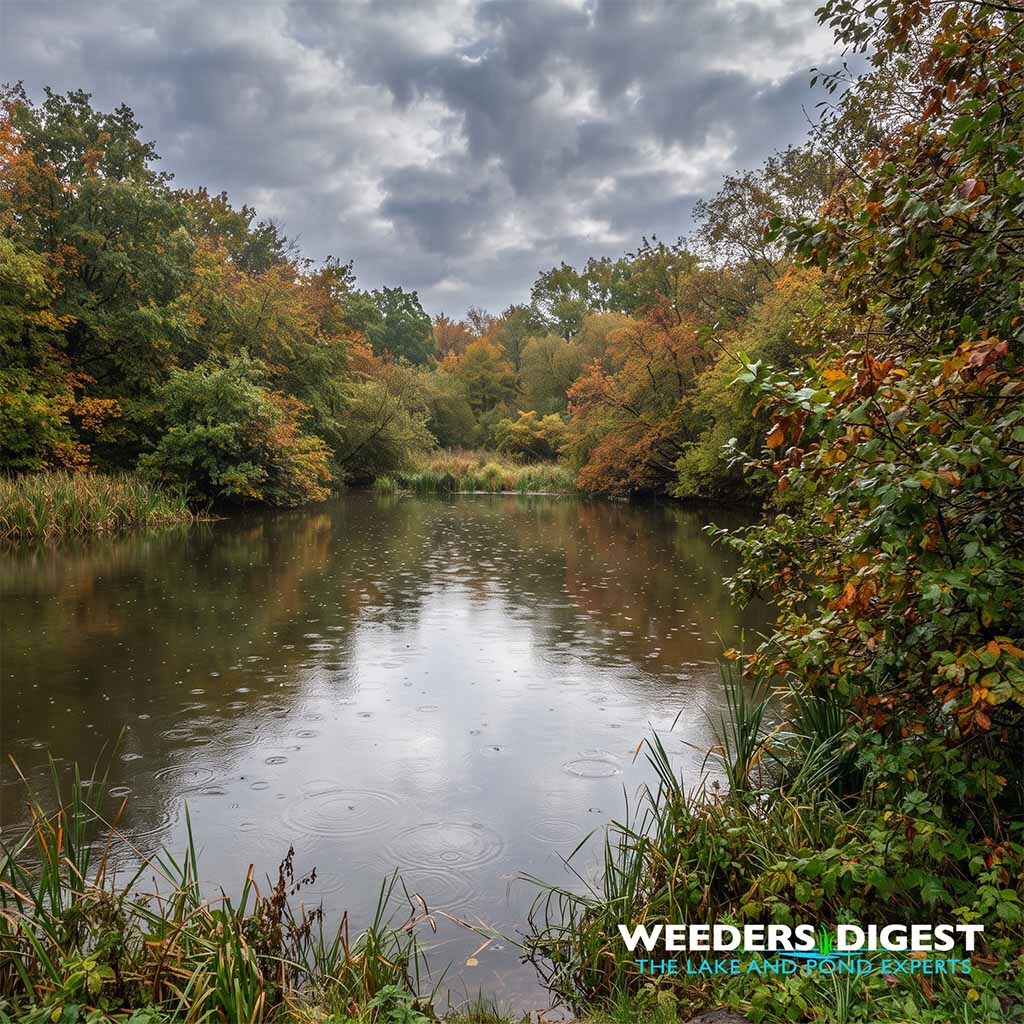
Heavy September rains dramatically disrupt a small pond's nutrient balance by washing concentrated terrestrial runoff, including nitrogen and phosphorus, into the water column while simultaneously cooling surface layers to trigger premature turnover. When our lake experts walk the perimeter of a residential water body after an early autumn downpour, we often observe a sudden shift from clear summer visibility to a murky, nutrient-rich brown haze accompanied by a faint earthy or sulfurous odor. This phenomenon occurs because the initial pulse of stormwater scours surrounding lawns and soils, delivering a massive load of dissolved organic matter straight into the aquatic ecosystem.
Understanding this seasonal shift is essential for maintaining a healthy aquatic environment as summer transitions into cooler months. Rainwater does not merely add volume; it acts as a delivery mechanism for external pollutants and organic debris that have accumulated throughout the dry summer months. As this nutrient-laden runoff enters the pond, it fuels biological activity while changing the physical dynamics of the water column. Without proactive management, these heavy autumn precipitation events can set off a chain reaction affecting oxygen levels and biological productivity for weeks.
The Science Behind It:
Limnological studies indicate that stormwater runoff serves as the primary vector for nutrient transport, with research published in the Journal of Environmental Quality highlighting that initial precipitation volumes—often referred to as the "first flush"—carry exceptionally high concentrations of bioavailable orthophosphates and nitrates. In small ponds, total phosphorus (TP) levels frequently spike beyond critical thresholds during these events, with concentrations surpassing 0.025 parts per million (ppm) routinely triggering rapid phytoplankton proliferation and cyanobacteria blooms. Nitrogen inputs, arriving predominantly as nitrates (NO_3^-) or ammonium (NH_4^+), synergistically accelerate this primary productivity, shifting the trophic state of the water body toward accelerated eutrophication.
Beyond chemical loading, heavy September rainfall alters the thermal stratification established during the preceding summer months. During summer, small ponds typically divide into an epilimnion (warm, oxygen-rich upper layer) and a hypolimnion (cool, anoxic bottom layer), separated by a distinct thermocline. When cool autumn rain and accompanying wind events arrive, they rapidly chill the surface water, diminishing the density barrier that maintains stratification. Research from university extension programs notes that once surface water density matches bottom water density, the entire water column mixes abruptly, a process known as autumn turnover.
This sudden mixing redistributes accumulated bottom nutrients throughout the entire water volume while simultaneously entraining oxygen-depleted water and hydrogen sulfide gas generated by anaerobic decomposition at the sediment-water interface. According to freshwater monitoring data, dissolved oxygen (DO) levels can plummet precipitously during this mixing phase; concentrations dropping below 3.0 milligrams per liter (mg/L}) induce severe physiological stress in aquatic life, while levels falling below 2.0 milligrams per liter (mg/L) frequently precipitate catastrophic fish kills. The biochemical oxygen demand (BOD) spikes as newly introduced organic debris and suspended biomass undergo microbial oxidation, placing immense strain on the ecosystem's respiratory capacity.
Consequently, the convergence of external nutrient loading from heavy rain and internal nutrient redistribution via autumn turnover creates a complex ecological challenge. The simultaneous influx of dissolved nutrients and reduction in dissolved oxygen require careful monitoring of water chemistry parameters. Pond experts must evaluate both the external watershed contribution and the internal sediment dynamics to prevent long-term ecological degradation, excessive organic sludge accumulation, and chronic water quality decline following severe seasonal precipitation events.
Sources / References:
- Pond Algae Solutions. "Heavy Rain and Pond Health: How to Neutralize Nutrient Runoff After a Storm." Research and Technical Blog, 2026. https://pondalgaesolutions.com/blogs/news/heavy-rain-and-pond-health-how-to-neutralize-nutrient-runoff-after-a-storm
- Journal of Environmental Quality. Studies on Stormwater Runoff, Nutrient Loading, and Phytoplankton Dynamics.
- University of Georgia Extension Services. "Pond Turnover & Oxygen Crashes: Insights for Southern Farmers." 2025. https://doughertyagriculture.extension.uga.edu/2025/07/pond-turnover-oxygen-crashes-insights-for-southern-farmers/