

Our Guide to Clearing Late-Season Slime From Your Swimming Area
 |

Summary:
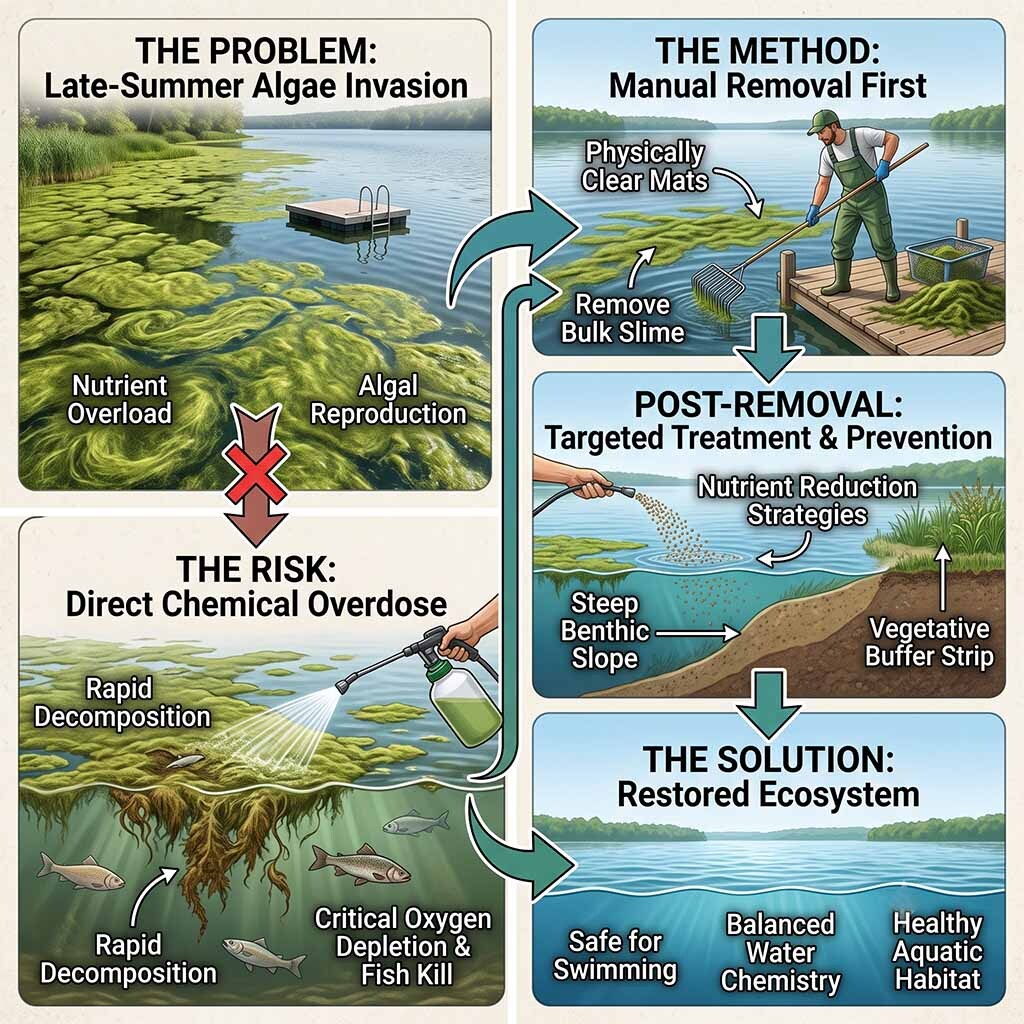
When late-season slime overtakes your swimming area, the most effective response is to immediately physically remove the floating mats and then implement strict nutrient-reduction strategies to starve the remaining algae. As the water warms in late July and August, single algal cells reproduce rapidly, joining into long strands that trap oxygen bubbles and float to the surface to form thick, unsightly mats. We consistently see this progression in nutrient-rich waters as the summer heat peaks. Our team knows how frustrating it is to lose access to your waterfront just as the season reaches its warmest point.
Our aquatic technicians frequently observe homeowners attempting to solve this issue by pouring algaecides directly onto these massive late-summer blooms without any prior physical harvesting. This is a critical mistake because treating thick algal mats chemically causes a massive, rapid die-off; as the slime decomposes, it consumes the dissolved oxygen in the water, which can trigger a catastrophic fish kill. Instead, manually removing the bulk of the slime—and we will not sugarcoat it, this physical harvesting is a big, labor-intensive project—is the safest and most effective first step for the long-term health of your aquatic ecosystem.
The Science Behind It:
The term "late-season slime" typically refers to filamentous algae or cyanobacteria (blue-green algae) that thrive under the specific limnological conditions of late summer. During the spring, aquatic ecosystems often experience a "clear water phase" driven by zooplankton consuming small, edible algal species. By late summer, however, these edible species are replaced by larger, colonial, or filamentous varieties that zooplankton cannot effectively consume. According to research from the University of Rhode Island, more than 40 species of algae can coexist in a single waterbody, but dominance shifts seasonally; in late summer, nutrient mixing from the benthic (bottom) zone provides a fresh supply of dissolved nutrients that fuels these nuisance blooms.
Filamentous algae lack a true vascular root system, meaning they derive all their required nutrients directly from the water column rather than the pond substrate. Phosphorus acts as the primary limiting nutrient for this rapid cellular growth. When temperatures peak and sunlight penetrates the shallow littoral (near-shore) zones, benthic algae photosynthesize aggressively. The resulting oxygen gases become trapped within the cellular network, causing these dense, interwoven algal mats to break free from the bottom and float to the surface. This physiological mechanism creates the characteristic floating mats that obstruct recreational swimming areas.
Addressing these late-season blooms chemically requires careful consideration of baseline water chemistry. Data from Ohio State University Extension indicates that in soft water with alkalinity levels below 40 mg/L, standard copper sulfate treatments become highly toxic to fish populations. Furthermore, when large accumulations of late-season algae die off simultaneously, the ensuing bacterial decomposition rapidly consumes dissolved oxygen. This biochemical oxygen demand can lower oxygen concentrations to lethal levels for aquatic life, emphasizing the scientific necessity for mechanical removal prior to any chemical application.
Long-term management of late-season algal dominance relies on altering the physical and chemical environment of the littoral zone. Limiting sunlight penetration is a crucial ecological control mechanism; aquatic scientists recommend contouring pond banks to a steep 3:1 slope—a one-foot drop for every three feet of distance—to quickly achieve depths that inhibit benthic algal growth. Combining steepened shorelines with proactive watershed management, such as establishing vegetative buffer strips to intercept agricultural and residential phosphorus runoff, fundamentally shifts the ecological balance. This integrated approach prevents the rapid cellular reproduction that forms these floating nuisance mats, stabilizing the aquatic ecosystem for future seasons.
Sources / References:
- University of Rhode Island: https://web.uri.edu/wp-content/uploads/sites/1667/Algae.pdf
- Ohio State University Extension: https://senr.osu.edu/sites/senr/files/imce/files/extension_outreach/ponds_fish_aq_mgmt/OhioPondNews/OPN_SP08vol7iss2.pdf
- Penn State Extension: https://extension.psu.edu/filamentous-algae