

Protecting Your Pond’s Amphibians: Balancing Weed Control and Wildlife Safety
 |

Summary:
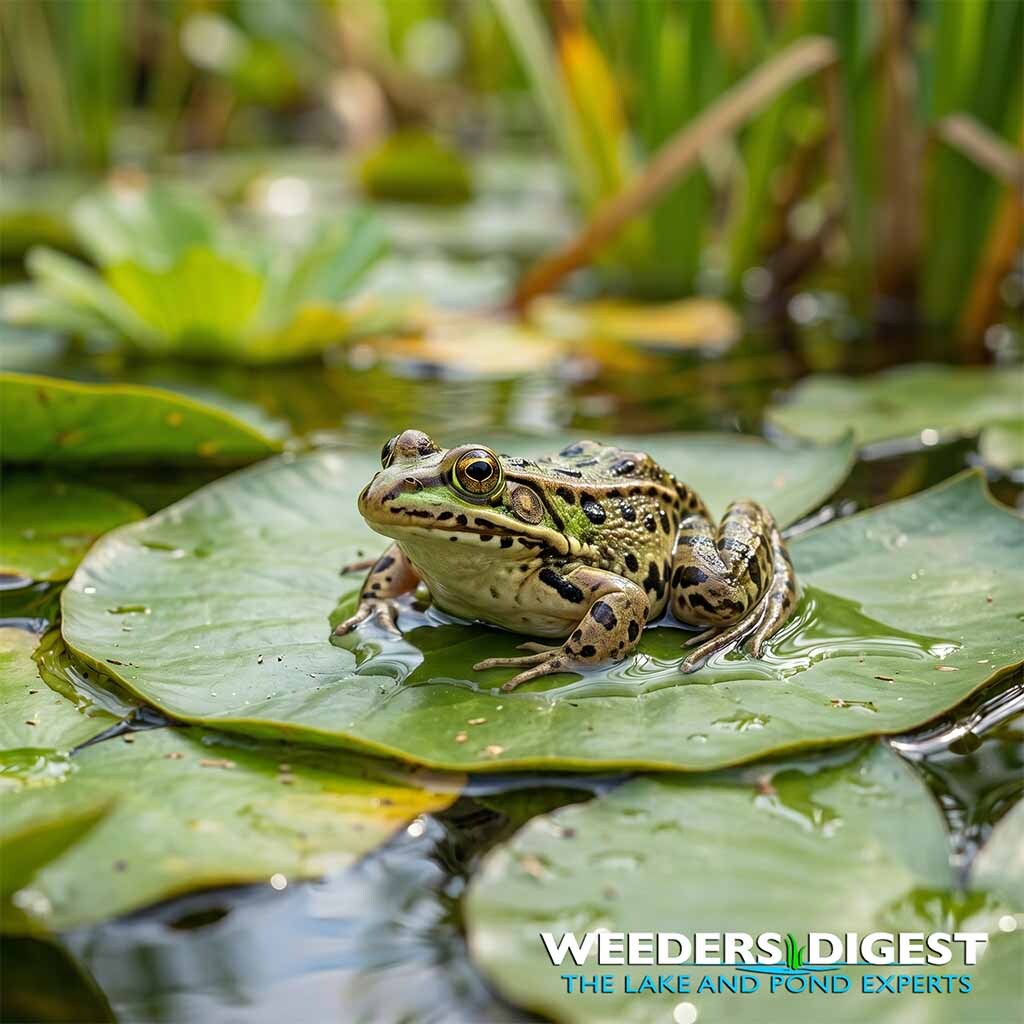
Aquatic herbicides can pose significant risks to frogs, salamanders, and other amphibians, primarily due to their unique physiological sensitivity and complex life cycles. While products labeled for aquatic use are strictly regulated and tested for environmental safety, their application can still result in negative outcomes for non-target wildlife if not managed with extreme caution. Amphibians are particularly vulnerable because they possess highly permeable, moist skin that easily absorbs chemicals from the water and sediment, and they spend critical parts of their development in both aquatic and terrestrial environments.
In my years as a Certified Lake Manager, I have found that the most common danger to amphibians isn't always the herbicide itself, but the timing and scale of the application. I often walk a shoreline before treatment and find masses of amphibian larvae tucked within the very weed beds we intend to manage. If we treat an entire pond at once, we risk overwhelming the system with decaying plant matter—which crashes dissolved oxygen levels—while simultaneously exposing sensitive larvae to a sudden influx of chemical concentrations. To truly protect these populations, we prioritize "spot treating" and partial pond management, ensuring that refugia (safe zones) remain untouched for our local frog and salamander populations to retreat into during the treatment window.
The Science Behind It:
The sensitivity of amphibians to aquatic herbicides is a well-documented phenomenon in ecological toxicology. Because these organisms serve as bioindicators of environmental health, their response to chemical inputs provides critical data on habitat integrity. Research indicates that the primary route of exposure is dermal, as amphibians breathe and absorb substances through their skin. Studies have demonstrated that up to 83% of an applied pesticide can be absorbed through the dorsal or ventral skin of certain amphibians, making them exceptionally susceptible to even low concentrations of chemicals (Brühl et al., 2011).
Much of the observed toxicity in aquatic herbicide applications is attributed to surfactants—the "inert" ingredients added to formulations to help the herbicide adhere to and penetrate plant cuticles. In laboratory settings, some glyphosate-based formulations have shown significant toxicity to tadpole species. For instance, research published in the journal Toxics noted that surfactant-heavy formulations can significantly decrease the survival rates of tadpoles even at medium exposure concentrations (Medkova et al., 2023). Furthermore, a study involving tiger salamanders showed that herbicide treatment led to a significant increase in larval mortality and a reduction in the mean snout-vent length (SVL) of metamorphosing individuals compared to untreated control ponds, highlighting how exposure hinders developmental growth (BioOne Complete, 2010).
Ecological interactions are further disrupted by sub-lethal exposures. Even when concentrations are not acutely fatal, herbicides can induce physiological changes that increase the vulnerability of amphibians to predators and disease. Research conducted at the University of Pittsburgh revealed that exposure to certain herbicide formulations can reduce the body mass of tadpoles by 39–41% and reduce overall survival rates by 30–80% in the presence of predators, as the chemicals impair the larvae's ability to exhibit anti-predator defensive behaviors (Relyea et al., 2005).
The risk is compounded by the accumulation of chemicals in the sediment. Research suggests that sediment concentrations of pesticides can be at least 1,000 times greater than water concentrations (Smalling et al., 2013). Since many amphibian species, including various salamanders, utilize the benthos (the bottom layer of the pond) for hibernation and foraging, they are exposed to legacy residues that persist long after the initial water-column treatment has diluted. These findings underscore the necessity of adhering to strictly controlled, professional-grade application strategies that emphasize minimizing the total volume of chemical introduced to the ecosystem.
Sources / References:
- Brühl, C.A., et al. (2011). "Direct pesticide exposure of amphibians: a review of the evidence."
- Medkova, D., et al. (2023). "Pesticides and Parabens Contaminating Aquatic Environment." Toxics, 11(4).
- Relyea, R.A., et al. (2005). "Pesticides and Amphibians: The importance of Community Context." University of Pittsburgh.
- BioOne Complete (2010). "Interaction of an Aquatic Herbicide and Predatory Salamander Density on Wetland Communities."