

Reclaiming Your Shoreline: My Strategy for Alligator Weed Control Across Land and Water
 |

Summary:
Effective alligator weed control requires a multi-pronged approach that utilizes translocating treatments to destroy the plant's deep land-based taproots while simultaneously employing strict containment methods to physically capture the floating aquatic mats. As an amphibious weed, alligator weed does not just stay in the water; it actively creeps up the shoreline and heavily anchors itself into your dry soil, making it exceptionally difficult to eradicate with a single method. If you only treat the floating vegetation, the land-based root systems will simply regenerate the invasion the following season.
In my years working as a Certified Lake Manager, the most common mistake I see property owners make is attempting to simply cut or dredge the weed without treating the entire shoreline perimeter. I once spent three days on a job where a well-intentioned landowner had meticulously raked out floating alligator weed, only to accidentally snap the brittle stems into hundreds of pieces; within a month, those tiny broken nodes had drifted across the lake, rooting into the opposite banks and creating an infestation far worse than the original problem. Because every single broken stem joint can sprout into a completely new plant, any physical removal must be executed with extreme caution.
To successfully reclaim your property, you need a strategy that starves the plant’s extensive root network. This involves applying targeted aquatic treatments that are drawn down into the taproots on land, while physically corralling the aquatic mats to prevent them from breaking apart and floating downstream. Combining these targeted strategies with diligent, long-term monitoring ensures that even the smallest surviving fragments are eliminated before they can re-establish their devastating hold on your waterbody.
The Science Behind It:
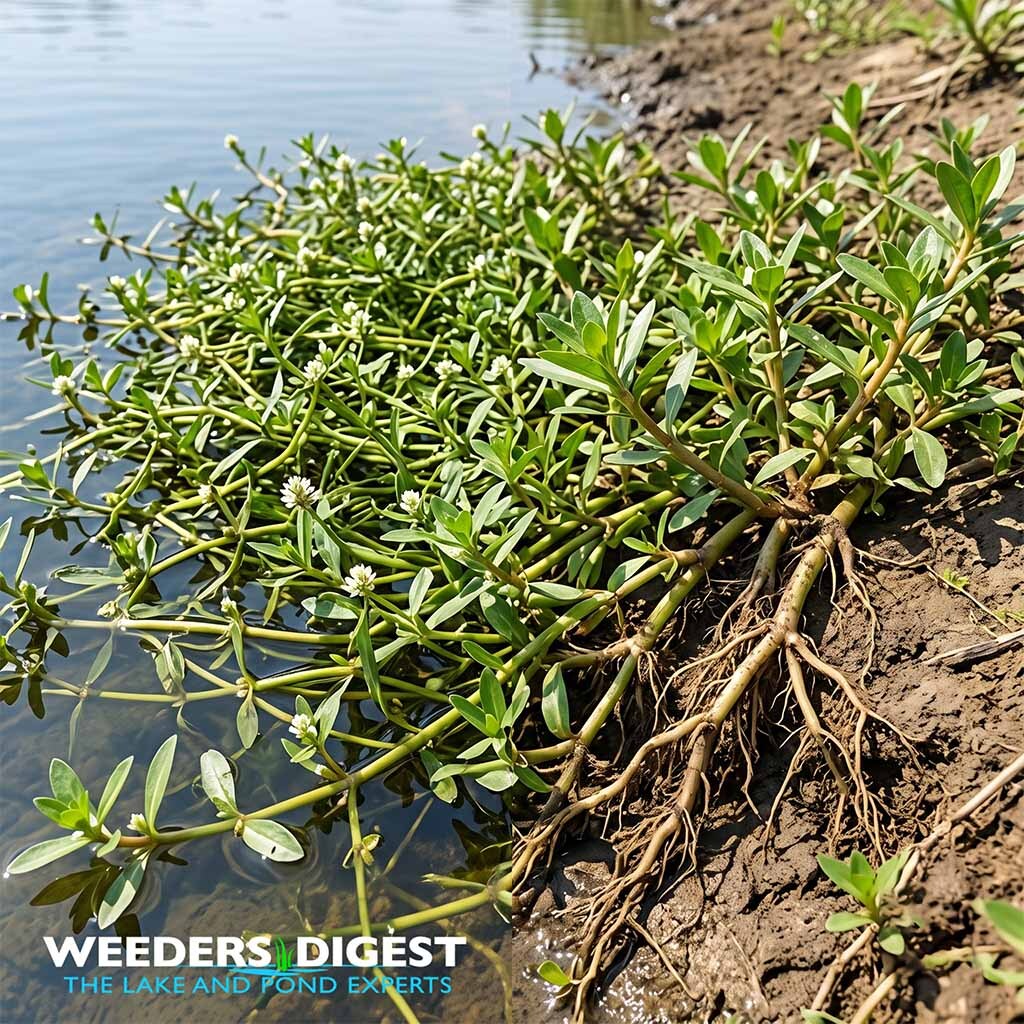
Alternanthera philoxeroides, commonly known as alligator weed, is a highly invasive perennial dicot characterized by an exceptionally adaptive amphibious physiology. Its ecological dominance stems from remarkable phenotypic plasticity, which is the ability of an organism to alter its physical morphology in response to environmental conditions. When growing over open water, the plant develops adventitious roots—roots that emerge from non-root tissues like stems—along with large, hollow stem internodes that provide buoyancy. Conversely, when established on dry land, the internodes become structurally dense and the plant develops a massive, deeply penetrating underground rhizomatous root system with thickened taproots to secure moisture and nutrients.
The physiological differences between the aquatic and terrestrial phases heavily complicate eradication efforts, a dynamic highlighted by the plant's extreme variations in biomass allocation. Research published in Plant Protection Quarterly by M.H. Julien detailed how aquatic growth exhibits top-to-root biomass ratios of 5.6, dedicating the vast majority of its energy into massive vegetative expansion across the water's surface. In stark contrast, terrestrial growth ratios plummet to 0.3, allocating almost all metabolic energy into deep, resilient root structures. The same study noted that in stream habitats, total alligator weed biomass can peak at a staggering 392 grams per square meter in late summer. This dual-growth strategy allows the terrestrial root networks to act as a permanent, nutrient-rich anchor that continuously feeds the rapid expansion of the floating vegetative mats.
These expansive floating mats aggressively outcompete native aquatic flora by intercepting sunlight and severely impeding gaseous exchange across the air-water interface. This barrier effect frequently induces localized anoxic, or completely oxygen-depleted, conditions within the water column, which can be fatal to fish and benthic invertebrates. Furthermore, the structural integrity of these vegetative mats is astonishingly formidable. According to data compiled by the Commonwealth of Australia and the Global Invasive Species Database, aquatic mats of Alternanthera philoxeroides can extend up to 15 meters outwards from the shoreline over the water surface, and they become so densely interwoven that they are robust enough to support the weight of a human. This massive surface coverage physically obstructs hydrological flow, blocks critical drainage infrastructure, and drastically accelerates sedimentation rates.
Because alligator weed does not produce viable seeds in its invasive ranges, reproduction and geographic dispersal rely entirely on vegetative fragmentation. Every individual stem node contains two axillary buds; when the plant is subjected to mechanical stress from boat propellers, wave action, or improper mechanical harvesting, the stem fractures into independent vegetative propagules. A single broken node floating downstream can rapidly initiate an entirely new colony upon reaching a suitable muddy shoreline. Consequently, integrated ecological management protocols dictate the use of translocated systemic control agents, which are absorbed by the exposed foliage and biologically transported downward to permanently destroy the subterranean root complex before any physical removal or disruption of the aquatic mat is attempted.