

The Frozen Mystery Beneath Your Boots: What Causes Bubbles Trapped in Lake Ice?
 |

Summary:
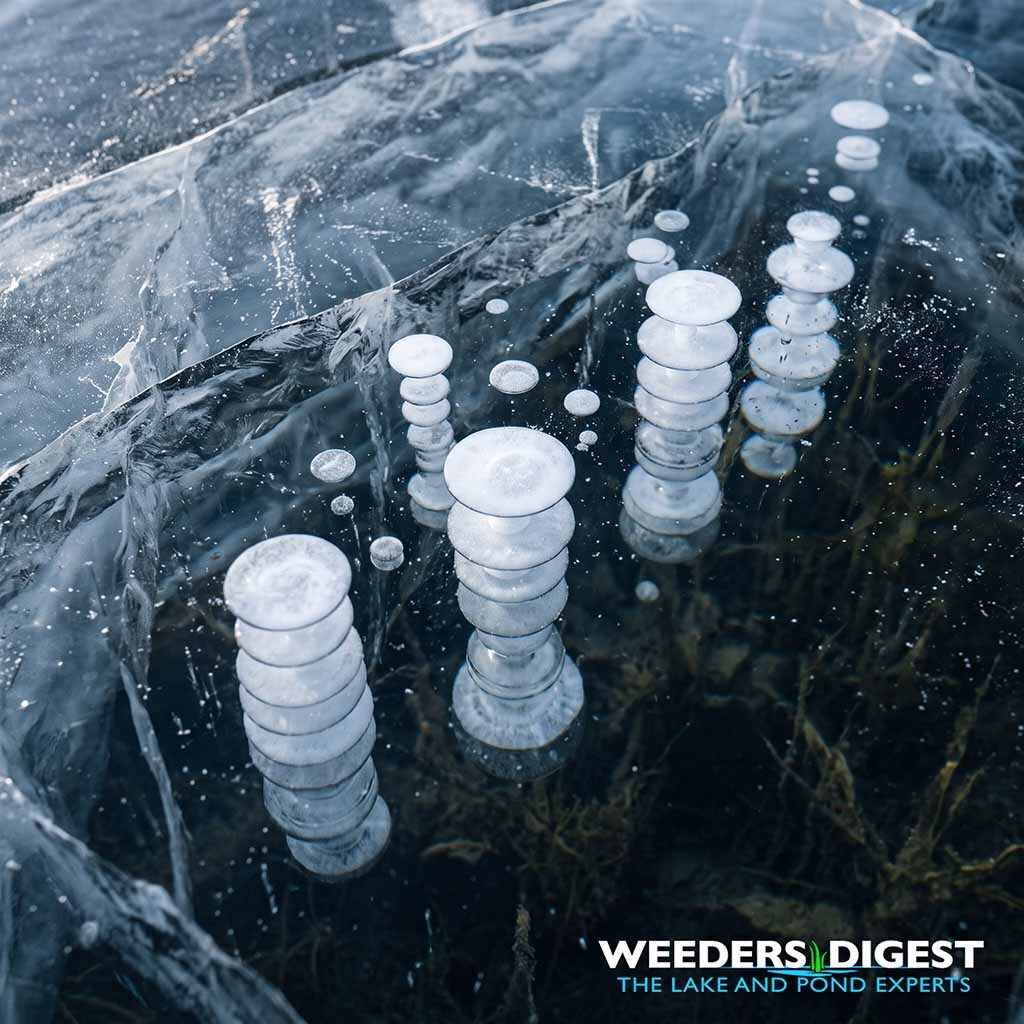
The tiny, frozen bubbles suspended inside thick lake ice are caused by gases—primarily biogenic methane and exsolved atmospheric gases—rising from decomposing organic muck on the lake bottom and getting encased as the freeze front moves downward. As winter settles over our northern lakes, microbial activity in oxygen-depleted benthic sediment continues to break down dead aquatic plants, leaves, and organic debris. This anaerobic decomposition produces pockets of gas that bubble upward through the water column toward the surface. When these rising gas plumes collide with the advancing freezing boundary of surface ice, they become immobilized, creating vertical stacks of white, disc-shaped bubbles frozen into the sheet.
Our lake and pond experts frequently encounter this phenomenon during early winter freeze-up evaluations across northern shorelines. Walking out over clear black ice, we often spot distinct clusters of milky-white bubbles stacked vertically like poker chips directly above dense weed beds and thick muck pockets. These formations provide an immediate visual indicator of the underlying sediment conditions: where you see high concentrations of trapped gas, you are looking directly down at active, oxygen-starved zones of decaying organic material below.
The Science Behind It:
The primary mechanism driving these suspended voids is biogenic ebullition, the rapid release of gas bubbles produced by methanogenic archaea inhabiting the benthic sediment. In productive lakes, the seasonal die-off of submersed vegetation, filamentous algae, and terrestrial leaf litter accumulates on the lake bed, forming dense organic silt. When aerobic bacteria exhaust dissolved oxygen in this bottom layer, anaerobic methanogens take over, metabolizing acetate and carbon dioxide to yield methane (CH4) along with carbon dioxide (CO2) and minor amounts of nitrogen (N2) and hydrogen sulfide (H2S). Because methane exhibits low aqueous solubility, it readily coalesces into discrete interstitial gas pockets within the muck until buoyancy overcomes sediment cohesion, driving bubbles upward through the water column.
The formation of the visual bubble column is dictated by the thermal physics of the ice-water interface, also known as the freezing front. As surface water cools below 0°C, congelation ice (columnar ice) grows unidirectionally downward into the water column. When rising methane bubbles hit the underside of this expanding ice sheet, surface tension and upward buoyant force hold them flat against the freezing boundary. As cold ambient temperatures cause the ice crystal lattice to advance past the gas pocket, the bubble becomes encased. Subsequent bubbles rising from the exact same benthic seep chimney arrive at the newly lowered ice boundary, creating distinct vertical stacks of flattened, disc-shaped voids separated by thin layers of clear ice.
Limnological research highlights the scale and biogeochemical behavior of this winter gas entrapment. In an extensive study led by Dr. Katey Walter Anthony and published in Biogeosciences by Greene et al., researchers investigated the mechanics of seasonal ice-bubble storage and methane ebullition. The study quantified that point-source ebullition seeps release substantial amounts of gas throughout winter, finding that approximately 70% to 80% of methane temporarily trapped in ice-bubble storage dissolves back into the under-ice water column before the ice completely encapsulates it, where up to 50% can be oxidized by methanotrophic bacteria. In separate seep classification studies across northern lakes, Walter Anthony et al. demonstrated that continuous point-source seeps can release anywhere from 6 to over 1,160 grams of CH4 per seep per year, illustrating how localized organic decay channels continuous plumes into the winter ice cover.
A secondary, non-ebullitive mechanism responsible for smaller, evenly distributed micro-bubbles is gas exsolution during ice crystallization. Water holds dissolved atmospheric gases such as nitrogen and oxygen, with solubility increasing as water temperatures approach freezing. However, the crystalline lattice of solid ice cannot accommodate these dissolved gas molecules, causing the advancing ice sheet to systematically reject dissolved gases into the boundary layer of liquid water directly beneath it. Once this interfacial boundary reaches super-saturation, excess gases nucleate into tiny micro-bubbles that become quickly engulfed by fast-growing congelation crystals, scattering sunlight and giving lake ice its cloudy, striated appearance.
Our Recommendation for Managing Trapped Ice Gases & Shoreline Muck:
The presence of heavy bubble clustering under winter ice is a direct symptom of severe benthic muck buildup and oxygen depletion along your shoreline. When dead aquatic vegetation and runoff collect in your swimming area or boat slips, it forms a thick, anaerobic layer of organic sediment that fuels continuous gas generation and robs the bottom water column of oxygen throughout the freeze period.
To eliminate this cycle, waterfront properties require proactive, mechanical sediment disruption and circulation before the lake freezes over. Applying directional water flow via an underwater thrusting system, such as our AquaThruster Muck & Weed Blower collection, prevents the accumulation of loose organic silt and leaf litter across your shoreline. By continuously oscillating and circulating water along the lake bottom, directional blowers displace decaying organic matter into deeper zones and oxygenate the sediment-water interface, significantly reducing the anaerobic decay and gas production that manifests as frozen bubble fields each winter.
Sources / References:
- Greene, S., Walter Anthony, K. M., Archer, D., Sepulveda-Jauregui, A., & Martinez-Cruz, K. (2014). Modeling the impediment of methane ebullition bubbles by seasonal lake ice. Biogeosciences, 11(23), 6791–6811. https://doi.org/10.5194/bg-11-6791-2014
- Walter Anthony, K. M., & Anthony, P. (2013). Constraining spatial variability of methane ebullition seeps in thermokarst lakes using point process models. Hydrobiologia, 721(1), 41–53. https://doi.org/10.1007/s10750-013-1663-x
- Walter Anthony, K. M., Vas, D. A., & Brosius, L. (2010). Estimating methane emissions from northern lakes using ice-bubble surveys. Quaternary Science Reviews, 29(23–24), 3022–3027. https://doi.org/10.1016/j.quascirev.2010.07.013