

The Midnight Oxygen Crash: Why Your Pond's Fish Are Suffocating Overnight
 |
Summary:
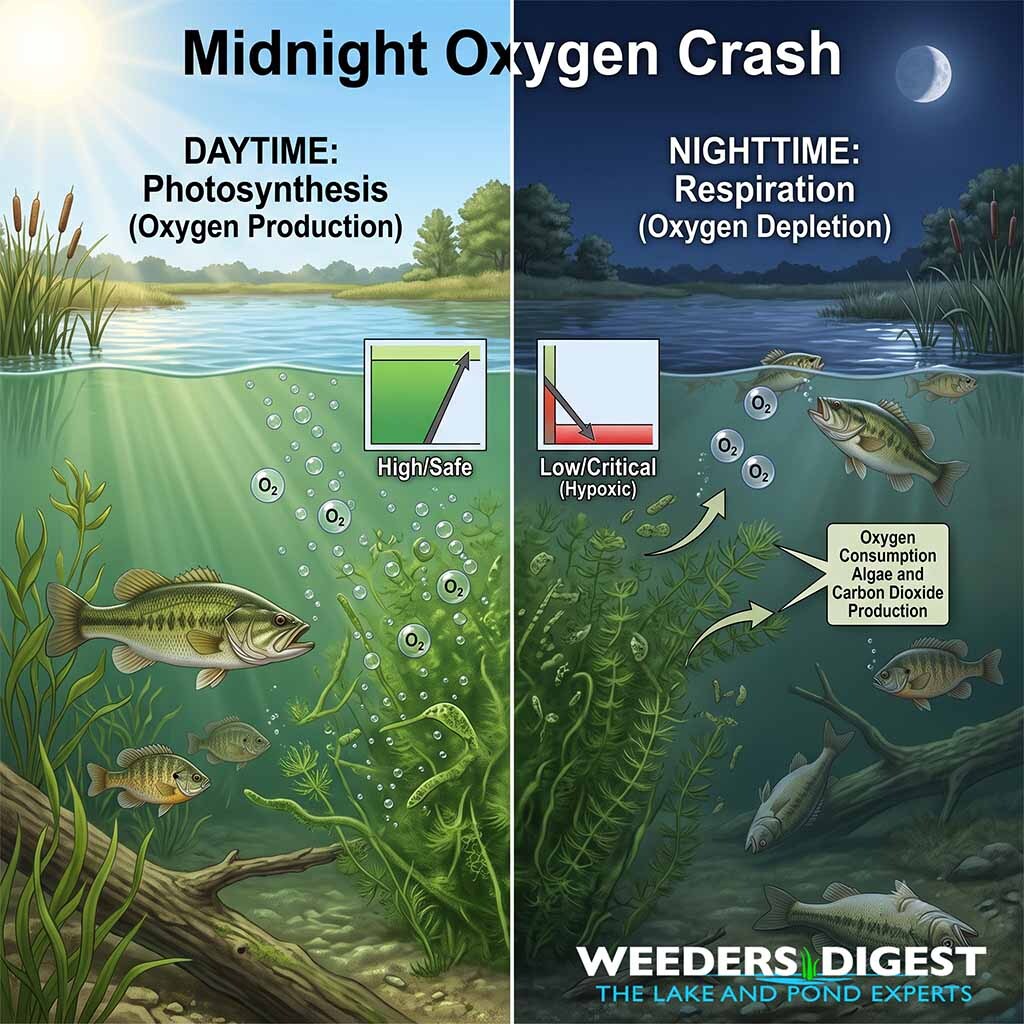
A midnight oxygen crash occurs when dense algal blooms consume the majority of a pond's dissolved oxygen during the night through respiration, leading to the rapid suffocation and death of fish before dawn. During the day, algae and aquatic plants produce abundant oxygen through photosynthesis, a process entirely driven by sunlight. However, once the sun sets, this production phase halts completely. Instead of adding oxygen to the water, the massive volume of algae shifts to consuming it alongside the fish, beneficial bacteria, and other aquatic organisms.
In ponds suffering from excessive nutrient loads and severe algal blooms, this biological demand far outpaces the available oxygen. The algae breathe heavily in the dark, causing dissolved oxygen levels to plummet to lethal lows just hours before sunrise. By the time the sun comes up to restart the photosynthesis cycle, it is often too late for the larger, more oxygen-dependent fish in the pond.
In my years working as a Certified Lake Manager, I have received countless panicked morning calls from property owners who walked out to their perfectly healthy-looking pond only to find their largest bass and bluegill floating at the surface. They almost always suspect a toxic chemical spill or malicious poisoning, but when I pull out my dissolved oxygen meter, the readings tell the true story of a nighttime crash. The water essentially suffocated them in the dark. It is a heartbreaking but incredibly common scenario during the hot, stagnant dog days of summer when water conditions are at their most vulnerable.
The Science Behind It:
The phenomenon known as a midnight oxygen crash is fundamentally driven by the diurnal (daily) cycling of dissolved oxygen (DO) and the biological oxygen demand (BOD) exerted by excessive phytoplankton populations. Phytoplankton, or microscopic algae, are the primary producers of DO in aquatic ecosystems, utilizing solar radiation to drive photosynthesis. During daylight hours, these organisms uptake carbon dioxide and release oxygen, often supersaturating the water column. However, the absence of photons during the dark phase halts photosynthetic oxygen production entirely, initiating a nighttime period dominated by cellular respiration.
During cellular respiration, phytoplankton, zooplankton, aerobic bacteria, and fish actively consume the residual dissolved oxygen to metabolize organic compounds. In a balanced aquatic ecosystem, this nocturnal decline in DO is a natural, harmless fluctuation. Conversely, in hypereutrophic environments—waterbodies heavily enriched with excess nutrients like phosphorus and nitrogen—the sheer biomass of the algal bloom demands an unsustainable volume of oxygen. This respiratory demand is further exacerbated by the aerobic decomposition of naturally dying algae cells, a process facilitated by bacteria that heavily taxes the oxygen reserves near the benthic, or bottom, layer of the pond.
The physical properties of water significantly amplify the risk of these nocturnal depletion events during the summer months. According to research published by the University of Florida Institute of Food and Agricultural Sciences (IFAS), the solubility of oxygen in water is inversely proportional to temperature. Their data demonstrates that water at 90 degrees Fahrenheit can only hold a maximum of 7.4 milligrams per liter (mg/L) of dissolved oxygen at saturation, whereas water at 45 degrees Fahrenheit can hold up to 11.9 mg/L. Because warmer summer water holds substantially less oxygen to begin with, the starting baseline at dusk is already physically compromised, leaving an incredibly narrow margin of error before critical biological thresholds are crossed.
When the combined respiratory consumption by the algal biomass and aerobic bacteria depletes the finite DO reserves, the aquatic environment rapidly becomes hypoxic (low oxygen) or completely anoxic (zero oxygen). Data compiled from the Texas A&M AgriLife Extension and UF IFAS indicate that most warmwater fish species experience severe physiological distress when DO concentrations fall between 2 and 4 mg/L. Mortality typically occurs rapidly when concentrations drop below the critical threshold of 2 mg/L. Because larger, mature fish have exponentially higher metabolic oxygen requirements, they are invariably the first to succumb to suffocation, which serves as a hallmark ecological indicator of an environmental oxygen crash rather than a localized toxicological event.
Prolonged overcast weather patterns and thermal stratification further complicate this delicate ecological balance. Without sufficient solar radiation during consecutive cloudy days, the baseline oxygen production from photosynthesis is severely stunted, leading to a net loss of oxygen over a 24-hour cycle. Furthermore, when a sudden meteorological event—such as a cold, heavy thunderstorm—rapidly cools the surface layer, it can trigger a premature pond turnover. This rapid mixing of the oxygen-rich epilimnion (the warm surface layer) with the anoxic hypolimnion (the cold, oxygen-depleted bottom layer) instantly strips the entire water column of its remaining dissolved oxygen, often resulting in a catastrophic, sudden fish kill across multiple species and size classes.