

The Science of Over-Wintering: How Your Lake Weeds Survive Under the Ice
 |

Summary:
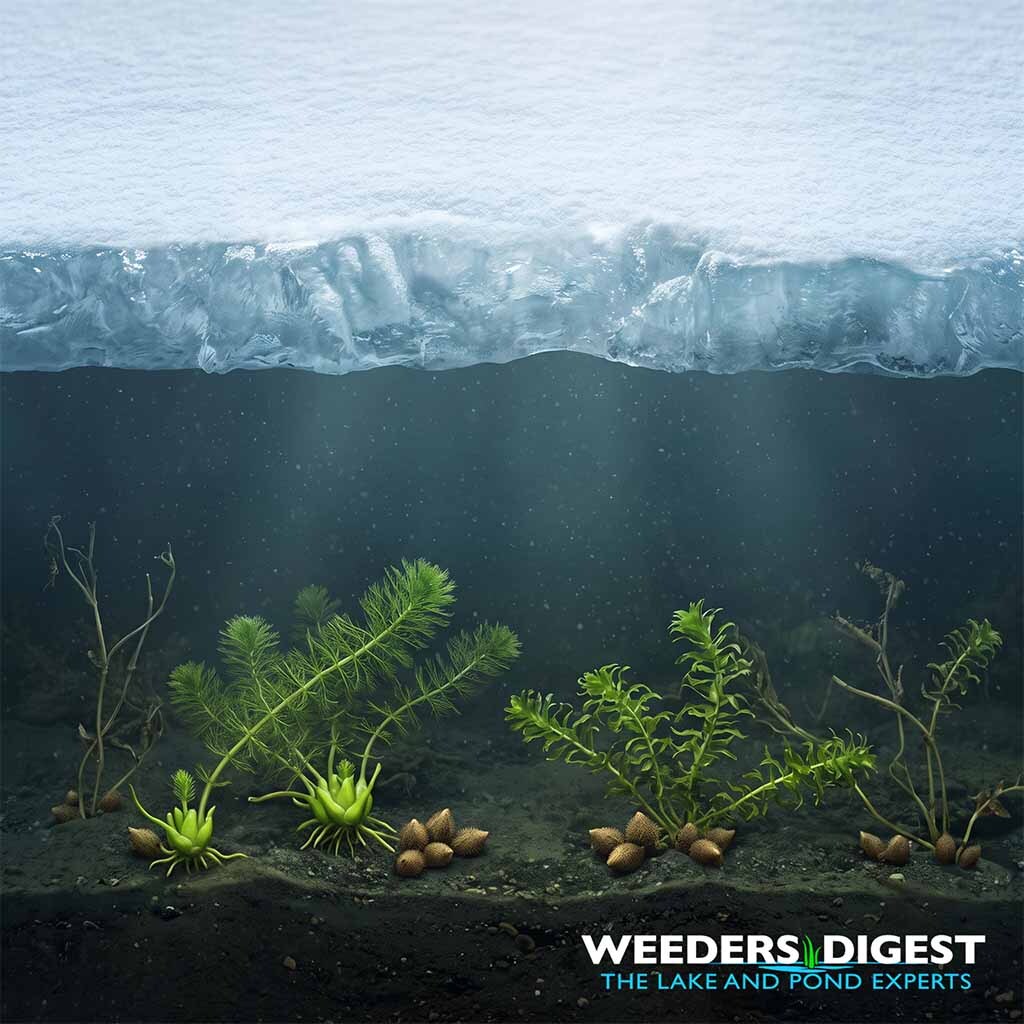
Aquatic weeds survive the freezing winter months by retreating to the lake bottom, storing highly concentrated energy starches in specialized root crowns and hardened winter buds, and utilizing the ice layer above as a protective, insulating blanket. While it might seem logical that a frozen lake would kill off all nuisance vegetation, the reality is quite the opposite. Because water is most dense just above freezing, the bottom of the lake remains in a stable liquid state, preventing the roots, stems, and seeds of aquatic plants from freezing solid. Instead of dying off, these weeds simply enter a state of strategic dormancy.
As a Certified Lake Manager, one of the most surprising things I show property owners during early spring surveys is just how alive their lake bottom is long before the ice fully melts. When we drop cameras down or conduct ice-off inspections, we frequently find invasive species like Eurasian watermilfoil sitting perfectly green and intact in the frigid water, simply waiting for a slight temperature bump. They do not start from scratch every spring; they are merely sleeping, loaded with energy and ready to explode in growth the moment the sunlight penetrates the thawing ice.
By pulling back their vital resources into specialized root systems, aquatic weeds ensure they have a massive head start on native vegetation when the season changes. Understanding this biological survival mechanism is exactly why treating a lake as a year-round ecosystem—rather than just a summer project—is so critical for long-term shoreline management.
The Science Behind It:
The ability of aquatic macrophytes to survive harsh winter conditions relies on specialized morphological adaptations and the unique thermal properties of water. As ambient temperatures drop, water freezes at 0 degrees Celsius (32 degrees Fahrenheit) and floats to the surface. This physical phenomenon creates an insulating barrier that prevents the deeper benthic zone—the ecological region at the very bottom of the lake—from freezing completely. Submersed aquatic vegetation capitalizes on this insulated, liquid environment by shifting their biological focus from active photosynthesis and canopy growth to energy conservation and structural dormancy.
One of the primary mechanisms for overwintering is the production of turions, which are specialized, highly compacted vegetative buds. Species such as curly-leaf pondweed and European frog-bit develop these densely packed meristematic tissues in response to decreasing photoperiods and dropping temperatures in the late summer and fall. Turions are fortified with a mucilaginous coating and packed with starch, allowing them to detach from the parent plant and sink safely into the sediment. According to ecological research and species data from Michigan State University, a single invasive plant can produce between 100 and 150 turions in one season. These vegetative structures are highly resilient to cold and can remain completely viable in the sediment for up to two years while waiting for optimal germination conditions.
Other aggressive invasive species, such as Eurasian watermilfoil (Myriophyllum spicatum), utilize a different physiological strategy by relying heavily on carbohydrate storage in their lower stems and root crowns. Rather than solely depending on seeds or detachable buds, the aboveground tissue of the plant typically dies back, while the root crowns accumulate massive concentrations of nonstructural carbohydrates. Research published by Michigan Technological University demonstrates that this stored starch allows the milfoil to survive prolonged periods with low or zero light penetration under snow-covered ice. In stable, insulated benthic zones, the plant can even maintain a leafy-green condition throughout the entirety of the winter.
This stored carbohydrate reserve gives invasive macrophytes a distinct ecological advantage over native species when the seasons shift. Because the energy is already stockpiled, plants utilizing this overwintering strategy do not need to wait for peak light levels to begin synthesizing food; they simply break dormancy and push new shoots from the root crowns the moment water temperatures approach 15 degrees Celsius (59 degrees Fahrenheit). This rapid mobilization of starches ensures that the invasive weeds reach the water column's surface first, effectively shading out native competitors and establishing a dominant canopy before the summer season officially begins.