

The Secret Behind Your Invaded Pond: Unlocking the Flawless Flotation of the Water Hyacinth
 |

Summary:
The water hyacinth floats flawlessly because its leaf stalks are swollen into bulbous, sponge-like structures filled with microscopic air chambers that act as permanent, built-in life jackets. Native to South America, this highly invasive aquatic weed has mastered the art of buoyancy to outcompete almost everything else in the water. Instead of investing energy into deep root systems anchored in the soil, the plant evolved to hover right at the surface where it can absorb maximum sunlight while dangling its dark, feathery roots directly into the water column to siphon up nutrients. This morphological trick allows it to rapidly colonize a waterbody, shifting freely with the wind and current.
While working as a Certified Lake Manager, my team and I frequently encounter thick, impenetrable mats of these floaters during early summer assessments, and what always stands out in the field is just how surprisingly heavy these plants are when you physically pull them from the water, despite how effortlessly they bob on the surface. The combination of dense water weight and trapped air creates a robust, interlocking raft that resists both sinking and manual removal.
Homeowners and pond enthusiasts often underestimate just how mechanically efficient this plant is. It doesn't just float; it uses its buoyancy to shield the water below from sunlight, effectively starving submerged plants and disrupting the entire local ecosystem. Understanding how this biological floatation device works is the first step in realizing why it is so difficult to manage once it takes hold in a backyard pond or massive lake.
The Science Behind It:
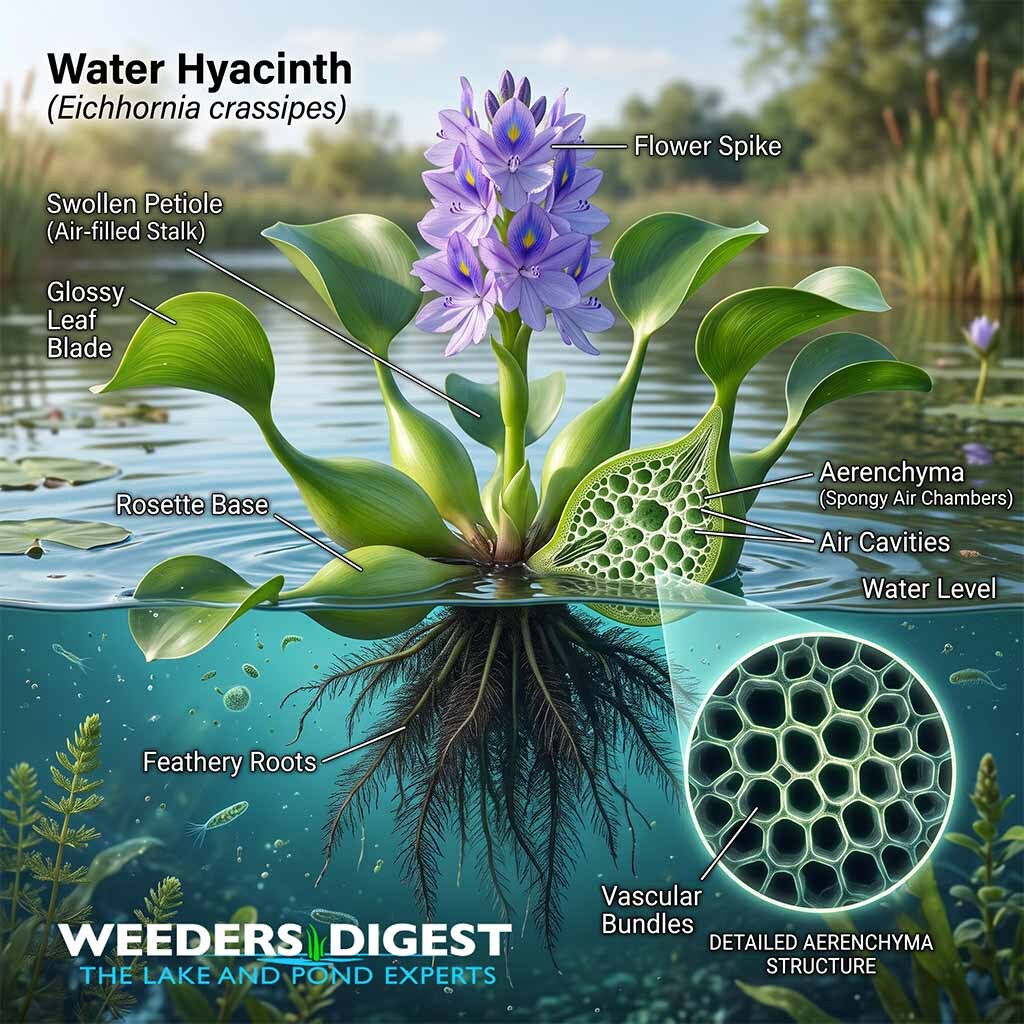
At the core of Eichhornia crassipes (water hyacinth) morphology is the highly specialized petiole, which is the botanical term for the stalk that connects the leaf blade to the base of the plant. In the water hyacinth, this petiole is drastically swollen and bulbous. This swelling is entirely driven by a specialized plant tissue known as aerenchyma. Aerenchyma consists of a network of interconnected, honeycomb-like intercellular spaces that trap atmospheric gases. This internal cavernous architecture dramatically decreases the plant's overall tissue density, ensuring it remains highly buoyant even as the plant accumulates significant physical mass and absorbs water.
The structural composition of this plant reveals a highly efficient biological composite. According to research published in the journal ACS Sustainable Chemistry & Engineering, water hyacinth biomass possesses an astonishingly rapid growth rate, capable of doubling its weight in just 6 to 28 days and producing up to 17.5 tons of wet biomass per hectare per day under optimal conditions. To support this rapid expansion without sinking, the aerenchyma tissue is encased in an epidermis with a waxy cuticle that prevents water ingress while the trapped oxygen and carbon dioxide maintain optimal buoyancy.
Furthermore, studies detailing the microstructural characteristics of the water hyacinth petiole published in the journal Materials (MDPI) note that the plant's living tissue is actually composed of approximately 90 to 95 percent water. Despite this immense water retention, the structural integrity of the aerenchyma is fortified by a rigid cellular matrix consisting of roughly 25 percent cellulose, 33 percent hemicellulose, and 10 percent lignin. This specific ratio of rigid botanical fibers to hollow air chambers creates an incredibly high strength-to-weight ratio, allowing the plant to resist mechanical stresses from wind and wave action without collapsing its internal air pockets.
In addition to the aerenchyma of the petioles, the root morphology significantly contributes to the plant's ecological dominance. The fibrous, adventitious roots hang freely in the pelagic zone (the open water column) rather than anchoring in the benthic zone (the bottom sediment). This un-anchored state allows the plant to drift and intercept dissolved nutrients directly from the water, acting as a biological filter. However, this same morphological trait enables a single hectare of water hyacinth to reach over 200 tons of wet weight, creating dense canopies that severely deplete dissolved oxygen levels in the water, block light penetration, and choke out competing native flora.