

The Truth About Why Your Shoreline Is Accumulating More Muck Right Now
 |

Summary:
Your shoreline is accumulating more muck right now because peak summer temperatures trigger massive aquatic plant die-offs while simultaneously depleting the dissolved oxygen that natural bacteria need to decompose that organic waste. During the heat of mid-summer, the sheer volume of dying algae, weeds, and organic runoff piling up in the shallow littoral zone completely outpaces what the local ecosystem can process. As water temperatures peak, the standard summer bacteria slow down in efficiency rather than going completely dormant due to the lack of oxygen, meaning the decomposition process stalls just as the organic load is at its heaviest.
We see the results of this biological bottleneck firsthand every summer when property owners notice rapid, foul-smelling sludge buildup that seemingly appeared overnight. As aquatic technicians, our field observations consistently show that dropping late-summer water levels further concentrate this decaying matter into near-shore depressions, baking it into a dense, anaerobic paste. Addressing this buildup is a big, labor-intensive project. Removing heavy, water-logged muck is never easy, and there is no simple magic fix for pulling years of accumulated organic material out of your waterfront, but understanding the environmental mechanics is the crucial first step in reclaiming your beach.
The Science Behind It:
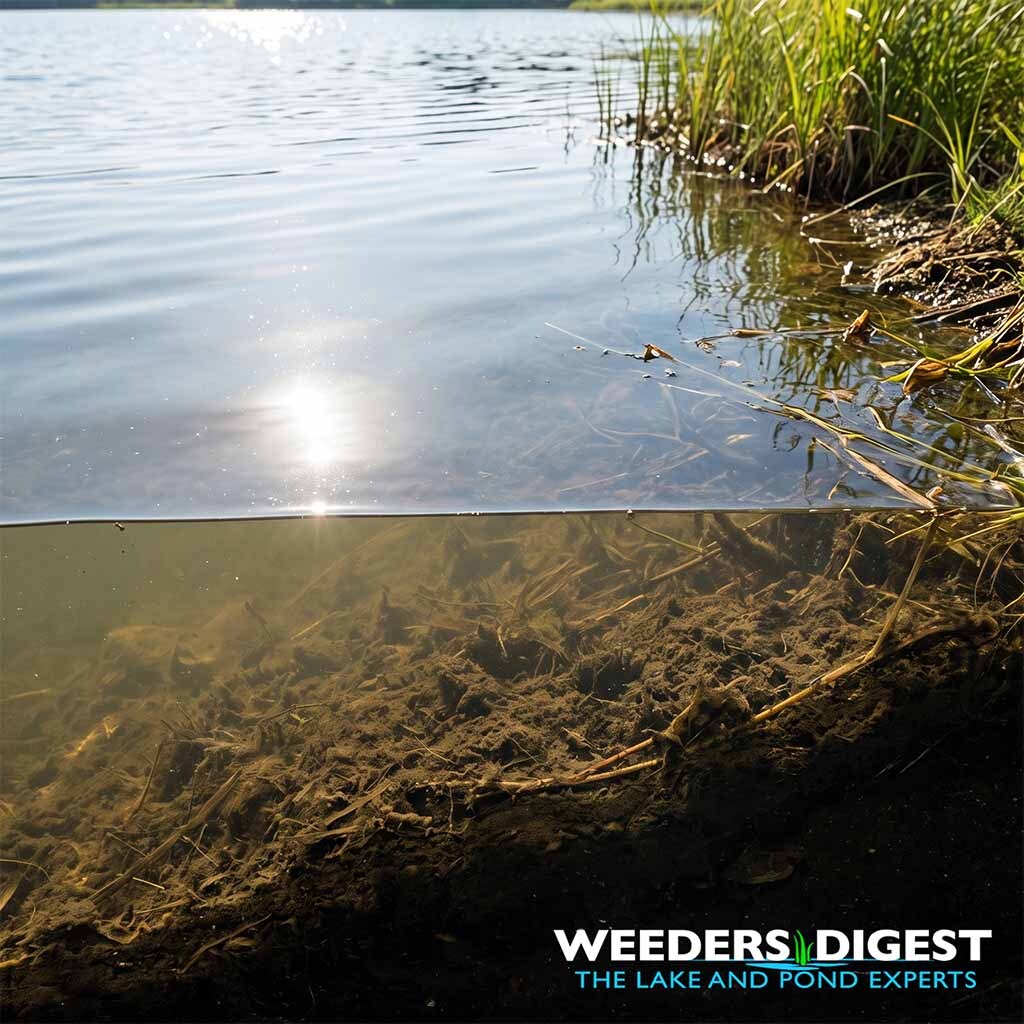
The accumulation of shoreline muck, scientifically referred to as benthic organic matter, is driven by a complex biogeochemical cycle dependent on temperature, dissolved oxygen availability, and internal nutrient loading. In the shallow margins of a waterbody, sunlight penetrates all the way to the bottom sediment, warming the water rapidly and stimulating the excessive growth of planktonic algae and aquatic macrophytes. When these organisms inevitably reach the end of their life cycles, they sink to the benthic zone, adding an immense load of labile organic carbon to the sediment.
As aerobic microbial communities attempt to break down this massive influx of biological material, they consume dissolved oxygen at an exceptionally high rate. According to comprehensive watershed science and geochemical profiling of littoral sediments, this intense biological activity leads to a rapid depletion of terminal electron acceptors, particularly oxygen, right at the water-sediment interface. Once the oxygen is depleted, the microbial metabolism becomes severely limited. The degradation process shifts to slower anaerobic pathways, leading to the accumulation of un-mineralized organic matter and the production of hydrogen sulfide gas, which causes the distinct foul odor associated with shoreline muck.
This anaerobic environment simultaneously triggers a highly destructive feedback loop known as internal nutrient loading. Studies monitoring shallow lake dynamics demonstrate that when oxygen levels crash at the sediment boundary during the summer, the release of phosphorus from bottom sediments can account for over 81% of the total phosphorus load in the ecosystem. This means the sediment itself becomes the primary fertilizer for the waterbody. Furthermore, researchers have quantified that a water temperature increase of just 3 to 4 degrees Celsius is sufficient to double the release rate of phosphorus from the lake bottom.
The physical structure of the littoral zone exacerbates this nutrient trap. Lacking the intense wave action and turbulent mixing found in open, deep waters, the shoreline acts as a natural settling basin for this nutrient-rich detritus. As the organic matter continuously piles up, it undergoes compaction and chemical transformation. The topmost sediment layers may contain fresh, semi-degraded organic matter, while the deeper layers compress into a fine-grained, anoxic sludge with extremely high organic carbon density. Reversing this accumulation requires significant mechanical intervention because the localized environment has fundamentally shifted away from decomposition and into a state of permanent organic sequestration.
Sources / References:
- Seasonal variations in pore water and sediment geochemistry of littoral lake sediments - PMC (https://pmc.ncbi.nlm.nih.gov/articles/PMC1769484/)
- The Assessment of External and Internal Nutrient Loading as a Basis for Lake Management - MDPI (https://www.mdpi.com/2073-4441/14/18/2844)
- Effects of Elevated Temperature on Resources Competition of Nutrient and Light Between Benthic and Planktonic Algae - Frontiers (https://www.frontiersin.org/journals/environmental-science/articles/10.3389/fenvs.2022.908088/full)