

Uncovering the Winter Secrets of Your Lake: What Really Happens to Our Muck When Temperatures Drop
 |

Summary:
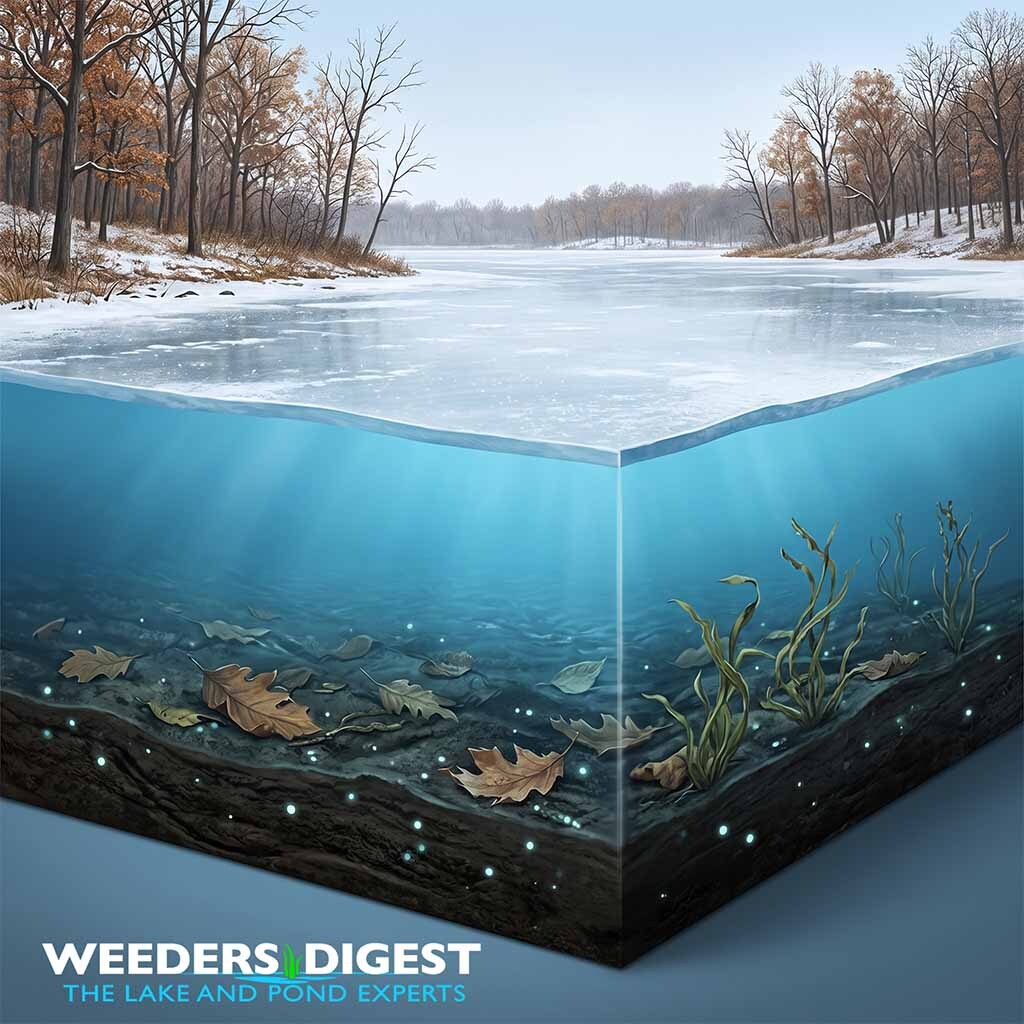
When water temperatures start to drop, the muck layer at the bottom of a lake or pond stops decomposing and begins to rapidly accumulate new organic material. As the seasons change and the water cools, the natural bacteria responsible for breaking down dead leaves, weeds, and fish waste experience a drastic reduction in their metabolic rate. It is a common misconception that these beneficial microbes go dormant or die off completely in cold water; in reality, they simply slow down their processing speed. Because the bacteria are eating much slower, the incoming dead organic matter from autumn debris outpaces the decomposition process, causing the sludge layer to grow thicker over the winter months.
As lake experts, we frequently observe this seasonal shift during late autumn sediment sampling. When pulling core samples from the bottom of a pond in mid-November compared to July, the sludge is often noticeably denser and more packed with intact, recognizable plant debris. Without the high-speed bacterial digestion seen in the warmth of summer, the cold water acts almost like a refrigerator, preserving the muck and setting the stage for a heavy nutrient load once the spring thaw arrives.
The Science Behind It:
The fundamental mechanism governing the accumulation of benthic organic matter in cooling water is driven by microbial thermodynamics and enzyme kinetics. In aquatic ecology, the muck layer, or benthic sediment, consists of partially decomposed organic carbon, nitrogen, and phosphorus compounds. The degradation of this material relies entirely on the metabolic activity of heterotrophic bacteria and fungi. As ambient water temperatures decrease, the kinetic energy available for enzymatic reactions within these microbial cells diminishes. This biological deceleration means that the hydrolysis and fermentation of complex organic polymers into simpler, soluble compounds—which would eventually be released as carbon dioxide or methane—are severely restricted.
To quantify this temperature sensitivity, researchers utilize a metric known as the Q10 temperature coefficient, which represents the factor by which the rate of a biological or chemical reaction changes for every 10-degree Celsius change in temperature. Peer-reviewed studies on northern wetland and lake sediment environments indicate that the Q10 values for methanogenesis and general organic matter decomposition typically range between 2.4 and 4.3. In practical terms, this specific statistic demonstrates that for every 10-degree Celsius drop in water temperature, the rate of sediment decomposition decreases by roughly two to four times.
Because the microbial metabolic rate slows down so dramatically rather than ceasing completely, an ecological bottleneck forms at the sediment-water interface. During the autumn turnover, lakes receive massive inputs of senescing aquatic macrophytes, dying phytoplankton blooms, and terrestrial leaf litter. While the input of this detritus peaks, the bacterial processing power is simultaneously slashed by the dropping temperatures. Consequently, the rate of organic loading vastly exceeds the rate of mineralization, resulting in a net positive accumulation of the muck layer throughout the winter season.
Furthermore, this suppressed decomposition alters the biogeochemical cycling of the entire aquatic ecosystem. In warmer conditions, active microbial respiration rapidly consumes dissolved oxygen, often leading to anoxic conditions at the sediment boundary. In colder, ice-covered water, the reduced biological oxygen demand allows dissolved oxygen to persist slightly longer in the lower strata, though prolonged ice cover can eventually block atmospheric exchange and still result in anoxia. Ultimately, the cold water preserves the latent nutrient bank within the muck, creating a highly concentrated reservoir of bioavailable phosphorus and nitrogen that will fuel rapid biological productivity and potential algal blooms as temperatures rise and the Q10 coefficient accelerates microbial activity in the spring.
Sources / References:
- https://www.tandfonline.com/doi/full/10.1657/1938-4246-44.4.469
- https://www.researchgate.net/publication/353708552_Limitations_of_the_Q10_Coefficient_for_Quantifying_Temperature_Sensitivity_of_Anaerobic_Organic_Matter_Decomposition_A_Modeling_Based_Assessment
- https://journals.plos.org/plosone/article?id=10.1371/journal.pone.0314534