

Understanding How Your Cleared Swim Areas Influence Lake Life
 |

Summary:
Clearing a localized swimming area in your lake does not fundamentally destroy the broader ecological corridor, provided that the activity remains limited to a small, recreational footprint. When you remove vegetation from a small, designated zone, you are creating a temporary "gap" in the littoral zone—the shallow, near-shore area where life is most concentrated. While this gap acts as a disruption to the immediate, continuous cover that some juvenile fish or macroinvertebrates use for protection, a lake’s ecosystem is generally resilient enough to recover or navigate around these small, managed spaces without suffering systemic harm.
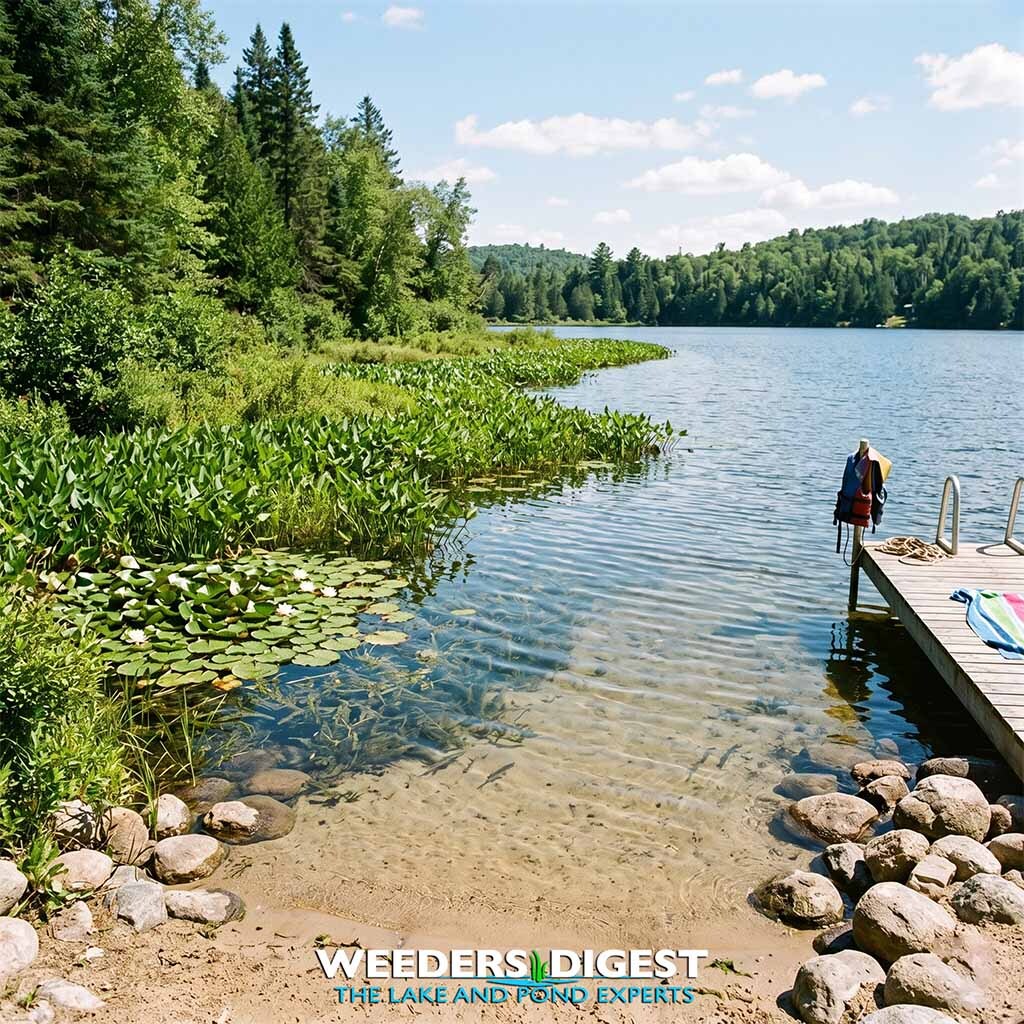
In my experience as a lake manager, I often see residents worry that a 20-by-20-foot clear zone will leave their entire shoreline "barren." In reality, when we walk the shoreline, we see that the surrounding aquatic vegetation—the thick, native pondweeds and lily pads—acts as an effective buffer. Nature doesn't treat your swimming area as a brick wall; rather, local fauna treat it as an open meadow in a forest. Fish and amphibians often use the "edge effect" created by the boundary of your cleared area and the dense vegetation to hunt, as this interface provides excellent visibility for predators and ample cover for prey.
The Science Behind It:
The littoral zone functions as the biological engine of a lake, facilitating nutrient cycling and providing critical nursery habitats. Scientific literature consistently demonstrates that submerged aquatic vegetation (SAV) provides vital structural complexity. Research indicates that for every 0.6 square meters increase in an SAV patch size, total fish biomass catch increases by 6.5 grams per hour, illustrating the direct relationship between plant density and faunal support. When a small area is cleared, the immediate, localized biomass of invertebrates and fish residing within that specific square footage is displaced.
However, the concept of an "ecosystem corridor" refers to the continuous movement of organisms along the shoreline. Intermediate levels of vegetation coverage—typically cited between 10% and 40%—are often identified by ecologists as optimal for species richness. This "intermediate disturbance hypothesis" suggests that minor gaps, such as a maintained swim area, can actually increase habitat heterogeneity. By maintaining a balance of both dense vegetation and small, open channels, property owners inadvertently create an edge-to-interior ratio that promotes higher biological activity compared to a completely uniform, overgrown shoreline.
The primary ecological risk occurs not from the clearing itself, but from the potential loss of "connectivity" if multiple, large-scale clearings are made along a single stretch of shoreline. If a significant percentage of the littoral zone is removed, the ability of smaller, less mobile organisms to traverse the shoreline is hindered. Research on habitat connectivity shows that when vegetation is decimated, juvenile fish are forced to emigrate to more vegetated areas, effectively narrowing the range of available nursery habitat. In contrast, small, singular management actions leave the surrounding matrix intact, allowing the local food web to maintain its functional stability.
Ultimately, aquatic communities exhibit significant adaptability to patchiness in their habitat. The structural architecture of native plants allows for the rapid recolonization of disturbed areas, provided the underlying sediment and water quality remain stable. Because a properly managed swimming area does not usually involve the total removal of the root systems or the degradation of the surrounding basin, the ecological corridor remains functional, allowing aquatic life to navigate around the recreational space with minimal long-term impact on the lake's biodiversity.
Sources / References:
- Frontiers in Conservation Science: Submerged Aquatic Vegetation Patch Size Affects Fish Communities in a Turbid-Algal Lake (https://www.frontiersin.org/journals/conservation-science/articles/10.3389/fcosc.2021.657691/full)
- ResearchGate / Farm Service Agency: Effects of Conservation Practices on Aquatic Habitats and Fauna (https://www.fsa.usda.gov/Internet/FSA_File/chap_6.pdf)
- ResearchGate: Effects of Aquatic Vegetation on Fish Assemblages in a Freshwater River of Taihu Lake Basin (https://www.researchgate.net/publication/268926368_Effects_of_Aquatic_Vegetation_on_Fish_Assemblages_in_a_Freshwater_River_of_Taihu_Lake_Basin_East_China)