

Understanding Your Water: The Basics of LC50 Toxicity Rates
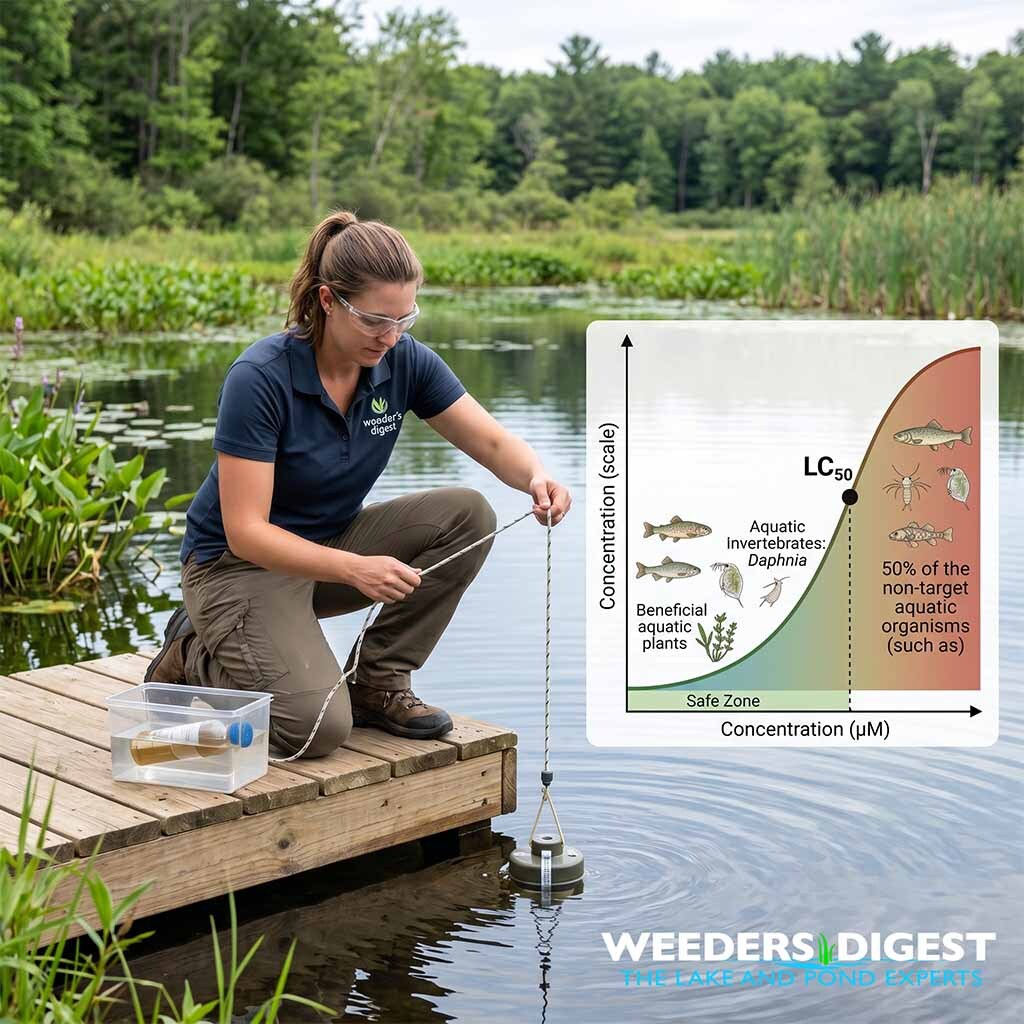

Summary:
An LC50 value is the specific concentration of a substance that is lethal to 50% of the test organisms within a defined timeframe, serving as a primary benchmark for assessing environmental safety. In the world of lake and pond management, it is the standard "measuring stick" used to ensure that the treatments we apply to control invasive weeds or algae do not cause unintended harm to fish, beneficial insects, or other non-target wildlife. By knowing the LC50 for a specific chemical, we can determine the margin of safety between the amount needed to control a nuisance plant and the amount that would endanger the broader ecosystem.
As a lake manager, I often see homeowners worry about the safety of their pond life when they see a treatment taking place. In my experience, these concerns are almost always addressed by strict adherence to these LC50 thresholds. When we calculate dosage rates, we are not just looking at the plant biomass; we are meticulously cross-referencing our application rates against the known LC50 data for local fish species and aquatic invertebrates. This ensures that the treatment remains far below the lethal threshold for the "good guys" living in your water.
The Science Behind It:
The LC50 (Lethal Concentration 50%) is the most reproducible measure of acute aquatic toxicity, providing a standardized quantitative endpoint for risk assessment. Toxicologists derive this value by exposing a population of specific test organisms—usually fish, invertebrates like Daphnia, or algae—to varying concentrations of a chemical over a fixed period, most commonly 96 hours. Mortality data are then plotted against concentration, and the concentration at which exactly half the population perishes is calculated using statistical methods like the Probit or Spearman-Karber method.
It is vital to recognize that LC50 is not an absolute measure of safety, but rather a relative measure of toxicity. A substance with a lower LC50 is inherently more toxic because it requires a smaller amount to induce mortality in 50% of the sample. For example, research into the herbicide diquat has shown measurable impacts on non-target biota, with studies documenting an LC50 of 155 µg/L for certain amphipods over a 6-week exposure, demonstrating the necessity of considering long-term exposure alongside acute 96-hour data.
Environmental variables profoundly influence these laboratory-derived numbers. Factors such as water pH, total alkalinity, and temperature can significantly alter the bioavailability and toxicity of a compound. Metals, for instance, often exhibit reduced toxicity at higher total alkalinities (typically >100 mg/L), whereas the toxicity of other substances can double with a 10°C increase in water temperature. Consequently, professional lake managers must account for the specific chemical profile of the water body to determine if the standard LC50 remains valid for their specific site conditions.
Because laboratory tests are conducted under idealized, controlled conditions, regulatory agencies and ecologists often apply an "application factor" to the 96-hour LC50 to estimate a "Maximum Allowable Toxicant Concentration" (MATC). These factors, often ranging from 0.001 to 0.1, help bridge the gap between acute lethality and chronic, sub-lethal impacts—such as reduced reproductive success or stunted growth—that do not immediately result in death but can destabilize a lake's food web over time.