

Unlocking the Mystery of Fractal Patterns on Our Winter Lake Ice
 |

Summary:
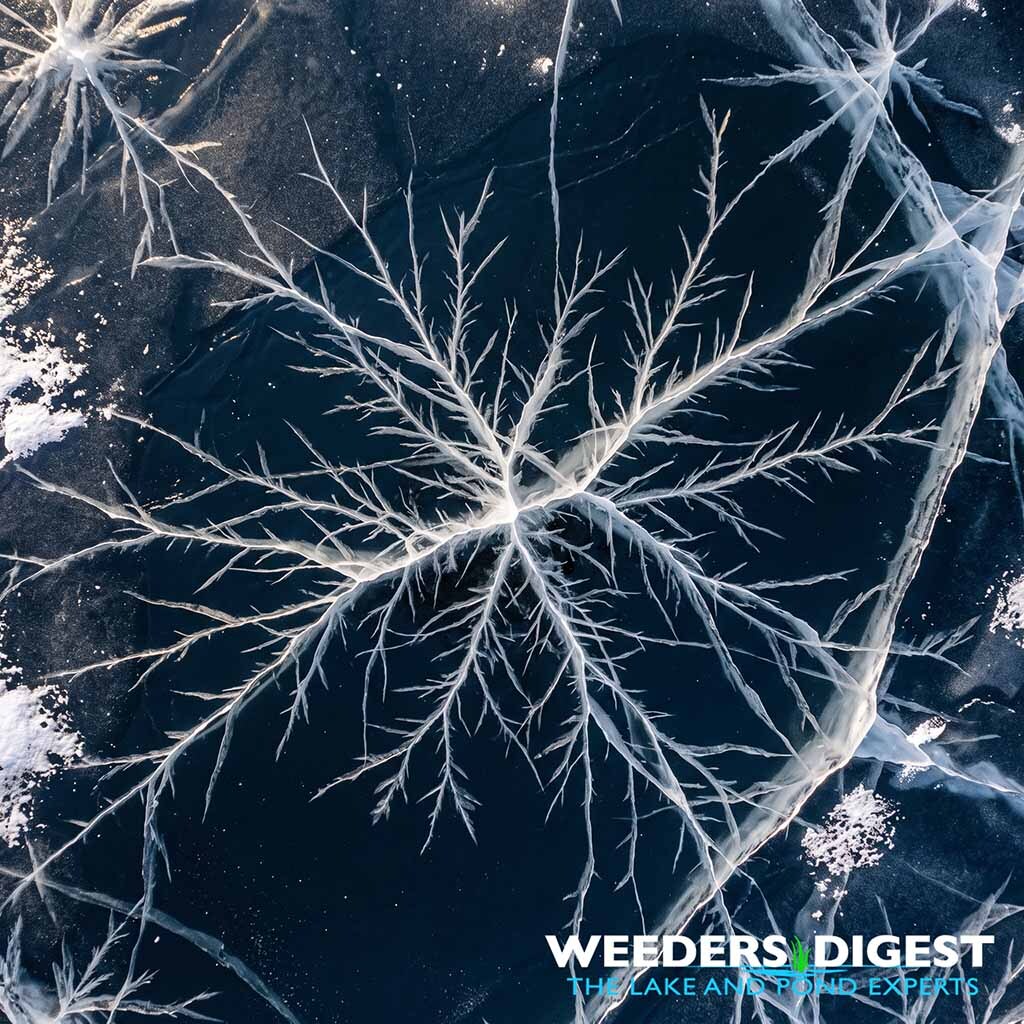
Spectacular fractal-like patterns on freshly frozen black ice are formed by a delicate thermodynamic tug-of-war between rapid sub-surface ice crystallization and hydro-thermal flow through porous slush. When calm, sub-freezing air flash-freezes ultra-pure surface water, the crystal growth front develops non-linear branches known as dendritic structures. If light snow settles across this thin crust and breaches occur, dense, relatively warm liquid water from beneath is forced upward by hydrostatic pressure, melting finger-like radial channels outward into the slush. The result is a striking, star-like geometric network that looks like frozen lightning across the dark abyss of a lake.
During early winter surveys, our lake and pond experts often step out onto pristine shoreline margins where overnight temperatures have plunged below zero under dead-calm winds. Looking straight down through glass-clear black ice, we frequently observe intricate webbed rosettes radiating several feet outward from tiny thermal vents, trapped vegetation, or micro-cracks. These transient formations provide a direct window into the dynamic physical limnology taking place beneath the frozen boundary layer long before heavy snow blankets the water body.
The Science Behind It:
The emergence of complex fractals on early-season lake ice is governed by interface stability during phase changes, specifically the Mullins-Sekerka instability and Stefan boundary conditions. In pure, still water bodies, black ice forms as congelation ice where thermal energy transfers vertically into the cold atmosphere. Research conducted by physical dynamicist Kenneth G. Libbrecht at the California Institute of Technology demonstrates that when supercooling levels are mild (Tbath< 2°C below freezing), ice crystal morphology naturally organizes into two-dimensional dendritic plates along the basal plane, oriented horizontally across the surface. As latent heat diffuses away from the rapidly solidifying boundary, subtle perturbations on the advancing ice front amplify rather than dampen, producing intricate branching geometries identical to mathematical fractals.
A secondary, highly dramatic fractal phenomenon occurs when snowfall lands on an ultra-thin black ice sheet, forming what limnologists call "lake stars". A foundational hydrodynamics study by physical oceanographers published via the Woods Hole Oceanographic Institution modeled this process using linear stability analysis of porous media flow. When the weight of a snow layer depresses thin ice, water just above the freezing point (0°C to 4°C) forces its way up through punctures caused by emergent reeds, thermal plumes, or stress fractures. This positive pressure head drives horizontal Darcy flow outward into the porous snow matrix at flow velocities typically quantified between 1 cm/hr and 10 cm/hr.
As the denser, warmer lake water percolates through the cold slush, advection and thermal diffusion melt preferential radial pathways. The Stefan condition at the advancing liquid-slush boundary causes the uniform circle to destabilize into elongated, branched "fingers". Field observations and mathematical derivations from this research confirm that these branched arms routinely span 1 meter to 3 meters in radius, governed by a Stefan number (S) exceeding 6. Once these melted conduits refreeze during another nocturnal sub-zero cycle, they lock into place as dark, glass-like dendritic stars against the white, air-entrained snow pack.
Thermal stress fractures also contribute to large-scale fractal networks across black ice sheets. Remote sensing limnology studies published in Remote Sensing tracking lake ice fracture mechanics revealed that rapid diurnal air temperature drops produce tensile stress that cracks brittle black ice along self-similar fractal dimensions (D), frequently exhibiting power-law distributions across expansive lake zones. Because black ice contains virtually no trapped air bubbles to diffuse light, every microscopic dendritic grain boundary, thermal shear, and refrozen flow line reflects light back with crystalline clarity.
Our Recommendation for Managing Shoreline Freeze Dynamics:
While early winter black ice and fractal stars are mesmerizing to observe, the physical forces that create them—namely rapid phase changes, thermal shifts, and fluctuating hydro-pressure—can inflict severe structural damage on docks, seawalls, and pilings. As lake ice expands, contracts, and shifts across the littoral zone, ice jacking can easily lift or crush stationary waterfront infrastructure.
To prevent costly winter damage, maintaining continuous localized water velocity around vulnerable shorelines is scientifically essential. Introducing continuous kinetic movement breaks thermal stratification and pushes warmer, denser 2°C bottom water upward toward the surface, permanently halting the nucleation process required for ice crystallization. Strategically deploying tools from our AquaThruster Muck & Weed Blower collection allows waterfront owners to direct powerful, continuous water flow around docks and boat lifts, keeping critical waterfront zones completely open and ice-free throughout the harshest winter freeze cycles.
Sources / References:
- Libbrecht, K. G. (2017). Physical Dynamics of Ice Crystal Growth. Annual Review of Materials Research / Caltech Physics. https://www.its.caltech.edu/~atomic/PhysicalDynamicsOfIceCrystalGrowth.pdf
- Woods Hole Oceanographic Institution / ResearchGate. (2007). The Formation of Star Patterns on Lake Ice. https://www.whoi.edu/fileserver.do?id=21243&pt=10&p=17213
- MDPI Remote Sensing. (2021). Fractal-Based Retrieval and Potential Driving Factors of Lake Ice Fractures. Remote Sensing, 13(21), 4233. https://www.mdpi.com/2072-4292/13/21/4233